
WMG News - Latest news from WMG
WMG welcomes representatives from the Steel All-Party Parliamentary Group
It was an honour to welcome Stephen Kinnock MP and Jessica Morden MP, Chair and Vice Chair respectively, of the Steel All-Party Parliamentary Group (APPG), to WMG at the University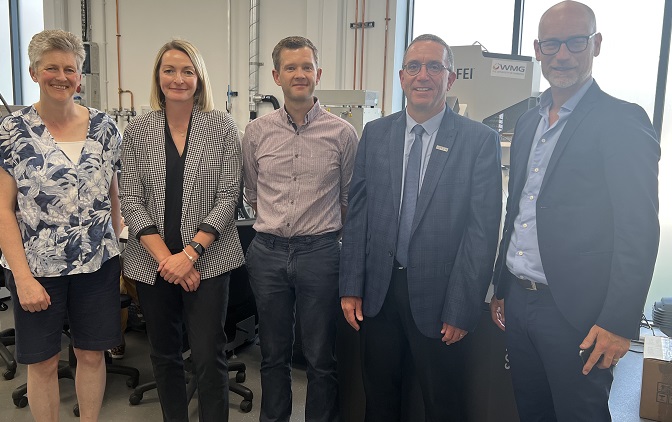 of Warwick this week.
The guests were met by Professor Claire Davis and Dr Russell Hall from the Advanced Steel Research Centre, and Dean of WMG, Professor Robin Clark.
They enjoyed a tour of the Advanced Materials and Manufacturing Centre (AMMC), home to WMG’s world-class steels research facilities, where they heard more about WMG’s work to support the steel industry including the importance of green steel production for a sustainable future.
Stephen Kinnock MP Chair of the Steel APPG and Jessica Morden MPVice Chair of the Steel APPG commented: “It was great to visit Claire Davis and her team at WMG's Advanced Materials Manufacturing Centre to see for ourselves the industrial research and development they're working on with the UK Steel sector, including cutting the cost of developing new steel alloys, deploying alternative fuels for green steel production or converting scrap steel to high value products.
“Innovation has a crucial role in improving the quality of UK steel production, reducing energy costs and making UK steel sustainable and it was heartening to see academics and industry working together on these critical issues for the future of UK steel, which is so important for our country."
Professor Claire Davis said: “Stephen and Jess were really interested in hearing about the work we do in the Advanced Steel Research Centre. It was great to show them examples of our fundamental and applied research supporting the development of new steel processing and alloys, and the impact it has for the UK steel industry. It is a very exciting, and challenging time to be working on steel due to the pace of change as we move to green steel production.”
Find out more about WMG’s Steels Processing research here: Steels processing (warwick.ac.uk)
Student projects help graduates to develop key employability skills
WMG, at the University of Warwick, is committed to supporting a variety of undergraduate student projects with connections to industry partners.
Each student project is supported and supervised by WMG Precision Engineer Dave Cooper, who has a background working for Honda Racing, and Lead Engineer Malcolm Swain, who specialises in electric vehicle battery technology.
The projects also engage with WMG PhD students; academics; technicians and industry sponsors. Students gain valuable practical and project management skills by being assigned an area of responsibility, from engineering and technical lead to marketing and sales support.
The student-led projects help to develop time and management skills; teamwork; and give practical hands-on experience.
While WMG provides some seed funding, it is the responsibility of the students to secure sponsors and funding, learning valuable networking, negotiation, sales and partnership skills along the way.
2022 student project teams
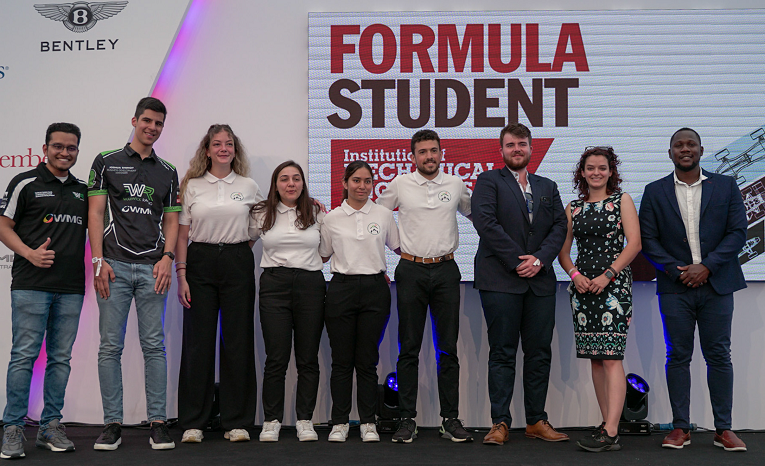 The Warwick Racing team entered the IMeche Formula Student Concept Class event at Silverstone to assess their new concept for an in-house built chassis. The judges, including an engineer from Mercedes F1 chassis team, were very positive about its ease of manufacture, lightweight, functionality, recyclability and cost saving design. The team is now developing the chassis based on the judges’ feedback to test its feasibility in the next electric racing car.
The Warwick Racing Business team was awarded second place for its business presentation out of 51 top global universities. The event follows a similar format to Dragon's Den, with the students developing a business idea, plan and model for producing the electric racing car to sell. This is an extremely challenging event and the team have high hopes to win first place next year.
In the Warwick Moto team, student technical lead Nesta Ferguson, was awarded the Best Dissertation Project Award, by the Institute of Mechanical Engineering, and recognised as a runner-up in the Engineering Undergraduate Innovation Award category. The Team’s research outputs were also accepted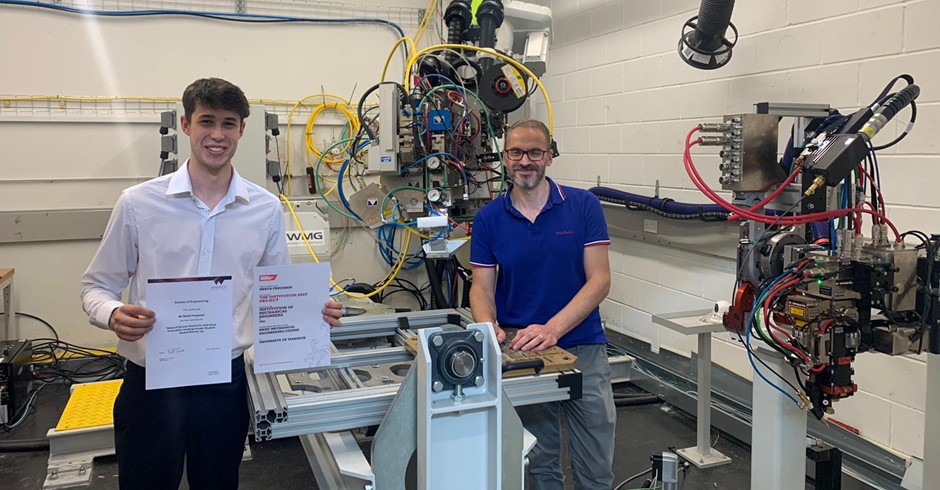 for publication by the flagship ICALEO conference and then promoted to the Journal of Laser Applications. Aneesh Jois, who also played a leading role in the Warwick Moto team, won Institution Best Student on the Mechanical Engineering Bachelor’s degree for academic achievement. Aneesh highlighted how invaluable his Warwick Moto project experience has been in learning how to design components for use in the real world and enabling him to achieve higher grades in application-based engineering modules.
The Warwick Robotics team worked with Dr Rachel Edwards, in the Department of Physics at the University of Warwick, to develop two wall climbing robots which perform Non-Destructive Testing (NDT) on steel structures such as storage tanks and wind turbine towers. The twin robots work in tandem carrying an electromagnetic acoustic transducer (EMAT), one with the receiver and one with the transmitter. To achieve the best results quickly the two robots must climb the structures with the transmitter and receiver aligned with each other at various distances apart. The students designed, built and tested a system that did this automatically in real-time using high resolution cameras and fiducial markers achieving +/-0.45degree accuracy. This will revolutionise industrial applications of NDT where this was considered not viable in the past.
Lee-Rose Jordan, Project Manager at WMG, University of Warwick explained: “These projects are a great example of how students can develop valuable hands-on engineering knowledge and skills, standing them in good stead as they embark on their chosen careers in some of the most esteemed companies in the world. This year, for example, some of our students have gone on to work at Delta Cosworth, Williams Advanced Engineering, McLaren Applied, Triumph, Alpine F1 and Mercedes.”
Find out more about the student projects here: Student Led Projects (warwick.ac.uk)
WMG supports unique community project inspired by Daniel Lismore
The WMG Outreach and SME teams, at the University of Warwick, were pleased to lend their support to the Herbert Art Gallery & Museum, for a unique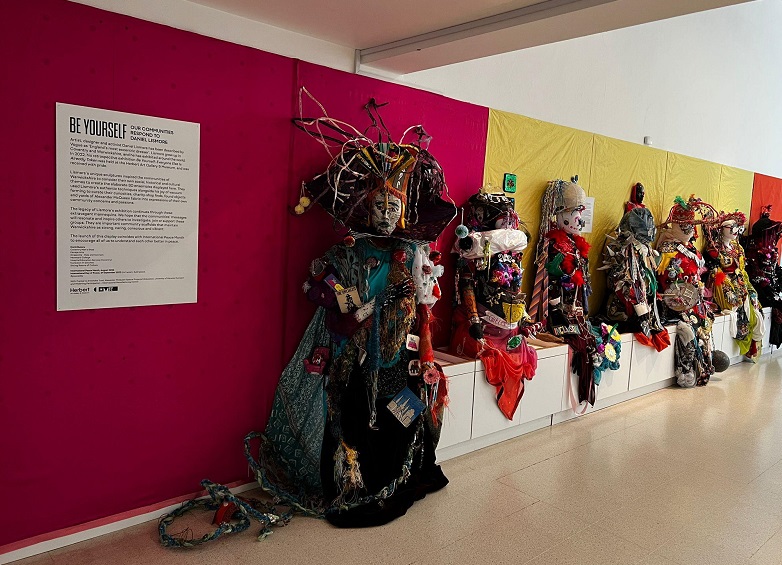 project inspired by Coventry artist and campaigner, Daniel Lismore.
The gallery hosted a series of masterclasses challenging local community groups to create their own mannequins using the techniques and skills adopted by Daniel in his recent exhibition ‘Be Yourself, Everyone Else is Taken.’
Daniel Lismore is known for his elaborate and extravagant creations that combine haute couture with charity-shop finds, including yards of vintage fabrics, found objects, ribbons, feathers, chain mail, shells, ethnic jewellery and retro accessories in an expression of creative energy, whilst giving voice to social calls for action and politically driven campaigns.
The Herbert Art Gallery & Museum approached Professor Margaret Low, Director of Outreach and Widening Participation at WMG, in need of some specialist equipment to help with the masterclasses. The WMG SME Team owned this equipment, and kindly agreed to loan it.
Amanda Haran, Community Engagement Officer at Culture Coventry explained: “Daniel was introduced to vacuum forming by English National Opera and as our aim was to make the creative journey as artistically authentic as that taken by Daniel, we were thrilled when the team at WMG offered the use of their machine.”
Bethany Haynes, Engineering Technician in the WMG SME Team, attended each of the masterclasses and guided the community groups through the vacuum forming process, enabling them to create some really imaginative pieces, combining engineering skills with process art.
 Bethany explains: “No object, providing it could withstand the heat, was off limits. We used key rings, broken bits of jewellery, fabrics and even real apples.
“It was a brilliant project to work on, totally different from anything I’ve done before, and it was lovely to have the freedom to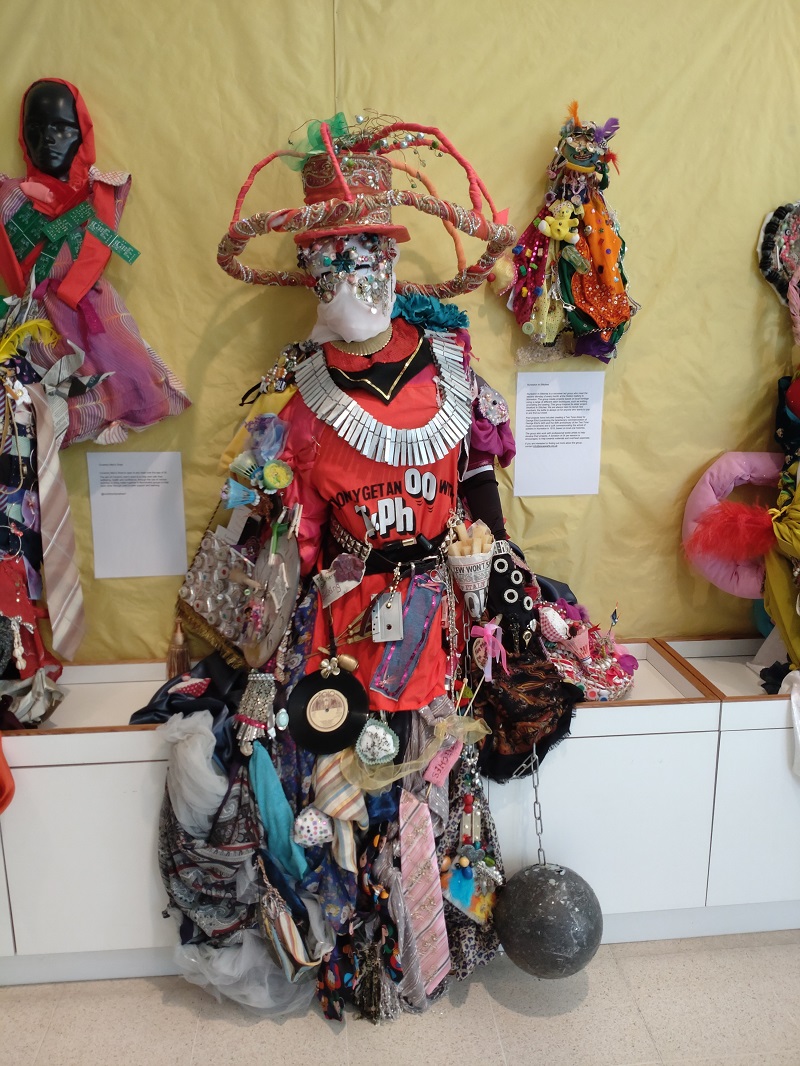 add my own ideas to the designs too.”
Amanda added: “Beth's instruction and support have been truly amazing, from making pomegranate moulds, to sourcing the specialist preferred foam. She met the energy of the groups being encouraging and adventurous, helping them to create the forms that best illustrate their theme.”
The Daniel Lismore inspired mannequins will be on display at the Herbert Art Gallery & Museum throughout August. Find out more here: Home - The Herbert Art Gallery & Museum
Warwick Submarine students compete at international engineering competition
The Warwick Submarine team, which consists of seven 4th year engineering students at the University of Warwick, has successfully completed the European International Submarine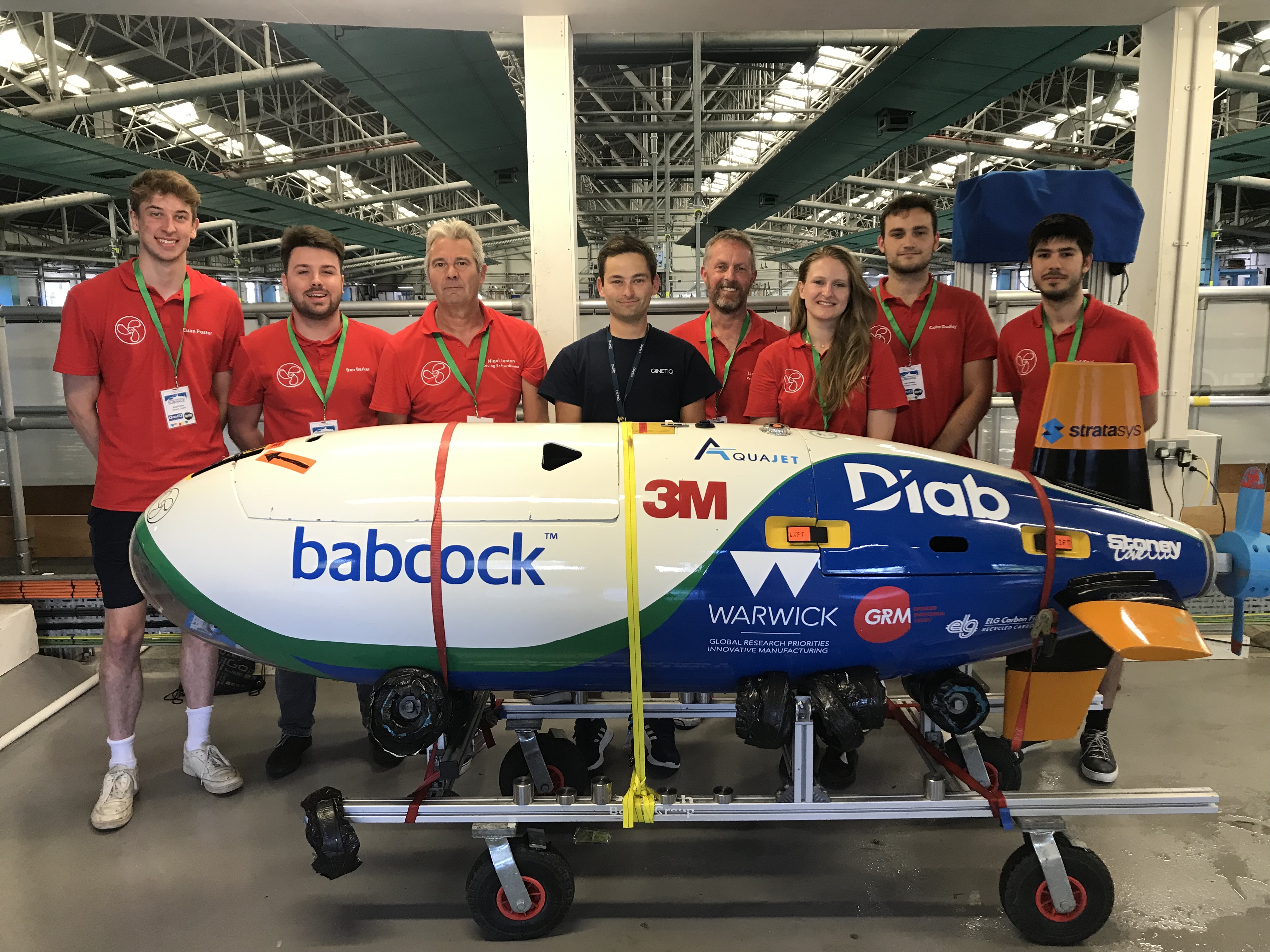 Races (eISR-22) in Gosport.
The student team raced their human powered submarine, against other science and marine engineering students from across the world. The submarine, named Godiva picked up two awards – the ‘Winner Day 5’ and a new award for best ‘Communication.’
The team was able to complete the whole slalom course at the Ocean Basin, and record a very respectable time of three minutes and 56 seconds. This is the first time that Godiva has achieved this since its very first entry at ISR in the USA in 2014. This impressive progress led to Godiva receiving the ‘Winner Day 5’ recognition.
The ‘Communication’ prize was judged by a group of school children who attended the races and met with the competitors. The children felt that the Warwick Sub team were the best at explaining the complexities of the project and notably without ‘talking-down’ to them.
The Warwick Submarine Academic Supervisor at WMG, University of Warwick, Professor Ian Tuersley, said: “The students were a real credit to the University, and their performance as practical engineers was very impressive”.
“The competition invariably involves a great deal of on-the-spot problem solving. Every single member of our team contributed handsomely to this effort by identifying the issues, generating innovative solutions, and then implementing them with only the barest of workshop resources to hand.”
In preparation for the competition, the students had access to cutting-edge engineering research and facilities at WMG at the University of Warwick, as well as funding from the High Value Manufacturing Catapult and help from sponsors.
Professor David Greenwood, CEO of the High Value Manufacturing Catapult, at WMG, University of Warwick, explained: “Well done to this year’s team on their achievements at e-ISR-22. We are now beginning the planning process for next year’s competition, and are looking forward to supporting a new group of students as they look to design and manufacture a new hull from composite materials. With the help of our team, they will gain indispensable hands-on practical engineering skills, at our world leading facilities.”
After arriving back from eISR-22 there was more good news for the team, as they were announced as winners of the inaugural Warwick Award for Public and Community Engagement (WAPCE), by the Warwick Institute for Engagement (WIE).
Professor Tuersley added: “It’s another fantastic achievement and provides further evidence of the team’s commitment to outreach and engagement activities.”
Find out more about the University’s student projects here.
WMG launches new sustainable elastomer research facility
WMG, at the University of Warwick, has launched its new sustainable elastomer research facility based in the International Institute for Nanocomposites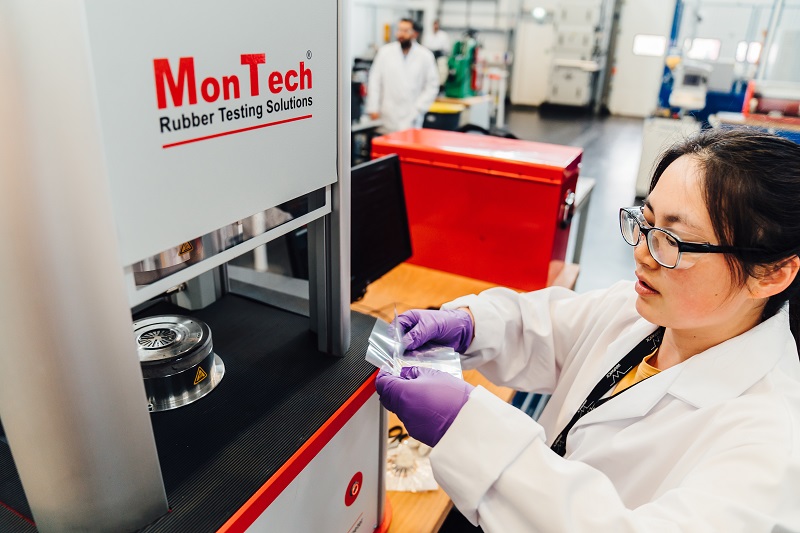 Manufacturing (IINM).
High performance elastomers are essential components in applications across a range of critical sectors, most notably for vehicle tyres, but also for footwear, soft robotics and automation.
However, the high durability of conventional rubbers also results in them being extremely difficult to recycle at the end of their service life, with many simply being incinerated and buried in landfills. The need for new and sustainable elastomer technology is becoming more urgent as society transitions towards fully electric vehicles, which are currently heavier and can cause tyre wear up to 30% faster. Tyre wear emission is accumulated as the second largest microplastics pollution globally.
The main scientific focus of the new facility is to bring together state-of-the-art research from across rubber composite processing and synthetic polymer chemistry - including manufacturing technology, multiscale characterisation, and prototype sustainable rubber products.
Capabilities within the facility include a twin-roll mill for rubber compounding; automated compression moulding and moving die rheometer (MDR); abrasion testing; and a new dynamic rubber process analyser (RPA), which enables advanced analysis of rubber networks over a temperature range of -40 °C to 232 °C, and a wide frequency range, as well as unique rheological characterisation at large amplitude oscillatory shear (LAOS).
Within the IINM there is also a wet chemistry laboratory designed for new formulation development, and rubber and nanoparticle functionalisation, as well as polymer characterisation and testing laboratories to support sustainable elastomer research and development.
Dr Chaoying Wan, Reader of Functional Polymers and Nanocomposites at WMG, University of Warwick explains: “Our new RPA has the capacity of a wider temperature range - it is the only one in the UK, and one of only a few in the world. This function is extremely useful for evaluating elastomer materials as well as for advanced scientific analysis. With support from the High Value Manufacturing Catapult, we are excited to be furthering our research towards extending the functionality of rubber materials and making the products recyclable and sustainable at end-of-life.”
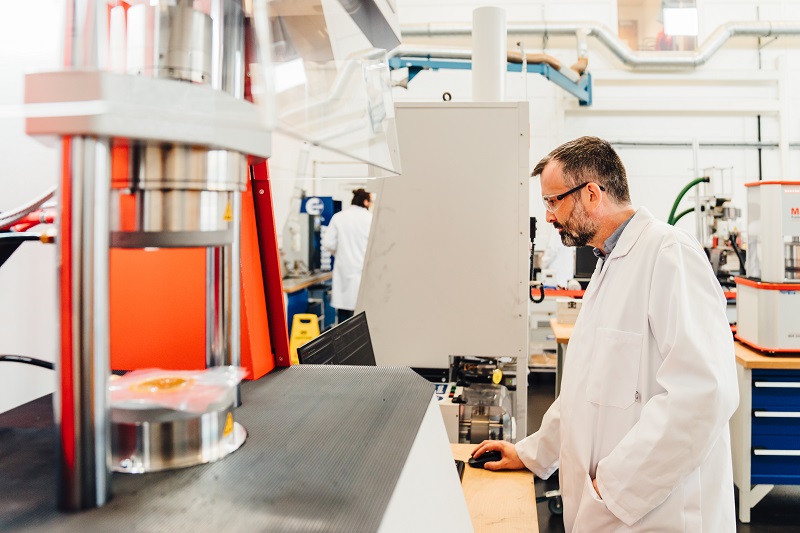 Projects currently underway in the new facility include integrating self-healing properties which result in improved safety and extended lifespan for tyres; stretchable sensors; and investigating other rubber products to enhance the durability of rubbers by the addition of nanofillers, including graphene, and recycling of rubbers for road and pavement uses.
Find out more about WMG’s Nanocomposites research here: Nanocomposites (warwick.ac.uk)
Contacts:
Dr Chaoying Wan – Rubber Chemistry and Dielectric Elastomer Technology
Professor Tony McNally - Composites of Elastomers and Nanomaterials
A WMG student's exceptional engineering talent has been acknowledged
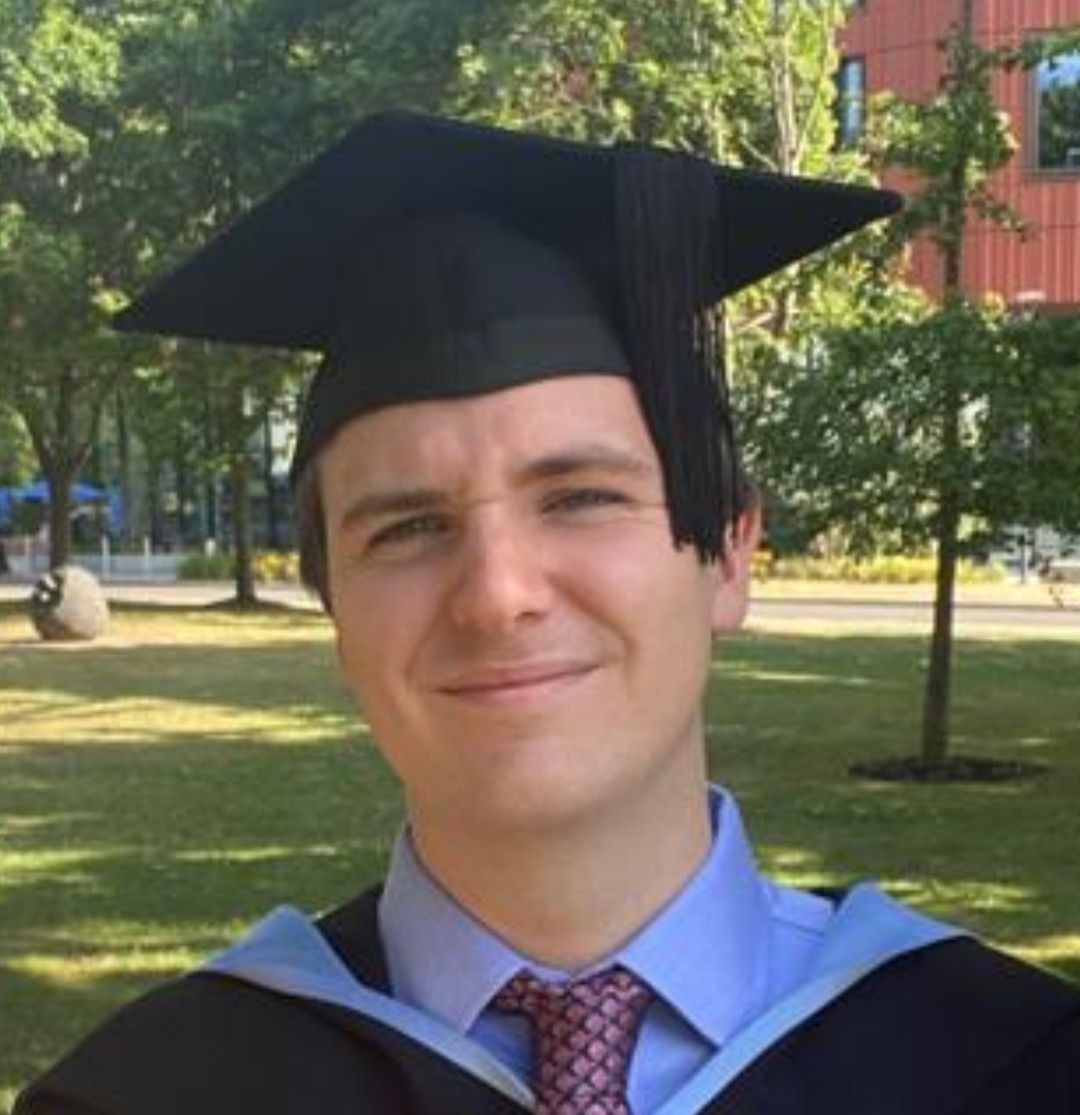 An engineering student from WMG, at the University of Warwick has been recognised for his hard work by the Institution of Engineering and Technology (IET).
The IET Manufacturing Prize is awarded annually to outstanding students who are completing a course of study which has been accredited by the IET. Prize winners are nominated by their university based on having shown distinction in their course leading to the award of a first degree.
As part of his win Nathan Bird will receive a certificate and two years free student membership of the IET.
Nathan said: “It is an honour to have been awarded this Manufacturing award from the IET and congratulations to others who have been given similar awards. This would not have been possible without the help from the many amazing staff at WMG and the School of Engineering, at the University of Warwick, and for that I thank them and hope my path crosses with them in the future."
Professor Danielle George MBE, President of the IET, said: “Our IET Prizes are a fantastic way for talented engineering students to be recognised for their outstanding ability in the early stages of their engineering journey. IET Membership provides early career professionals with the opportunity to connect with a global community, grow their networks and develop their technical knowledge.
“The IET is passionate about promoting engineering excellence and our awards and prizes showcase some of the very best engineering talent. All of the winners should be incredibly proud of their achievements. I wish them all the best for a very fulfilling and successful career – they are all difference makers of the future.”
Professor Gill Cooke, Pro-Dean (Education) at WMG, University of Warwick, added: “We are delighted to recognise Nathan’s achievements and we wish him every success in the future.”
To find out more information about the range of prizes and awards available to young and aspiring engineers through the IET, visit: www.theiet.org/awards.
UK Government awards £9.5m to British consortium to build world first advanced electric flight ecosystem
- New consortium of leading British aviation companies awarded government funding to demonstrate the commercial and operational viability of Advanced Air Mobility (AAM)
- First-of-a-kind ecosystem will accelerate introduction of AAM in the UK
- Demonstration of urban and cross-country flights planned at London Heathrow, Bristol, London City airports and a new vertiport at a London General Aviation (GA) airport
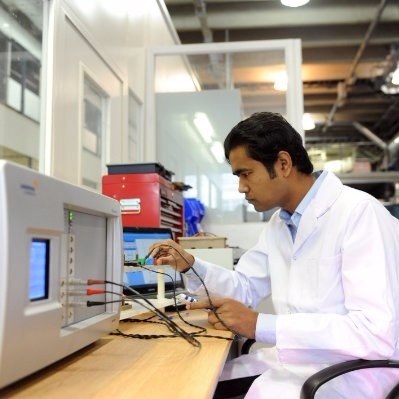
Vertical Aerospace, Virgin Atlantic, Atkins, Skyports and NATS, along with Connected Places Catapult and leading academic institutions Cranfield University and WMG, University of Warwick, today announced the creation of the Advanced Mobility Ecosystem Consortium. Together, the organisations will develop key technology and infrastructure in a project that will significantly accelerate the introduction of AAM in the UK.
The Consortium has been awarded a £9.5 million grant by the UK Government’s Future Flight Challenge to develop the essential building blocks of a viable AAM ecosystem that has the potential to be progressed into full commercial operations. This first-of-a-kind ecosystem will accelerate AAM in the UK by creating and testing technological developments in aircraft electrification, airspace management, ground infrastructure, operational procedures and the systems and supporting business cases required to implement a new model of aerial passenger transport in the UK.
Accelerating AAM
The project will demonstrate the feasibility of a UK AAM ecosystem using Vertical Aerospace’s emission-free VX4 eVTOL aircraft, operated by Virgin Atlantic. Two physical flights will take place between Bristol Airport to an airfield in South West England, and between London Heathrow Airport and the Living Lab vertiport. A third simulation flight will demonstrate urban connectivity between London City and Bristol airports.
These demonstrations will explore key aspects of the passenger journey, vehicle operation, airspace navigation, ground charging, security provision and local stakeholder engagement. Heathrow Airport, Bristol Airport, Skyports and NATS, the UK’s national air navigation service provider, will collaborate to deliver the physical and digital infrastructure to facilitate these missions through a complex airspace environment. The two-year project will be overseen by aerospace engineering experts Atkins as consortium lead.
Benefits of Advanced Air Mobility
AAM offers a new form of travel, enabling cost-effective connectivity into congested urban areas and across regions under-served by existing infrastructure. The UK Government Future Flight Challenge forecast that the introduction of AAM services will increase UK GDP by 1.8% by 2030 and support the government’s Levelling Up and Net Zero agendas, reflecting the productivity and wider economic benefits of increased connectivity.
James Richmond, Head of Advanced Air Mobility at Atkins, said: “This is an exciting leap forward for AAM. This project brings together experts from across the industry to maintain the UK’s leading position in the future of aviation, moving us closer to commercial operations that will connect regions and contribute to the UK’s net zero targets.”
Professor David Greenwood, CEO of the High Value Manufacturing Catapult at WMG, added: This project, created by a major consortium of aviation leaders, will really push forward the boundaries of developing and proving commercial eVTOL flights by demonstrating in a real-time, operational AAM ecosystem testbed. WMG is delighted to be contributing to a project which will help the UK aviation industry meet its net zero carbon goals.”
Other nations are racing to establish their own AAM ecosystems by 2025 – this project ensures the UK will be amongst the leaders in this new decarbonised form of transport. Gary Cutts, Future Flight Challenge Director at UK Research and Innovation said: “our roadmap sets out how air taxis could be in use in the UK by 2030, but a lot needs to occur for that to happen. By bringing technical developments from across the aviation industry together into one network, and undertaking early demonstration in the real-world, the Advanced Mobility Ecosystem Consortium could accelerate the timescale for AAM introduction by years. This project could revolutionise travel, not just in the UK but around the world.”
Novel Infrastructure
Skyports will build and operate a “Living Lab” vertiport to create a testbed for ground, passenger and air operations for the project duration. This centre of innovation will help to materially accelerate the development of AAM services and establish the UK as a leader in the design and operation of vertiport infrastructure.
Duncan Walker, CEO of Skyports, said: “Just as airports are critical to commercial aeroplane travel, vertiports are critical to AAM. Our Living Lab will be a central component of the consortium, enabling Skyports and partners to demonstrate end-to-end operations and test the complexities of developing a commercially viable AAM network in the UK.”
New Regional Air Connectivity
Holly Boyd-Boland, VP Corporate Development at Virgin Atlantic, said: “We are thrilled to be working alongside our consortium partners to accelerate the introduction of zero emission flight to UK customers. As the only airline in the consortium, Virgin Atlantic brings 38 years of operational excellence, a relentless focus on safety and security, and an unrivalled focus on the end-to-end customer journey. Alongside our partners, we are looking forward to getting the first Virgin Atlantic eVTOL aircraft into the skies.”
Andrew Macmillan, Director of Strategy of Vertical Aerospace, said: “Vertical is not flying solo. We are building the best industrial and commercial partner ecosystems and are progressing in Britain with our UK launch customer, Virgin Atlantic. We want the UK to lead the electric aviation and AAM revolution. This consortium will help prove how we can deliver safer, cleaner and quieter air travel with the VX4.”
A focus on integration
Atkins will lead the consortium and is responsible for technical management and integration of the two-year programme as it moves AAM from concept stage towards implementation. It will leverage its decades of aviation expertise to oversee the systems architecture and deliver a digitally enabled passenger journey management tool for infrastructure and flight operators.
For further information on WMG's research in this area, visit: https://warwick.ac.uk/fac/sci/wmg/business/transportelec/
*The full Advanced Mobility Ecosystem Consortium comprises Atkins; Vertical Aerospace; Skyports; Virgin Atlantic; Heathrow Airport; London City Airport; Bristol Airport; NATS; Cranfield University; WMG, at the University of Warwick; Connected Places Catapult; with support from EVE Air Mobility.
WMG and Jaguar Land Rover bridge the gap between academia and industry through the appointment of new Industrial Professor
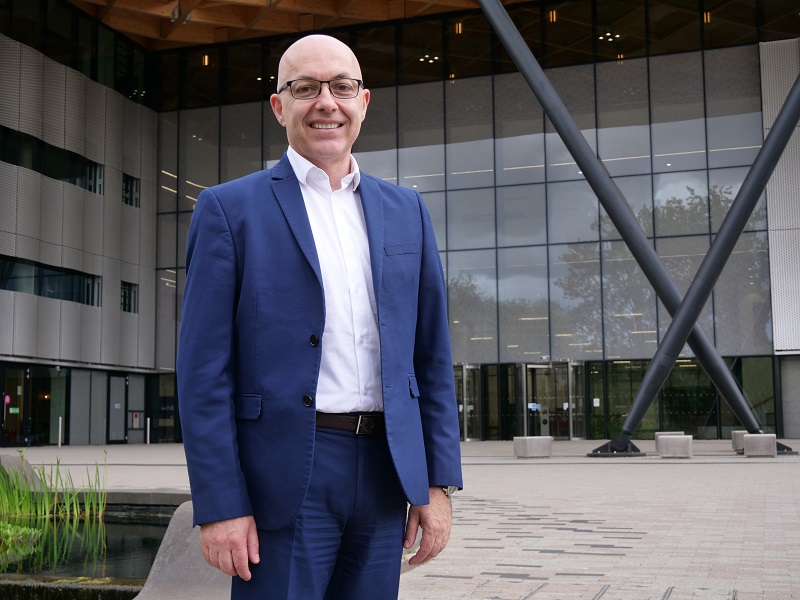 WMG at the University of Warwick has demonstrated its intentions to continue delivering industrially-informed research and education by bolstering its expertise and appointing Dr Alex Mouzakitis, Programme Director for Cyber Security at Jaguar Land Rover, as an Industrial Professor of Automotive Systems.
The new role has been awarded to Dr Mouzakitis in recognition of an influential 20-year career at Jaguar Land Rover, within which he has been leading collaborative multi-million-pound research and development projects and helping shape industrially relevant education across automotive machine learning, software development, architectural systems and cyber security with WMG since 2006.
The main objective of the Industrial Professorship is to bridge industry and academia, helping industrialise academic research approaches and shape education to help Jaguar Land Rover adopt the latest talent and technologies within its operations and product line.
As part of his new role, Dr Mouzakitis will be delivering lectures, defining agendas, addressing skills gaps and future needs for training, supporting bids for collaborative research projects, supervising PhD students and featuring on WMG advisory panels.
Commenting on the Industrial Professorship, Dr Mouzakitis said:
“It’s a privilege and an honour to receive the appointment. This is recognition for the work that I have done fully-hearted over the past 20 years, and this motivates me for the next 20 years. This also carries a level of responsibility to do more going forward as part of Jaguar Land Rover’s Creators’ Code to deliver modern luxury through exceptional engineering. I’ve had an active working relationship with WMG for over 16 years and look forward to continuing this relationship to help prepare for and respond to future skills needs throughout the automotive industry.
“We need to produce graduates that are better equipped to take on industrial jobs from day one, without the need to retrain. I will be addressing this and exploring what we can do to close this skills gap. If we are to retain and add to the volume and quality of manufacturing in the UK, whilst remaining competitive globally, we need skills.”
Since achieving a PhD in ‘Machine Learning and Artificial Intelligence for Autonomous Vehicles’ at the University of Wales (now known as the University of South Wales) in 2002, and later achieving an EngD (Title: Innovative Solutions for Automotive Embedded Software Development) at WMG, University of Warwick, Dr Mouzakitis has published over 135 academic papers across international journals and conferences and has also been actively contributing to the creation and delivery of MSc programme content.
Dr Mouzakitis is a Chartered Engineer and a Fellow of the IET and InstMC engineering institutions. He is a member of Industrial Advisory Panels across several international conferences, a member of the InstMC System and Control Technology Panel, the InstMC National Council and the InstMC Accreditation Panel.
Thomas Müller, Executive Director of Product Engineering at Jaguar Land Rover, commented:
“I want to say a big congratulations to Alex. Not only is it a great personal achievement, but it is also hugely significant for Jaguar Land Rover. This appointment will help us to bridge the gap between industry and academia, something that is increasingly important as we continue to Reimagine and become a proud creator of modern luxury.”
Dr Mouzakitis has affiliations and collaborative research relationships with other internationally-renowned academic institutions, including the University of Cambridge, Harvard University, University of Oxford, MIT Media Lab, University of Birmingham, University of Southampton, University College London, University of Surrey, University of Edinburgh, Heriot Watt University, Loughborough University and Cranfield University. In addition, Dr Mouzakitis has featured as an external examiner for Masters and Doctoral level awards.
Professor Paul Jennings, Pro Dean (Research) at WMG, University of Warwick, has been collaborating with Dr Mouzakitis since 2006, and also mentored the newly-appointed Industrial Professor as part of his EngD. Commenting on the appointment, Professor Jennings said:
“This Industrial Professorship is recognition of Dr Mouzakitis’ significant achievements across systems engineering within industry. The award also acknowledges impressive academic contributions as a mark of quality and rigour across research and education.
“We will now further tap into Dr Mouzakitis’ extensive knowledge, experience and insights in the industry, and work together to ensure that our research and education programmes continue to be leading edge and are tuned to the requirements of a fast-changing industry as we move to electrified, connected and automated mobility.”
Dr Mouzakitis will be delivering his inaugural lecture as Industrial Professor of Automotive Systems at WMG, University of Warwick later this year.
Find out more about Dr Mouzakitis here.
ENDS
WMG, University of Warwick
WMG is a world leading research and education group, transforming organisations and driving innovation through a unique combination of collaborative research and development, and pioneering education programmes.
As an international role model for successful partnerships between academia and the private and public sectors, WMG develops advancements nationally and globally, in applied science, technology and engineering, to deliver real impact to economic growth, society and the environment.
WMG’s education programmes focus on lifelong learning of the brightest talent, from the WMG Academies for Young Engineers, degree apprenticeships, undergraduate and postgraduate, through to professional programmes.
An academic department of the University of Warwick, and a centre for the HVM Catapult, WMG was founded by the late Professor Lord Kumar Bhattacharyya in 1980 to help reinvigorate UK manufacturing and improve competitiveness through innovation and skills development.
WMG students celebrate success!
Congratulations to the incredible Class of 2022 as they celebrate their graduation.
This year a total of 321 Master’s, Postgraduate Research and Undergraduate students graduated from across WMG.
There were 269 Master’s students comprising 156 UK and 89 overseas full-time students, and a further 24 from the part-time Master’s programme.
From the Undergraduate courses, 30 graduated from BSc Cyber Security and two from Digital Healthcare Science.
There were a further 20 from the Postgraduate Research programme including six EngD, 13 PhD and one Master’s by Research.
Celebrations were extra special this year because, as well as celebrating the success of the Class of 2022, it was also an opportunity for graduates whose original ceremonies were postponed, due to Covid-19, to celebrate.
Professor Robin Clark, Dean of WMG, said: “It is always a pleasure to recognise the achievements of our students, and graduation is the culmination of all their hard work under the guidance of the teaching staff.
“It is especially important this year as all the students graduating have had parts of their education journey impacted by the pandemic. To deal with this and demonstrate the resilience and commitment to study is truly commendable. Very well done to everyone and congratulations on your award!”
Find out more about WMG’s education programmes, here: Education (warwick.ac.uk)
Young engineers hit the headlines with Design & Make triumph
Three schools from the Black Country and Warwickshire have been crowned as the main winners at one of the biggest independent manufacturing-education events in the UK.
Ernesford Grange Community Academy, Great Wyrley Academy and WMG Academy for Young Engineers Coventry beat off competition from five other rivals to take the Manufacturing,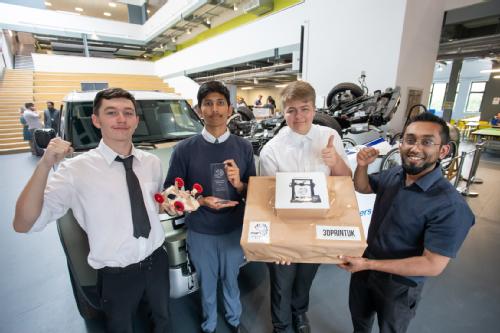 Innovation and Efficiency titles respectively at the Design & Make Challenge 2022.
The trio were joined on the podium by Alcester Grammar School, who claimed the first ever ‘Communications’ prize for its use of social media in promoting the day.
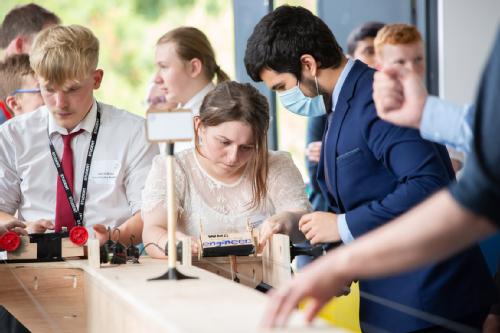
Organised by the Manufacturing Assembly Network (MAN), more than 35 students swapped their daily lessons for the chance to test out their design, engineering, prototyping and communication skills at the all-day event held at WMG Academy for Young Engineers in Solihull.
Teams of four Year 11 and Year 12 pupils were set the challenge of using basic materials and tools to make a vehicle that could be propelled by a falling weight. They tested their devices, modified them and then raced them on a purpose-built 7.5m long track to see which one would complete the distance in the fastest possible time – a race that WMG Academy Coventry won in just 3.64 seconds.
“Now, more than ever, we need young people to choose engineering and manufacturing as a career and we’re not going to change perceptions by sitting on our hands, doing nothing,” explained Austin Owens, founder of Grove Design (Pembridge) Ltd and Co-Chair of the Manufacturing Assembly Network.
“This was a comeback for the Design & Make Challenge after a Covid-19 enforced break and we were delighted to see the appetite to take part was still there. I have to say the task was the hardest yet and the young people really embraced it.”
He went on to add: “The atmosphere in the room was amazing and I’m convinced we’ve seen some of the engineers of the future here, engineers that will go on and improve the way we live for the better.”
Ernesford Grange Community Academy, Great Wyrley Academy and WMG Academy Coventry all received a 3D printer for their efforts.
This latest technology was kindly donated by 3DPRINTUK, who are specialists in low volume production using state-of-the-art powder bed fusion 3D printing systems with polymer materials.
Nick Allen, Managing Director of 3DPRINTUK, commented: “We are both proud and delighted to sponsor the Design & Make Challenge 2022.
“The competition is a great fit for us. By donating 3D printers to the winners, it allows the next generation of engineers and manufacturers to learn in a hands-on way about the advantages - and disadvantages - of 3D printing for any given application. It’s something we are passionate about both now and for the future.”
Joining Alcester Grammar School, Ernesford Grange Community Academy, Great Wyrley Academy and WMG Academy Coventry at the Design & Make day were Gospel Oak School, Lawrence Sheriff School, Southam College and WMG Academy Solihull.
Peter Davies, Chief Executive of James Lister & Sons and Co-Chair of the Manufacturing Assembly Network, added his support: “The day is all about bringing sound design and engineering principles to the fore to solve a topical industrial issue, with young people encouraged to work together to develop innovative designs and then build a product they can test against their peers.
“Apprentices from MAN companies and graduates from WMG at the University of Warwick, were working with the groups and talking about their own experiences following a career in manufacturing and some of the skills they may need to realise their ambition.
“All the feedback we received was positive, which excites us about doing it again next year. We now urge other manufacturers to look at how they can play a role in helping promote our sector to young people.”
 Dr Mark Swift, Head of SME Programmes at WMG at the University of Warwick, concluded: “Design & Make is a wonderful example of how to inspire future engineers - making it real and helping to bridge the skills gap, particularly in small manufacturing and engineering businesses.
“SMEs are the lifeblood of manufacturing in the UK, and they offer a wonderful, rich, challenging and rewarding destination for the next generation of engineers. They get access to all parts of the business, from working with customers and suppliers to the management team and gaining experience on the shop floor – all of this will accelerate their future career.”
About the Manufacturing Assembly Network
Formed in 2006, The Manufacturing Assembly Network is made up of Alucast, Barkley Plastics, Brandauer, Grove Design, James Lister & Sons, KimberMills International, Muller Holdings, Nemco and PP Control & Automation.
The eight sub-contract manufacturers and specialist engineering design agency form a unique global collective that works together to share best practice and secure contracts for UK industry.
It is the third year that the group has held the Design & Make Challenge and earlier competitions have resulted in 352 hours of hands-on manufacturing experience for young people, seven MAN company visits completed by schools and over £25,000 of press coverage to raise the profile of the sector.
More details on MAN can be found at www.man-group.co.uk or follow MAN Group on LinkedIn.