
Politics and International Studies BA (UCAS L260)

Discover more about our Politics and International Studies degree at Warwick
Does democracy bring greater stability to societies? Why do states use violence? If these questions fascinate you, this degree could be the right fit for you. Learn about politics at a national and international level. Gain valuable skills in theoretical analysis, qualitative and quantitative research, and written and verbal communication.
General entry requirements
A level typical offer
AAA
A level contextual offer
We welcome applications from candidates who meet the contextual eligibility criteria and whose predicted grades are close to, or slightly below, the contextual offer level. The typical contextual offer is ABB. See if you’re eligible.
General GCSE requirements
Unless specified differently above, you will also need a minimum of GCSE grade 4 or C (or an equivalent qualification) in English Language and either Mathematics or a Science subject. Find out more about our entry requirements and the qualifications we accept.
We advise that you also check the English Language requirements for your course which may specify a higher GCSE English requirement. Please find the information about this below.
IB typical offer
36.
IB contextual offer
We welcome applications from candidates who meet the contextual eligibility criteria and whose predicted grades are close to, or slightly below, the contextual offer level. The typical contextual offer is 32. See if you’re eligible.
General GCSE requirements
Unless specified differently above, you will also need a minimum of GCSE grade 4 or C (or an equivalent qualification) in English Language and either Mathematics or a Science subject. Find out more about our entry requirements and the qualifications we accept.
We advise that you also check the English Language requirements for your course which may specify a higher GCSE English requirement. Please find the information about this below.
Will be considered as long as essential entry requirements are met.
General GCSE requirements
Unless specified differently above, you will also need a minimum of GCSE grade 4 or C (or an equivalent qualification) in English Language and either Mathematics or a Science subject. Find out more about our entry requirements and the qualifications we accept.
We advise that you also check the English Language requirements for your course which may specify a higher GCSE English requirement. Please find the information about this below.
International qualifications
English Language requirements
All applicants have to meet our English Language requirements. If you cannot demonstrate that you meet these, you may be invited to take part in our Pre-sessional English course at WarwickLink opens in a new window.
This course requires: Band B
Learn more about our English Language requirementsLink opens in a new window
Frequently asked questions
Warwick may make differential offers to students in a number of circumstances. These include students participating in a Widening Participation programme or who meet the contextual data criteria.
Differential offers will usually be one or two grades below Warwick’s standard offer.
All students who successfully complete the Warwick IFP and apply to Warwick through UCAS will receive a guaranteed conditional offer for a related undergraduate programme (selected courses only).
Find out more about standard offers and conditions for the IFP.
We welcome applications for deferred entry.
We do not typically interview applicants. Offers are made based on your UCAS form which includes predicted and actual grades, your personal statement and school reference.
Course overview
In this degree, there is an emphasis on the international dimensions of politics. While political theory provides the core of the degree, you can tailor your course to focus on your main interests within International Studies.
You will engage with core questions in political theory and how they apply to situations across the globe. You will confront how power is distributed internationally and evaluate the different ways in which societies organise their political systems. You will explore the ideological roots and gendered and racialised effects of world problems and interrogate the ways in which economic imperatives affect foreign policy.
Your studies will investigate how theoretical assumptions underpin political decisions and explore the concrete issues that are faced by individuals, governments and organisations around the world.
Study abroad
There are two options to which you can apply for study abroad: Integrated or Intercalated.
Integrated (included within your three-year degree)
An integrated year enables you to replace your second year with a year of studying abroad. The grades gained during your year abroad become your second-year marks.
Intercalated (adds a year to your degree)
This option adds one year to your degree. You can either apply to study at one of our partner universities or set up an approved work placement.
Partner countries
Countries and partner universities where students have studied abroad (please note countries and institutions are subject to change):
USA
- University of California
Canada
- University of Waterloo
- University of British Columbia
- Queen’s University
- McMaster University
Europe
- Countries: France, Spain, Italy, Germany, Austria, Norway, Denmark, Sweden
- Cities include: Paris, Madrid, Vienna, Berlin, Milan, Barcelona
Japan
- Waseda University
- Hokkaido University
- Kyoto University
- Nagoya University
Australia
- Monash University
China
- Shanghai Jiao Tong University
Hong Kong
- University of Hong Kong
- Chinese University of Hong Kong
- City University Hong Kong
- Hong Kong University of Science and Technology
Singapore
- National University of Singapore
South Korea
- Seoul National University
You may also apply for a work placement in the UK or abroad (approval from department needed).
Core modules
This degree takes place over three years. In each year you study core modules that provide a strong foundation in the academic discipline of Politics and International Studies.
You then have the choice to tailor your degree with optional modules. Optional modules are divided into four specialisms or pathways:
- Political Theory and Public Policy
- International Relations and Security
- Comparative Politics and Democratisation
- International Political Economy
Pick modules from one pathway to specialise your degree or mix and match across different pathways to suit your interests.
Lectures and seminars take place for 25 weeks during the academic year. The last 5 weeks are dedicated to final examinations.
Year One
Introduction to Politics
Introduction to Politics gives you a broad overview of the main issues and theoretical perspectives within Politics. You'll learn first to understand and then apply the core concepts of comparative political science and theory to processes, institutions, ideologies and practical policy-making. You'll conduct a comparative study of different political systems and political change, both in writing and in open debate.
Read more about the Introduction to Politics moduleLink opens in a new window, including the methods of teaching and assessment (content applies to 2022/23 year of study).
World Politics
In this module, you'll be introduced to world politics and the role that international relations plays in the interactions between nations. You'll gain a solid understanding of the historical underpinnings of the structure and systems of states, and become familiar with major theories of international relations post-1945. You'll analyse contemporary writings on world politics and engage critically, both orally and in writing, with key concepts and theoretical debates on the nature of international political systems.
Read more about the World Politics moduleLink opens in a new window, including the methods of teaching and assessment (content applies to 2022/23 year of study).
Political Research in the 21st Century
On this course, we aim to make you a better communicator and critical thinker. Armed with cutting-edge research methods and the academic skills to make a successful transition to university-level study. This module focuses on how best we can support you to become independent learners, giving you the firm foundations from which to achieve the best possible degree, in addition to valuable transferable skills post graduation.
Read more about the Political Research in the 21st Century moduleLink opens in a new window, including the methods of teaching and assessment (content applies to 2021/22 year of study).
Year Two
Political Theory from Hobbes: Seeking Freedom and Equality
How should human beings be governed? The thinkers you'll study – from Hobbes to Marx – had very different answers to this question. Building on your understanding of political philosophy, you'll read significant primary and secondary texts to develop your understanding of how political convictions are shaped by the context and history of individual thought and social interaction. You'll confront and assess complex ideas in political theory, and present and defend your point of view, both orally and in writing.
Read more about the Political Theory from Hobbes: Seeking Freedom and Equality moduleLink opens in a new window, including the methods of teaching and assessment (content applies to 2022/23 year of study).
Optional core modules (also available as Optional modules)
- Politics of International Development
- Theories of International Relations
- States and Markets: An Introduction to International Political Economy
- International Security
Year Three
Issues in Political Theory
Should parents send their children to private schools? Is freedom of movement a moral right? Is it unjust to rear animals for food? Who should bear the costs of climate change? You'll explore fundamental questions of political morality by critically analysing complex arguments from contemporary political philosophy. You'll study closely John Rawls’s theory of justice, and consider the rival theories of Robert Nozick, G. A. Cohen and Ronald Dworkin. You'll have practical opportunities to develop and defend your own ethical standpoint through your considered judgements on current dilemmas, taking into account opposing arguments and perspectives.
Read more about our Issues in Political Theory moduleLink opens in a new window, including the methods of teaching and assessment (content applies to 2021/22 year of study).
Optional modules
Optional modules can vary from year to year. Example optional modules may include:
Year One
- Contemporary Themes in Comparative Politics
- Foundations of Political Economy
- Justice, Democracy, and Citizenship
- Nine Ideas in International Security
- Introduction to Qualitative Methods
- Introduction to Social Analytics I
- Introduction to Social Analytics II
- Understanding Social Inequalities
Year Two
- Politics in the UK
- Politics of the USA
- Politics of Contemporary China
- Europe: Politics and Ideas
- Core Issues in Comparative Politics
- Themes in European Integration
- Capitalism and its Alternatives
- Gender Matters in International Relations
- Political Economy and the Liberal-Democratic State
- Introduction to Comparative Public Policy
- Public Policy for 21st Century Challenges
- Intermediate Social Analytics: Survey Design and Data Collection
- Intermediate Social Analytics: Survey Analysis and Reporting
Year Three
- Gender and Development
- Governing Britain Since 1918
- European Union Policy-Making
- Politics of Globalisation
- United States Foreign Policy
- Britain and the War on Terror
- Critical Security Studies
- Vigilant State: The Politics of Intelligence
- East Asian Transformations: A Political Economy Perspective
- State, Power, Freedom: European Political Theory
- The Political Economy of Money
- International Relations of the Americas
- Latin America: Democratisation and Development
- War in the 21st Century
- Politics and Culture in the Middle East
- Violence, Rights, Justice and Peace in the Middle East
- The Global Energy Challenge
- The Politics of Climate Change
- Applying Quantitative Methods to Social Research
- Experiments in the Social Sciences and Humanities
- Public Opinion
- Determinants of Democracy
- Dissertation
Assessment
Modules are usually assessed through a mixture of exams and essays.
- Summative assessments include exams and coursework that go towards your final grade.
- Formative assessments do not contribute marks to your final grade. However, they help you understand key learning points and assessment styles.
Teaching
Most modules are taught using a combination of weekly lectures and seminars. Lectures give an introduction to a topic to help prepare you for discussions in seminars. In seminars, you can engage in debates and share your views.
Learn from experts with international research profiles across many subfields including:
- Political theory
- International relations
- International security
- International political economy, and international development
- Comparative politics
- Political systems
You will have a personal tutor who you can speak to about any questions you may have. There are also regular feedback sessions and opportunities to speak to module directors and seminar tutors.
Class sizes
Lecture sizes vary. Lectures are typically accompanied by seminar teaching which allows you to discuss and consolidate your learning.
Typical contact hours
There are 8-12 hours of classroom contact available per week. This is also supplemented with group work, one-to-one advice, feedback sessions, and the use of web-based materials.
Tuition fees
Scholarships and bursaries
Your career
We have a dedicated careers consultant who can support you with your career choices. We offer one-to-one appointments and workshops to help you find a career path, internship or work placement.
Graduates from these courses are working in:
- Government and politics (national, regional and international)
- Public affairs
- Education
- Charity and campaigning
- Media
- Public relations
- Journalism
- IT
- Banking and finance
- Recruitment
- Hospitality
- Advertising
Our graduates have gone on to work for employers such as:
- United Nations
- BBC Television
- Houses of Parliament
- OECD (Organisation for Economic Co-operation and Development)
- Lloyds Banking Group
- Human Rights Watch
Helping you find the right career
Our department has a dedicated professionally qualified Senior Careers Consultant offering impartial advice and guidance together with workshops and events throughout the year. In addition, PAIS students have access to guest lecturers, careers information and placement support. Previous examples of workshops and events include:
- Your future awaits - the many things you can do after your degree in the PAIS department
- Careers in Government and Politics
- Warwick careers fairs throughout the year
- Careers Q&A sessions
- Assessment Centres and Interviews: an overview of what to expect for PAIS students
Politics and International Studies at Warwick
Join an innovative, creative and passionate department with a lively and interactive culture. Stretch and challenge yourself with the support of friendly staff and your peers.
Find out more about us on our website
Our courses
- Politics (BA)
- Politics and International Studies (BA)
- Politics and International Studies with Chinese (BA)
- Politics and Sociology (BA)
- Politics, International Studies and French (BA)
- Politics, International Studies and German (BA)
- Politics, International Studies and Hispanic Studies (BA)
- Politics, International Studies and Italian (BA)
Related degrees

Life at Warwick
Within a close-knit community of staff and students from all over the world, discover a campus alive with possibilities. A place where all the elements of your student experience come together in one place. Our supportive, energising, welcoming space creates the ideal environment for forging new connections, having fun and finding inspiration.

Find out how to apply to us, ask your questions, and find out more.

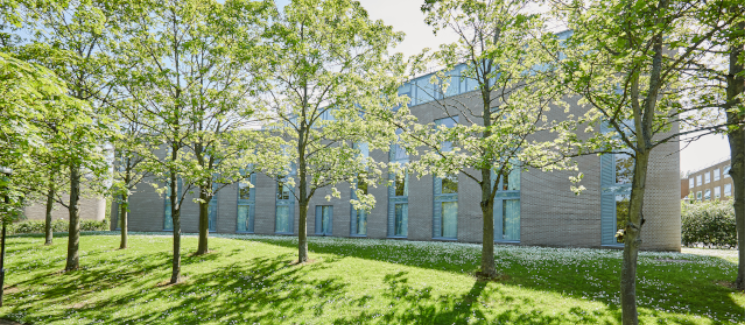
Warwick Accommodation
Finding the right accommodation is key to helping you settle in quickly.
We have 12 self-catering undergraduate halls of residence on campus.
Our student property management and lettings agency manages more than 8,000 rooms both on and off campus, and provides advice to all full-time undergraduates.
Our campus
You won't be short of ways to spend your time on campus - whether it's visiting Warwick Arts Centre, using our incredible new sports facilities, socialising in our bars, nightclub and cafés, or enjoying an open-air event. Or if you need some peace and quiet, you can explore lakes, woodland and green spaces just a few minutes’ walk from central campus.

Food and drink
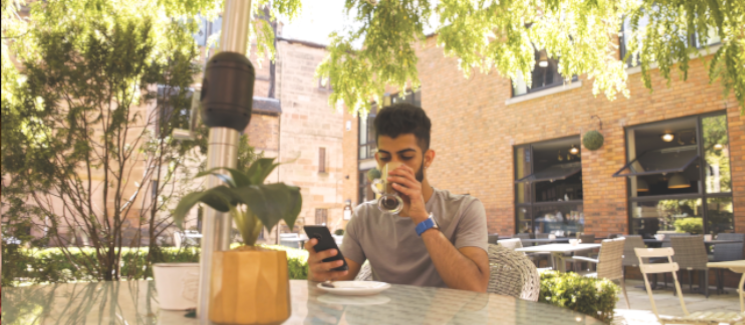
We have lots of cafés, restaurants and shops on campus. You can enjoy great quality food and drink, with plenty of choice for all tastes and budgets. There is a convenience store on central campus, as well as two supermarkets and a small shopping centre in the nearby Cannon Park Retail Park. Several of them offer delivery services to help you stay stocked up.
And don't miss our regular food market day on the Piazza with tempting, fresh and delicious street food. Soak up the atmosphere and try something new, with mouth-watering food for all tastes.

Clubs and societies
We currently have more than 300 student-run societies.
So whether you’re into films, martial arts, astronomy, gaming or musical theatre, you can instantly connect with people with similar interests.
Or you could try something new, or even form your own society.
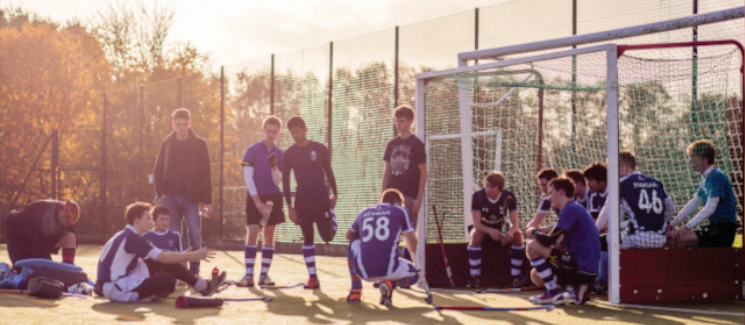
Sports and fitness
Staying active at Warwick is no sweat, thanks to our amazing new Sports and Wellness Hub, indoor and outdoor tennis centre, 60 acres of sports pitches, and more than 60 sports clubs.
Whether you want to compete, relax or just have fun, you can achieve your fitness goals.


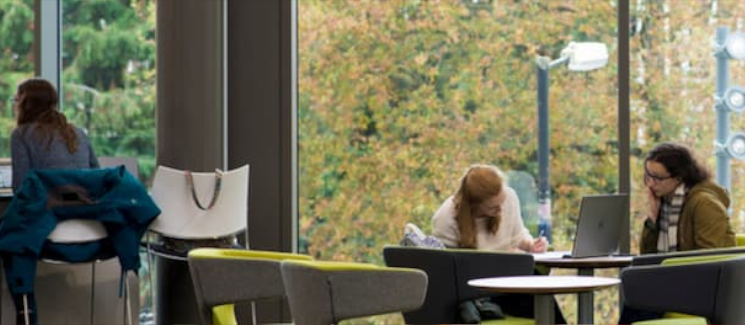
Studying on campus
Our campus is designed to cater for all of your learning needs.
You will benefit from a variety of flexible, well-equipped study spaces and teaching facilities across the University.
- The Oculus, our outstanding learning hub, houses state-of-the-art lecture theatres and innovative social learning and network areas.
- The University Library provides access to over one million printed works and tens of thousands of electronic journals
- Three Learning Grids offering you flexible individual and group study spaces.
Travel and local area
Our campus is in Coventry, a modern city with high street shops, restaurants, nightclubs and bars sitting alongside medieval monuments. The Warwickshire towns of Leamington Spa and Kenilworth are also nearby.
The University is close to major road, rail and air links. London is just an hour by direct train from Coventry, with Birmingham a 20-minute trip. Birmingham International Airport is nearby (a 20-minute drive).
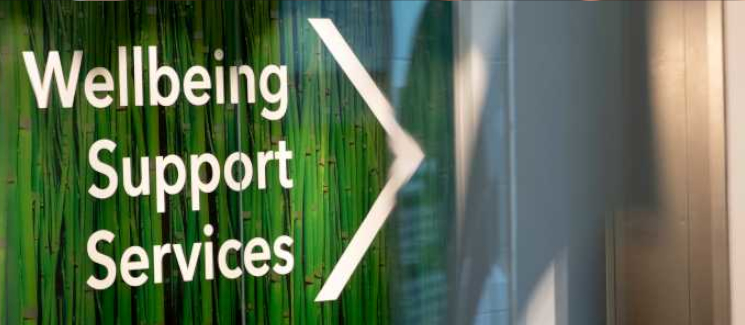
Wellbeing support and faith provision
Our continuous support network is here to help you adjust to student life and to ensure you can easily access advice on many different issues. These may include managing your finances and workload, and settling into shared accommodation. We also have specialist disability and mental health support teams.
Our Chaplaincy is home to Chaplains from the Christian, Jewish and Muslim faiths. We provide regular services for all Christian denominations and a Shabbat meal every Friday for our Jewish students. There is also an Islamic prayer hall, halal kitchen and ablution facilities.
How to apply
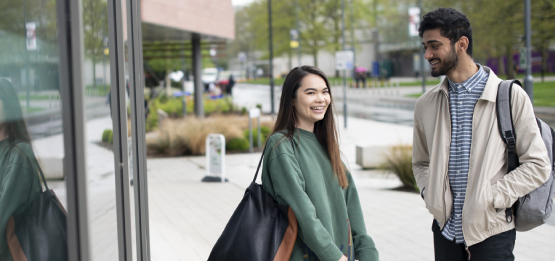
Learn more about our application process.

Key dates
Key dates for your application to Warwick.

Writing your personal statement
Make an impression and demonstrate your passion for your course.

After you've applied
Find out how we process your application.
Our Admission Statement
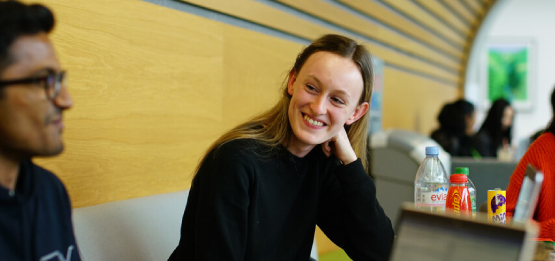
Read Warwick's Admission Statement
3 ways to connect
Talk to us
Join us at a live event. You can ask about courses, applying to Warwick, life at Warwick, visas and immigration, and more.
Warwick Experience
Take a virtual, student-led campus tour. Then join an interactive panel session, where you can hear from and chat to our current students and staff.
Student blogs
Explore our student blogs in OurWarwick. You can read about campus life from students themselves, and register to post questions directly to students.
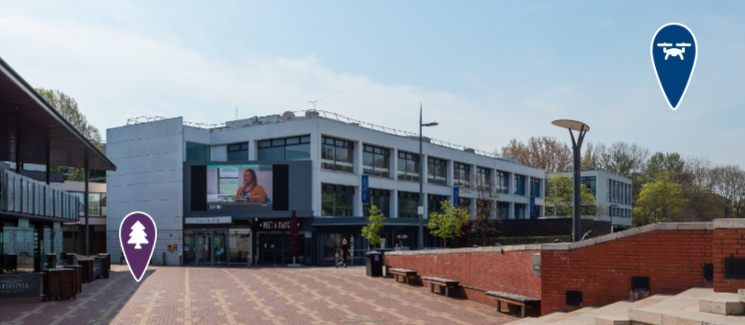
Explore campus with our virtual tour
Our 360 tour lets you:
- Watch student videos
- View 360 photography and drone footage
- Learn about facilities and landmarks
Explore our campus virtually through our 360 campus tour now
Come to an Open Day
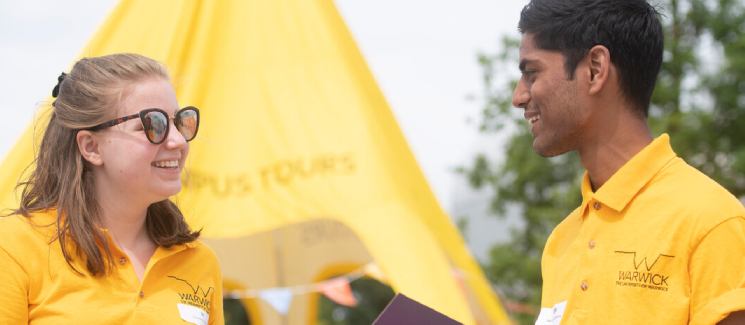
Don’t just take it from us, come and see for yourself what Warwick is all about. Whether it's a virtual visit or in-person, our University Open Days give you the chance to meet staff and students, visit academic departments, tour the campus and get a real feel for life at Warwick.
Sign up for updates
Discover more about our courses and campus life with our helpful information and timely reminders.