Imogen Knox-Teaching Fellow in Medieval and Early Modern History
Research Overview
I am a historian of early modern Britain with particular interests in the intersection of gender and emotion in everyday life and their implications for mental health and wellbeing.
My new research deals with the role of gender and age in men’s mental health in early modern England. This project maps the boundaries of healthful and unhealthful passion in relation to masculinity and the lifecycle. It emphasises age-related shifts in how men appropriately expressed passion, explores the mechanisms by which men might maintain a ‘healthy’ range, and charts the implications for their subjectivity, physical health, and interpersonal relationships.
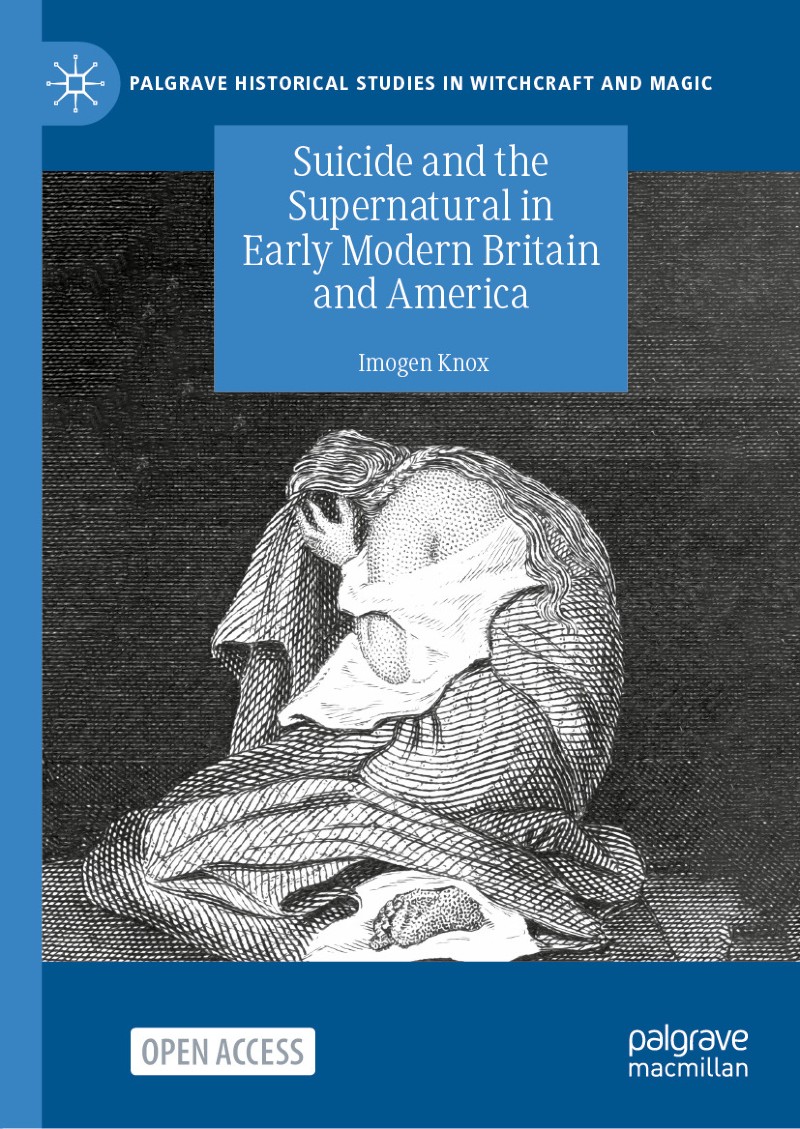
My previous work explored the ways in which early modern people expressed and enacted suicidal feelings as recorded in supernatural narratives in early modern Britain and New England. Published as Suicide and the Supernatural in Early Modern Britain and America by Palgrave Macmillan in 2026, this study illuminated the deep connections between early modern ideas about suicide and interactions with the supernatural and evidenced that, rather than furthering the stigma and shame often associated with suicide by historians, the language of the supernatural provided a means of expressing self-destructive desires and opened up avenues for community care and treatment.
Broadly, I am interested in interior experiences in the early modern Anglophone context and their depiction in cheap print, personal writing, theological tracts, and medical texts.
In 2026-27 I co-lead the Fear Network, a cross-faculty research group which explores the role of negative emotions in society and culture.
Research Interests
- Mental health, interior experience, and the mind
- History of Emotions (Fear Network co-lead)
- Gender, particularly masculinity
- Early modern religion and popular belief
- Laughter and humour
Teaching
In 2026/27 I teach on the following modules:
- Crossing Boundaries and Breaking Norms in the Medieval World
- The British Problem: Empire, Conflict and National Identities, 1558-1714
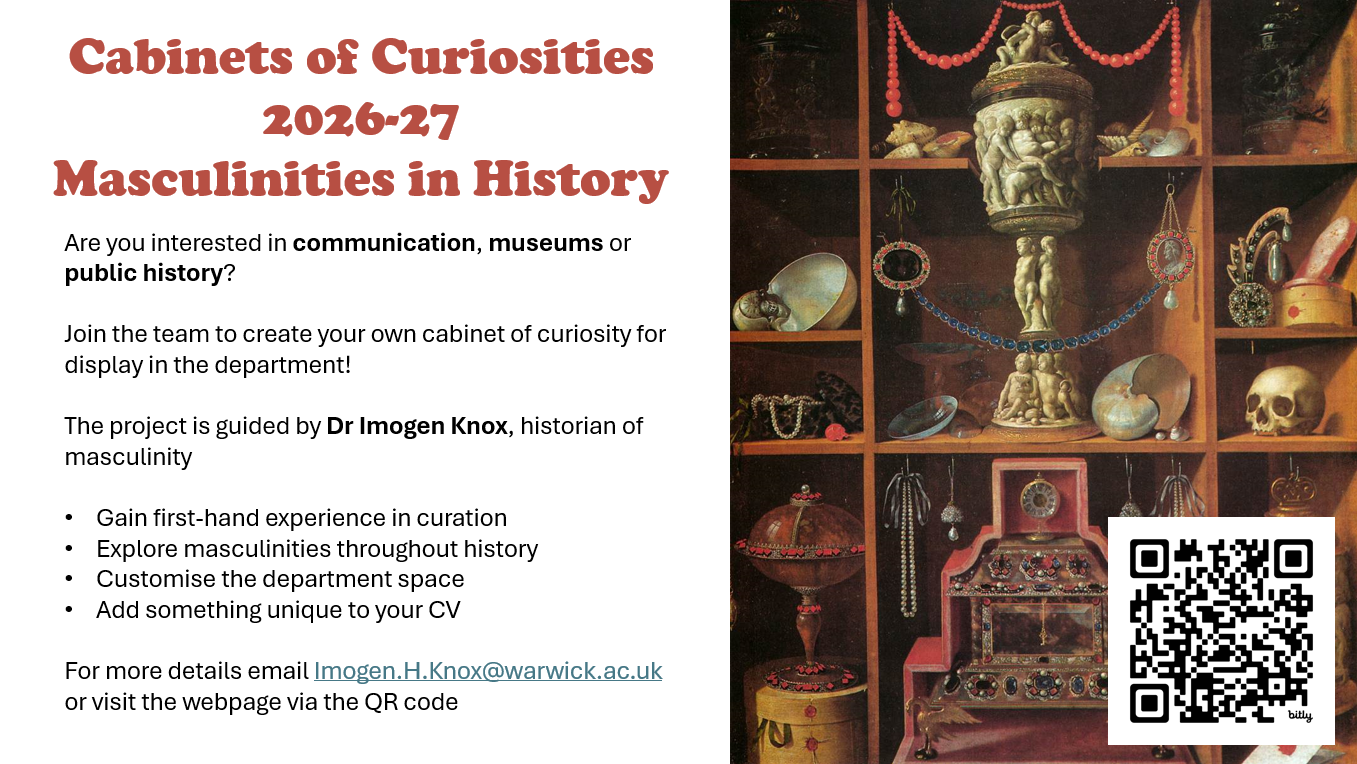
I am also leading the Cabinets of Curiosity project on the theme Masculinities in History.
I am interested in supervising dissertations on early modern topics, particularly those related to gender and religion in the Anglophone world, as well as projects drawing on the History of Emotions.
At Warwick I have previously taught:
- Europe in the Making
- Deviance and Nonconformity in Early Modern Europe
- Understanding Wellbeing: Theory and Practice
- Academic Research and Writing
As a lecturer at Exeter I taught on a range of undergraduate and postgraduate modules related to pre-modern and medical history, as well as supervising second year projects and final year dissertations.
I am a Fellow of the Higher Education Academy and an Advance HE Collaborative Award for Teaching Excellence winner. I was previously editor of the Journal of Postgraduate Pedagogic Practice. In 2025 I spoke about my experience as a GTA with History UK's series History in Practice.
Publications
Monographs
Suicide and the Supernatural in Early Modern Britain and America (Palgrave Macmillan, 2026), available Open Access.
Articles
'Truth, deceit, and identity-theft in seventeenth-century witchcraft reporting', forthcoming with English Historical Review.
‘Faithful men and false women: Love suicide in early modern English popular print’, Gender & History 38:1 (2026), 53-69.
‘Pin swallowing and self-destruction in early modern Britain and Ireland’, Journal of Cultural and Social History 20:4 (2023), 499-515.
Book Chapters
‘Attempted suicide in early modern England’, in Julia A. DeLancey, Monica Calabritto, and Elizabeth Mellyn (eds), Reassessing Early Modern Suicidality. Forthcoming 2027.
‘Self-destruction’, in Katie Barclay and Peter Stearns (eds), The Routledge History of Anger. Forthcoming 2027.
Online Publications
-
‘A Man of Temper and Humanity’? The Character of the Ordinary of Newgate in the Spencer Collection, Rylands Blog (2025)
-
Early modern Britain was terrified of women trying to swallow pins, The Conversation (2024)
-
Death and uncertainty in the Early Modern Community, History Workshop Online (2022)
-
PinLink opens in a new window, Key Things blog series, CEMS KCL (2022)
-
‘The devil will tear me in pieces’: Self-destruction and sympathy in a seventeenth-century witchcraft case, The Many Headed Monster (2021)
-
‘Some choice directions’: John Prince and early modern suicide advice literature, Social History Society Research Exchange (2021)
Public Engagement
‘Researching ordinary people of the early modern period: Parish Registers’, workshop session in collaboration with the Lord Leycester, January 2024 and March 2025
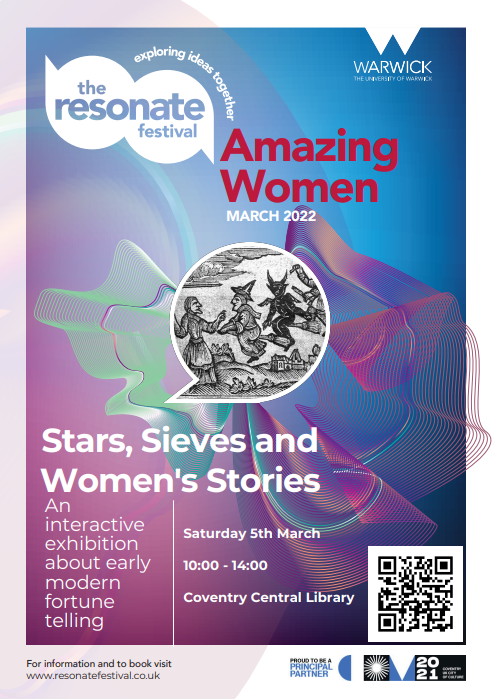
'Ghosts, fairies and a womb full of rabbits: women’s stories of the wondrous in early modern Britain’, Coventry City of Culture: Amazing Women, March 2022
‘Stars, sieves, and women’s stories: An interactive exhibition about early modern fortune telling’, Coventry City of Culture: Amazing Women, March 2022 (reran in May 2022 for Faculty of Arts Building opening)
‘Can the past foretell your future?’, British Academy Summer Showcase, June 2021
Select Papers
'Masculinity, emotions and capital punishment in the Ordinary’s Account, 1689-1730', University of Northampton History Seminar, 11th November 2026*
Book launch: 'Suicide and the Supernatural in Early Modern Britain and America', University of Warwick, 15th October 2026
‘Masculinity in the face of death: men, emotions and capital punishment in England, 1689-1720’, Restoration Conference, University of Warwick, 30th July 2026
‘“A Most Soveraigne Preservative”: Consolatory literature and suicide prevention in early modern England’, Centre for Cultures and Environments of Health, University of Exeter, 25th March 2026
Keynote speaker: ‘Suicide and the supernatural in early modern Britain and New England’, York Cabinet of Curiosities Conference, 24th June 2025*
‘“Bear their Misfortunes like Men”: Emotional Masculinity in English Criminal Accounts, 1689-1730’, University of Manchester, 19th March 2025*
‘Representing male emotional pain in early modern English love ballads’, NACHE Conference, 8th June 2024
‘Self-destructive desires and the supernatural in early modern Britain’, University of Birmingham
Eighteenth Century Centre seminar, 6th March 2024*
‘Self-destruction and the supernatural in Britain’, TU Dresden Early Modern Colloquium, 14th December 2023*
‘Love suicide in early modern England’, Disappearances: Representations of Suicide in Literature, Culture, and History, International Symposium, 10th July 2023*
‘Attempted suicide in early modern Britain’, Renaissance Society of America Conference, Dublin, 30th March 2022
‘Emotional responses to suicidal intent in British supernatural narratives, 1560-1735’, Emotion, Embodiment and the Everyday, 1500-1800, University of Cambridge, 10th December 2021
‘Sharp objects, self-harm and the supernatural in early modern Britain’, Newberry Library Multidisciplinary Graduate Conference, 9th February 2021
Profile
2026-Present: Teaching Fellow in Medieval and Early Modern History, University of Warwick
2025-2026: Lecturer in Early Modern History, University of Exeter
2024-2025: John Rylands Early Career Visiting Fellow, University of Manchester
2023: Visiting Researcher, TU Dresden
2022-2023: Teacher Champion and Journal of Postgraduate Pedagogic Practice Editor, University of Warwick
2021-2024: Senior Graduate Teaching Assistant in History, University of Warwick
2020-2024: PhD in History, University of Warwick. Supervised by Professor Peter Marshall and Dr Naomi Pullin
Dr Imogen Knox
she/her
Imogen.H.Knox@warwick.ac.uk
Office hours
Mondays and Fridays, 11-12
FAB 3.53