
Computer Science News
Zhenjian Lu joins the department as a Research Fellow
We're happy to announce that Zhenjian Lu has joined the department as a Research Fellow. He is currently funded by the project "New approaches to unconditional computational lower bounds", with support from the Royal Society.
Zhenjian Lu will soon defend a PhD thesis in computational complexity at Simon Fraser University under the supervision of Prof. Valentine Kabanets and Prof. Andrei Bulatov.
He is primarily interested in Computational Complexity, Circuit Lower Bounds, Algorithms, Pseudorandomness, Analysis of Boolean Functions, and Meta-Complexity.
Exoplanet Validation with Machine Learning: 50 new validated Kepler planets
Dr Theo Damoulas (Department of Computer Science) along with Dr David Armstrong (Department of Physics) and Jevgenij Gamper (Department of Mathematics) have developed probabilistic machine learning algorithms that can separate out real planets from fake ones in the large samples of thousands of candidates found by telescope missions such as NASA’s Kepler and TESS. The results of which have led to fifty new confirmed planets, the first to be not only ranked but also probabilistically validated by machine learning.
The paper "Exoplanet Validation with Machine Learning: 50 new validated Kepler planets" has been accepted to the Monthly Notice of the Royal Astronomical Society, DOI: 10.1093/mnras/staa2498
Wearable IoT Electronic Nose for Urinary Incontinence Detection
Work performed by Computer Systems Engineering student Michael Shanta for his 3rd year project, supervised by Dr. Marina Cole and Dr. Siavash Esfahani in the School of Engineering, was written up in a paper that was recently accepted for presentation at the IEEE Sensors 2020 Conference.
For his 3rd year project Michael worked on developing machine learning techniques for an Electronic Nose in order to classify odours based on the sensor responses. The system aims to detect incontinence incidents, allowing alerts to be sent to relevant personnel from an IoT network via a cloud server.
Dr Sathyawageeswar Subramanian joins the department as a Research Fellow
Dr Sathyawageeswar Subramanian has joined the department to work as a Research Fellow on the "Foundations of classical and quantum verifiable computing" project, which is led by Dr Tom Gur.
Sathya completed his PhD in quantum computing at the University of Cambridge under the supervision of Prof. Richard Jozsa. His primary interests are quantum algorithms and computational complexity theory.
Welcome to Our New Students!
We congratulate all A-level students on their recent achievements. The quality of our intake in recent years has been outstanding and we are delighted to report that we will be welcoming another exceptional cohort of first year students. We look forward to getting to know you all in the coming term, and hope you will enjoy taking your next steps in your development as Computer Scientists.
Due to this year's special circumstances, this cohort will be by far the largest in the history of the department. While there will be challenges for students and staff alike, we will work hard, together with our students, to ensure that everybody can fully realize their considerable potential. We are excited and are looking forward to meeting this new talented group of students
Grasshopper jumping on a sphere gives new quantum insights
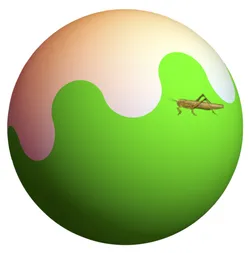 Dr Dmitry Chistikov and Professor Mike Paterson, together with physicists Olga Goulko (Boise State University) and Adrian Kent (Cambridge), have published an interdisciplinary paper Globe-hopping, solving a probabilistic puzzle on the sphere that has applications to quantum information theory.
Suppose a lawn must cover exactly half the area of a sphere. A grasshopper starts from a random position on the lawn and jumps a fixed distance in a random direction. What shape of lawn maximizes the chance that the grasshopper lands back on the lawn? A natural guess would be that a hemispherical lawn is best. It turns out, however, that this is nearly never the case — there are only a few exceptional jump sizes.
This work involving spherical geometry, probability theory, basic number theory, and theoretical physics appears in the Proceedings of the Royal Society A and shows, apart from concern for the well-being of grasshoppers, that there are previously unknown types of Bell inequalities. The Bell inequality, devised by physicist John Stewart Bell in 1964, demonstrated that no combination of classical theories with Einstein's special relativity is able to explain the predictions (and later actual experimental observations) of quantum theory.
A University press release can be found here.
Many congratulations to our new graduates!
 Congratulations to our 3rd and 4th year students, who are receiving their results today!
Here is a video for the occasion from the head of department.
Well done, all the best for your careers, and let us stay in touch!