
Astronomerology III: SF and Science Communication
Regular readers of this blog will be aware that an ongoing interest of mine is the extent to which science fiction is influenced by and in turn influences professional astronomy. I recently attended this year’s Royal Astronomical Society National Astronomy Meeting (NAM), the UK’s largest annual gathering of professional astronomers, at the University of Birmingham.
Following on from my careers survey at NAM 2022 and its subsequent follow-ups, I thought I would pose a new pair of questions for NAM 2026, focussing on science outreach and communication.
Posing the Right Questions
The process of engaging with each year’s NAM is a fairly long one. In the late autumn, the scientific organisers (in this case, astronomers at the University of Birmingham, ably chaired by Ben Gompertz) release a call for session proposals. Once sorted and selected by a Scientific Organising Committee, these define a set of 90 minute sessions (each run by a different team) to which requests for individual presentations (usually 15 or 20 minutes long talks, and supplemented by a display of large A0 or A1 posters) can be submitted.
Amongst the sessions selected for NAM 2026 was “Bridging Perspectives: Art and Science in Collaboration”, organised by Ulrike Kuchner, Soheb Mandhai, Jenni French and Jake Noel-Storr. The abstract for the session was the following:
Art and science intersect to expand knowledge by creating spaces where diverse expertise can collaborate. In astronomy, the scale and complexity of data and methods can limit creative engagement beyond standard analytical approaches. Art can function as a boundary object: a flexible medium that enables collaboration across disciplines without requiring full agreement (Star, 2010). A single artwork, for example, may be approached by scientists for ideation, outreach or communication, and by artists as an outcome of creative research addressing societal needs. This flexibility allows shared meaning while respecting distinct perspectives. We will discuss three aspects of ArtScience practice:
ArtScience collaborations: Examples of successful projects demonstrate how collaboration can generate new research questions and connect research to societal challenges.
Data visualisation and interdisciplinary tools: Visualisation, extended reality, and sonification are increasingly popular entry points into creative engagement and science communication, allowing teams to negotiate understanding.
Inclusivity and STEAM education: Artistic approaches foreground accessibility, inclusivity, and diverse learning styles. How can they be integrated into scientific practice, education and outreach?
With this session in mind, I submitted a request specifically for a poster with the following statement of intent:
Science and Science Fiction have matured in parallel over the last century or more. As they have done so, scientists, the media and the general public have all reached for science fiction when seeking to interpret or understand cutting edge scientific results. Narratives reflect societal concerns about the use of science, as well as offering non-threatening scenarios in which to contextualise complex scientific ideas. In this poster I will reflect on recent work to explore the connection between science fiction and professional astrophysics. I will also seek to build on my successful experiment at NAM 2022 by dedicating half the poster to an interactive survey, asking the NAM community to reflect on their personal positioning with regard to the use of science fiction in science communication and their experiences of so doing.
Happily, the session chairs agreed to this proposal. Given the demand for poster spaces, the Local Organing Committee decreed that this year’s posters would have to be in the smaller A1 format (to fit them all in!) and so I decided to focus slightly more tightly than I originally intended specifically on the pros and cons of science fiction in outreach and science communication (these terms are used effectively interchangeably, although there are subtle differences).
The poster laid out the premise as follows:
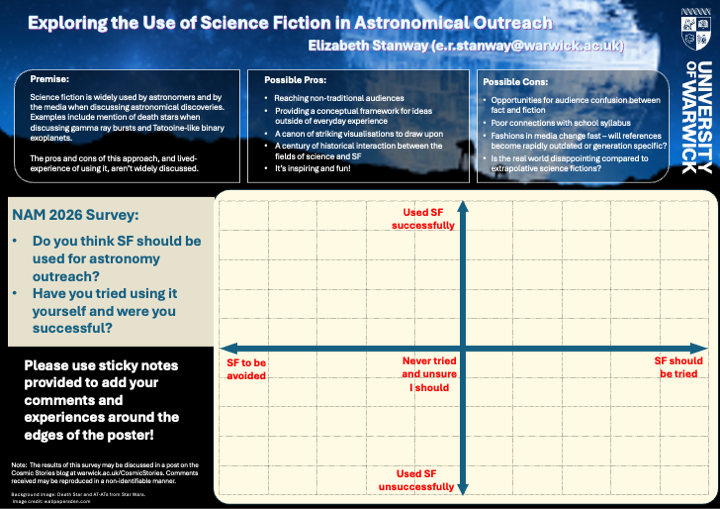
Science fiction is widely used by astronomers and by the media when discussing astronomical discoveries. Examples include mention of death stars when discussing gamma ray bursts and Tatooine-like binary exoplanets.
The pros and cons of this approach, and lived-experience of using it, aren’t widely discussed.
I provided some examples of pros that occurred to me:
Reaching non-traditional audiences
Providing a conceptual framework for ideas outside of everyday experience
A canon of striking visualisations to draw upon
A century of historical interaction between the fields of science and SF
It’s fun!
I also laid out some potential cons:
Opportunities for audience confusion between fact and fiction
Poor connections with school syllabus
Fashions in media change fast – will references become rapidly outdated or generation specific?
Is the real world disappointing compared to extrapolative science fictions?
The poster then invited astronomers to place a sticky dot to indicate the strength of their feelings on the following questions [1]:
Do you think SF should be used for astronomy outreach? (with axes stretching from “should be tried” to “should be avoided”)
Have you tried using it yourself? (with axes stretching from “used unsuccessfully” to “used successfully”)
It also invited people to leave comments on a set of sticky-backed notes provided.
With the poster printed, and post-its and stickers (a different colour for each day) in hand, all that remained was to wait and see how much response the poster attracted.
The Results
After a slow start (with the poster tucked away out of sight on an upper floor for the first three days), the momentum of responses really built after the Local Organising Committee were kind enough to move the poster to a more prominent position near a coffee table!
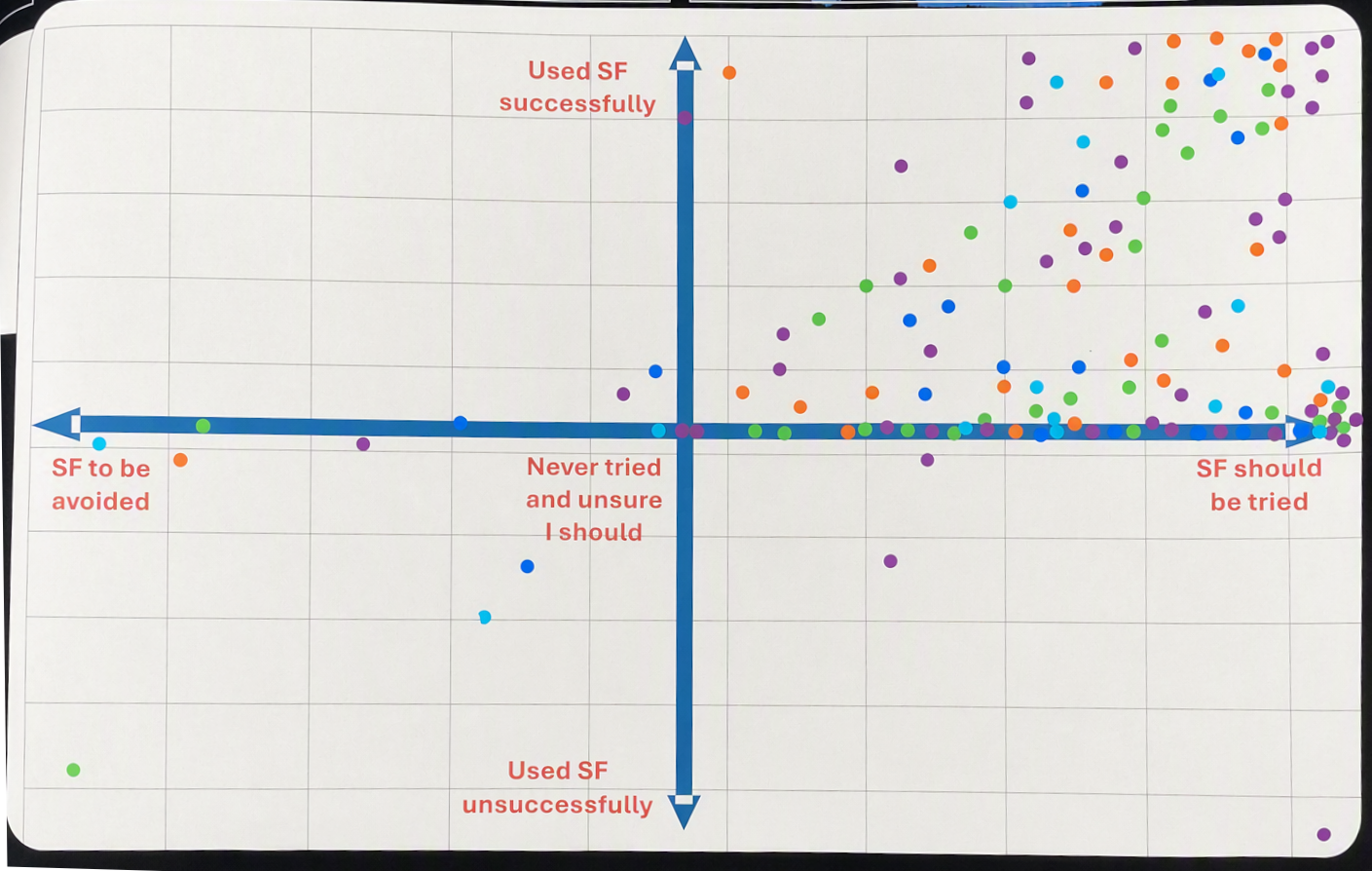
Overall, 136 astronomers placed a sticker, and six wrote comments. The sticker placement was overwhelmingly positive.
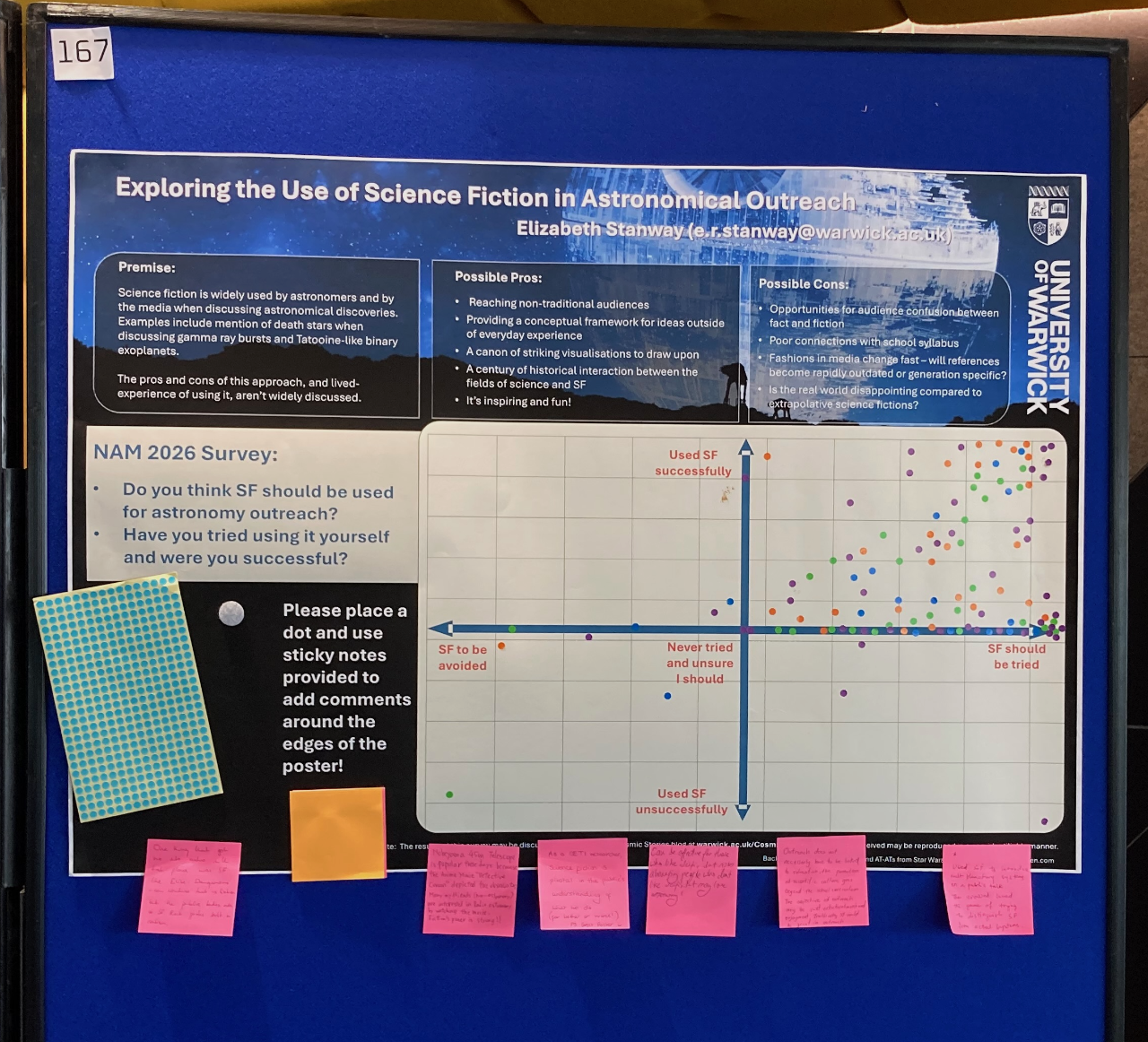
92% of respondents thought SF should be used for outreach and science communication, with the remaining 8% (a twelfth of the respondents) on the neutral or negative side. Of people who placed a sticker, 66% (two thirds) had tried astro SF outreach (excluding a small margin around the axes as well as the points on the axes themselves). Only 3% (5 people) had tried it significantly unsuccessfully (with a few more very close to the axis), and of those, only one person (0.7% of the total) felt strongly that SF was to be avoided, while another felt equally strongly that it should be used, despite their own unsuccessful experience. Perhaps unsurprisingly, no one who had used SF successfully in outreach felt strongly that it should be avoided by themselves or others [2].
Broadly speaking, there was a correlation between past success in using SF in outreach and strength of belief that it is of benefit, although, as I suspected might be the case, there are also a reasonable number of respondents that had never used SF, despite firmly believing it should be used. Since NAM has an early-career-researcher focus, many of these were likely to be junior researchers who have not yet had an opportunity to do so. There was no evidence for a strong evolution in preferences by respondents over the course of the week, with the distribution in each colour reasonably consistent.
A more challenging statistic to interpret is the number of astronomers who did not respond to the question at all. The total attendance at the conference was around 700, although a number of these came for only one or two days (including those days when the poster was hard to locate), or were attending meeting strands in rooms at a significant distance from the relocated poster (and so would most likely have taken coffee elsewhere). The schedule was very full, and did not include a dedicated poster session, meaning that opportunities to peruse the posters conflicted with those for academic networking and scientific discussion. Even so, it is likely that those with an intrinsic interest in science fiction themselves were more likely to have been attracted by the imagery and title of the poster, introducing an inevitable bias.
Lived experiences
The write-in comments left on sticky notes along the bottom of the poster were limited in number, but interesting in the way they captured the lived experience and opinions of astronomers in a way that a simple two dimensional question could not.
Of the first two to appear, one noted a concern which I have shared in the past:
“Can be effective for those who like scifi, but risks alienating people who don’t like scifi, but may love astronomy!”
The second, who labelled both their sticker and note, so I can connect the two and confirm that the individual was both highly positive about SF outreach and had used it successfully, confirmed that:
“Used SF to introduce multi-planetary systems in a public talk. The crowd loved the game of trying to distinguish SF from actual systems.”
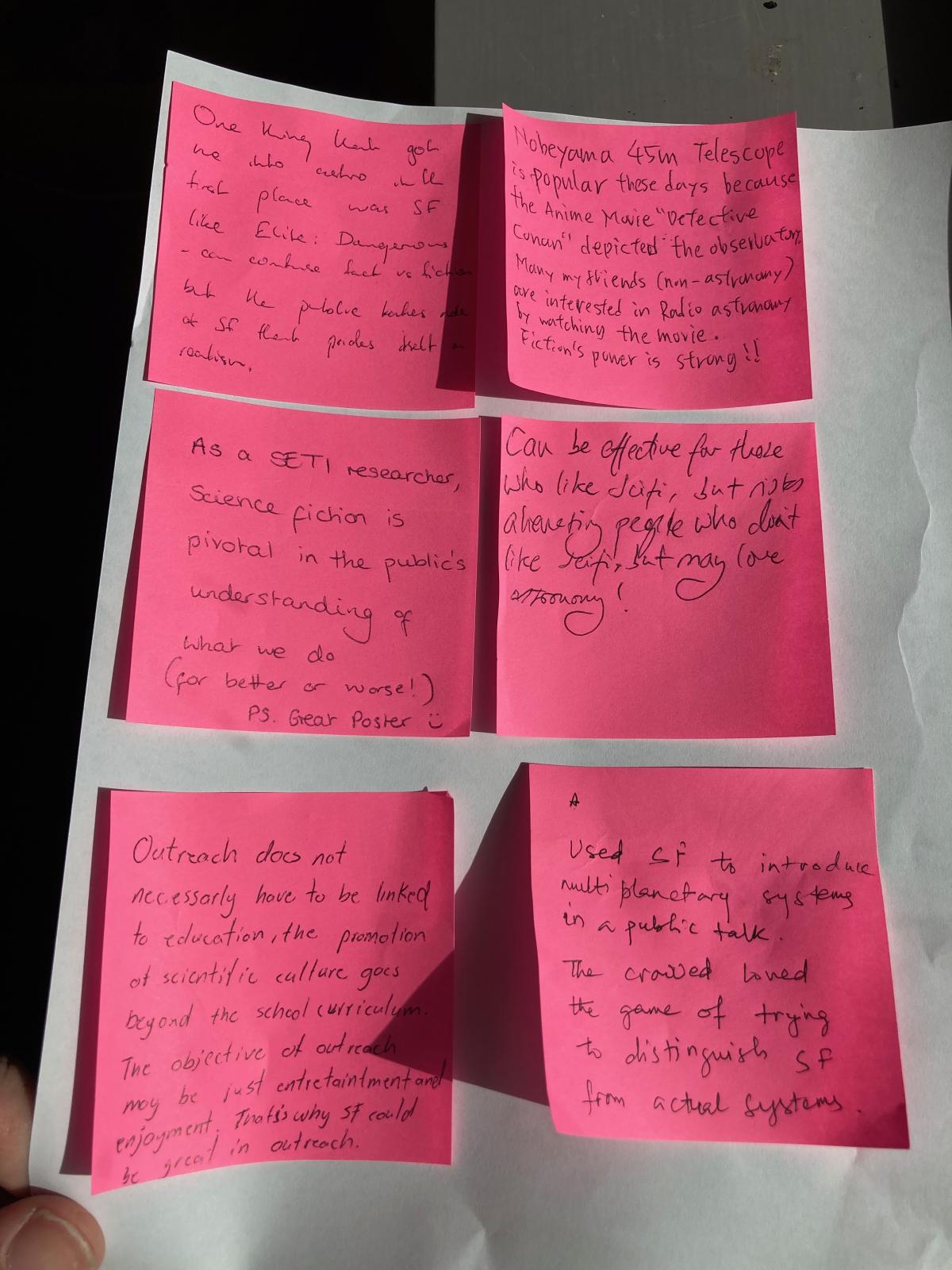
Other comments came in later in the week:
“As a SETI researcher, science fiction is pivotal in the public’s understanding of what we do (for better or worse!).”
“One thing that got me into astro in the first place was SF like Elite:
Dangerous - can confuse fact vs fiction but the public takes note of SF that prides itself on realism.”
One comment raised a good point about SF’s general enjoyability too:
“Outreach does not necessarily have to be linked to education, the promotion of scientific culture goes beyond the school curriculum. The objective of outreach may be just entertainment and enjoyment. That’s why SF could be great in outreach.”
Finally, one comment referenced a large radio telescope in Japan:
“Nobeyama 45m telescope is popular these days because the anime movie “Detective Conan” depicted the observatory. Many of my friends (non-astronomy) are interested in radio astronomy by watching the movie. Fiction’s power is strong!”
With examples ranging from anime to video games, each of these brief comments underlines the important role that science fiction plays in astronomy communication and the strength of feeling amongst members of the astronomical community - even if sounding the occasional note of caution along the way.
Astronomy, Outreach and SF
Frustratingly, the ArtScience session at NAM 2026 clashed with another on stellar physics for which I was a co-organisor, so I didn’t see quite as much of it as I would have hoped. Those contributions and discussions I was able to see made it clear just how much interest and variety there is in collaborations between professional astronomy and interdisciplinary approaches to both research and science communication. There were presentations about artistic residencies, poetry, work with groups of varied ages and backgrounds, anthropology and many other topics.
There was also further interest in science fiction, notably in the form of a pre-recorded presentation by Emile Zana on “A high schooler's attempt to analyse the link between British arts/popular culture and astrophysics”, which ran as a video on a loop through the lunch session, alongside my own short video looking at artistic representations of black holes, inspired by my recent blog entry "A Tale of Two Black Holes" [3].
(Above: Youtube link to three minute video short on the artistic representation of black holes.)
Interestingly, this science fiction connection also occurred elsewhere at NAM.
Another session, “How do we make progress in science? Metascience and community” had a discursive format, with each session including a number of short “provocations”. One of these, delivered by John Holmes at the University of Birmingham took the topic “Science fiction and scientific progress: Olaf Stapledon and Astrobiology”, based on his previous work emphasising the intersection between SF, astronomy and philosophy in works such as Stapledon’s novels Last and First Men (1930) and Star Maker (1937), and the impact these had on James Lovelace's later Gaia theory, or the academic field of Earth systems science. The subsequent discussion included further references to SF, including noting that its decades of thought experiment may be relevant in the context of the current debate regarding artificial intelligence.
It’s fascinating to watch the interdisciplinary approaches to astronomy research and engagement become more popular. There’s also an increasing recognition that these approaches reflect on aspects of culture and intersect with other areas of academic study, as well as simply focussing on outreach.
Outside of NAM, the International Astrophysical Union has recently formed its newest sub-panel. Commission C5 is dedicated to Cultural Astronomy, considering intersections between the sky and aspects of cultural history, archaeology, identity, philosophy and creativity. The commission is still new, feeling out its path through several different areas of cultural astronomy, but represents a new pathway towards opportunities for interdisciplinary interactions.
There are still challenges. While aspects of both popular and traditional culture, including science fiction, undoubtedly influence professional astronomers, and the results of my NAM 2026 survey suggests that many astronomers are strongly supportive of its continued use for science communication, it remains to be seen how interdisciplinary approaches can influence the execution of astronomy research, rather than its sociology and outreach. In all honesty, while experiments of scientists working with artists in installations and performances are interesting - reportedly providing new insights and modes of thought - the experimentation has been limited in scale and scope. Modern professional astronomy is a highly technical, highly mathematical and computationally intensive study, requiring many years of training and development. I suspect that the artistic approach, while valuable, is more clearly suited to communication and public engagement than observational or theoretical/computational research, and will continue to be used in those ways.
The growing frequency of interdisciplinary studies, and events such as those seen at the National Astronomy Meeting this year, is nonetheless fascinating.
And, if my survey results are to be believed, the use of SF in astrophysics outreach will continue to be enthusiastically supported for some time to come.
“Astronomerology III: SF and Science Communication”, Elizabeth Stanway, Cosmic Stories, 23rd August 2026.
Notes:
[1] I iterated a few times with members of the Warwick Astronomy and Astrophysics group to ensure clarity in the precise phrasing of the axes, considering some ‘SFesque’ phrases before deciding to settle on something fairly neutral instead. [Return to text]
[2] If anyone wishes to reproduce this experiment, a tabulation of the results, based on a scan of the poster can be provided. [Return to text]
[3] There’s also been this recent paper on aesthetic and practical choices in the representation of black holes by the Event Horizon Telescope team. Released after I recorded my video, it showed the care and considerations that went into development of the now-famous EHT black hole accretion disk image released in 2019. As the authors noted: "Some EHT researchers have also sought to navigate the boundary between art and science, for instance when submitting their image to the photo collections of art museums, such as the MoMA in New York and the Rijksmuseum in Amsterdam, and celebrating its acceptance." [Return to text]
The views and opinions expressed here are those of the author and do not necessarily reflect those of the University of Warwick. NAM 2026 logo sourced online. Original photographs and results presented here should not be reproduced without crediting this blog page and Elizabeth Stanway as the original source.