
History News
Titus Oates and his 'Popish Plot': Professor Mark Knights on BBC Radio 4's In Our Time
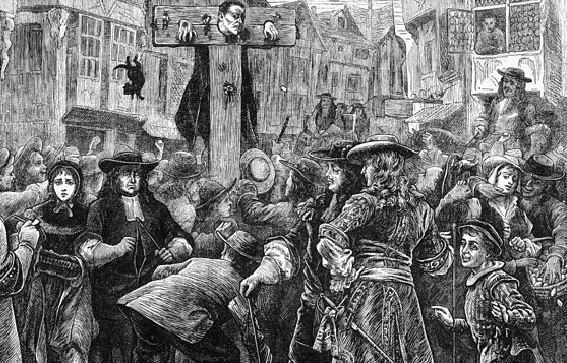
Melvyn Bragg and guests Mark Knights (Professor of History, University of Warwick) and Clare Jackson (Senior Tutor and Director of Studies in History at Trinity Hall, University of Cambridge) discuss Titus Oates who, with Israel Tonge, spread rumours of a Catholic plot to assassinate Charles II. From 1678, they went to great lengths to support their scheme, forging evidence and identifying the supposed conspirators. Fearing a second Gunpowder Plot, Oates' supposed revelations caused uproar in London and across the British Isles, with many Catholics, particularly Jesuit priests, wrongly implicated by Oates and then executed. Anyone who doubted him had to keep quiet, to avoid being suspected a sympathiser and thrown in prison. Oates was eventually exposed, put on trial under James II and sentenced by Judge Jeffreys to public whipping through the streets of London, but the question remained: why was this rogue, who had faced perjury charges before, ever believed?
 |
 |
City of Castellon's Peace Award 2016
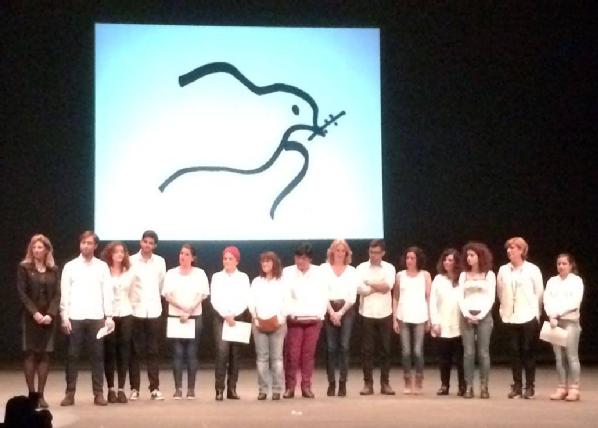
The City of Castellon's Peace Award 2016 has been awarded to the International Summer School on Peace Education. This is in recognition of four years' work by the project which has been developed and led by Dr Malik Hammad Ahmad, a member of the Warwick History of Violence Network and former PhD student of the Warwick History Department.
 |
'5 things you (probably) didn't know about the crusades' by Dr Aysu Dincer Hadjianastasis
Dr Aysu Dincer Hadjianastasis, Teaching Fellow in Medieval and Early Modern History at the Warwick University History Department, has written and had published the article '5 things you (probably) didn't know about the crusades' for HistoryExtra.
 |
Professor Hilary Marland on 'In Our Time' and delivering the 'Roy Porter Lecture'
Professor Hilary Marland was a guest on BBC Radio 4's 'In Our Time' programme on the topic of Bedlam on Thursday 17th March 2016, and is scheduled to give the Roy Porter Lecture, "Hearing the Convict Cry, Hearing the Patient’s Voice", at the Wellcome Collection on Tuesday 22nd March 2016.
| |
 |
Article by PhD Student Nicole Beardsworth, "How to Win an Election in Uganda", published by Newsweek
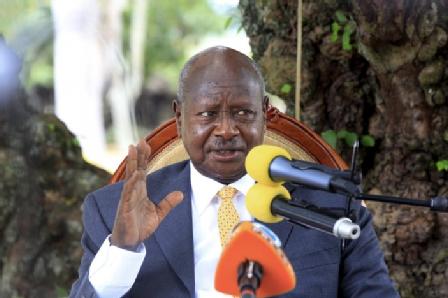
An article, "How to Win an Election in Uganda", regarding the recent Ugandan election co-authored by Nicole Beardsworth, PhD student in the departments of History and PaIS at Warwick University, has been published online by Newsweek.
 |
Screenwriter and director Oliver Stone receives honour from University of Warwick
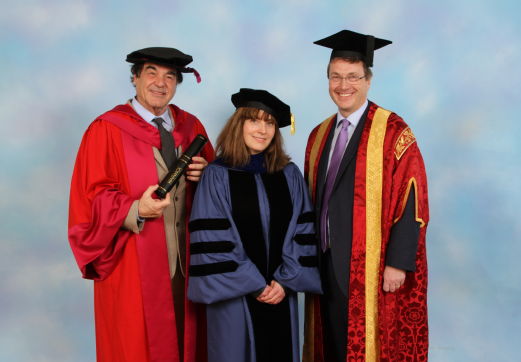
The creative force behind films such as Platoon, Scarface, Born on the Fourth of July and Wall Street was conferred an honorary Doctor of Letters degree. He officially received the honour from the University’s Vice Chancellor Professor Stuart Croft during a formal ceremony held on campus.
After the ceremony, the Academy Award winner put aside his academic robes to take part in an informal ‘in conversation’ interview in front of an invited audience. As well as discussing his past achievements he discussed his next project, “Snowden”, about Edward Snowden the US government contractor whose revelations were the start of a series of global surveillance disclosures. During the Warwick event Oliver Stone described the film as “a fascinating story- it tells you what’s going on, the new state of things.”
He was interviewed Dr J.E. Smyth of Warwick’s department of History who also organised the event. She said: “Oliver Stone is Hollywood’s most dedicated and influential political filmmaker. Throughout his career he’s asked tough questions about America and its legacies of greed, corruption, and imperialism. I’m delighted that the University of Warwick is honouring his career.”
During the conversation he discussed his repertoire of films and screenplays. He has written and directed over 20 full-length feature films, among them some of the most iconic films of the three decades. Many have been political and even controversial such as “Salvador” (1985), which revealed the U.S. government’s involvement in Central America; “Platoon” (1986), the first of his three Vietnam films; “Born on the Fourth of July” (1989); “JFK” (1991); “Natural Born Killers” (1994); and “Nixon” (1995).
Stone was born September 15, 1946 in New York City. He served in the U.S. Army Infantry in Vietnam in 1967-68, and was decorated with the Purple Heart and the Bronze Star for Valor. After returning from Vietnam, he completed his undergraduate studies at New York University Film School in 1971. He worked as a taxi driver, merchant marine, messenger, advertising salesman, and production assistant before breaking through as a filmmaker. His script for “Midnight Express” (1978) earned him his first Academy Award and “Scarface” (1983) transformed the gangster genre and became a cult hit.
Though focused on controversial questions about the U.S., Stone’s films have a global audience and massive cultural impact, among them “Wall Street” (1987), an exposé of American capitalism; “World Trade Center” (2006), a true story of 2 (of only 20) 9/11 survivors; and “The Doors” (1991), a biopic of influential rock icon Jim Morrison. He has produced or co-produced a dozen films including “The People vs. Larry Flynt” (1996), “The Joy Luck Club” (1993), and “Reversal of Fortune” (1990).
Stone’s documentaries include three on Fidel Castro (“Comandante” (2003); “Looking for Fidel” (2004); and “Castro in Winter” (2012)); one on South America, “South of the Border” (2009), prominently featuring Hugo Chavez and six other Presidents in a continent undergoing huge social changes. He also made “Persona Non Grata” (2003) on Israel-Palestine relations.
His recent “The Untold History of the United States” (Showtime, 2012), is a 12-hour televised documentary series interrogating the conventional, triumphalist narrative of U.S. history. The companion book, co-written with Peter Kuznick, was a best seller.
Article by doctoral student Kyle Jackson published in Studies in History
Warwick History doctoral student Kyle Jackson has published an article from his thesis research in the latest issue of a prestigious journal in the field of South Asian Studies. The article appears in a special issue of the journal focusing on "Borderland Histories: Northeast India", and can be found online at:
Kyle Jackson, 'Globalizing an Indian Borderland Environment: Aijal, Mizoram, 1890–1919', Studies in History 32.1 (2016): 39-71.
 |
ESRC PhD Studentship in Collaboration with the University of Warwick and the Parliamentary Archives
The ESRC Doctoral Training Centre at the University of Warwick, one of 21 such centres in the UK, embodies the university’s commitment to producing the next generation of leaders in social science research. Internationally renowned for its research excellence, Warwick is now inviting applications for an ESRC Doctoral Studentship in association with our collaborative partner the Parliamentary Archives to commence in October 2016 on the subject of ‘From Suffragette to Citizen: Women and Parliament in the Late Nineteenth and Early Twentieth centuries.’ The Parliamentary Archives holds the historic records of the House of Commons and House of Lords dating back 500 years, providing innovative and expert information management, preservation, access and outreach services enabling anyone in the world to use Parliament’s records, both now and in the future.
For more information and details of how to apply, please see the advert on jobs.ac.uk.