
Founding Fictions: Early Modern Utopias and Novels
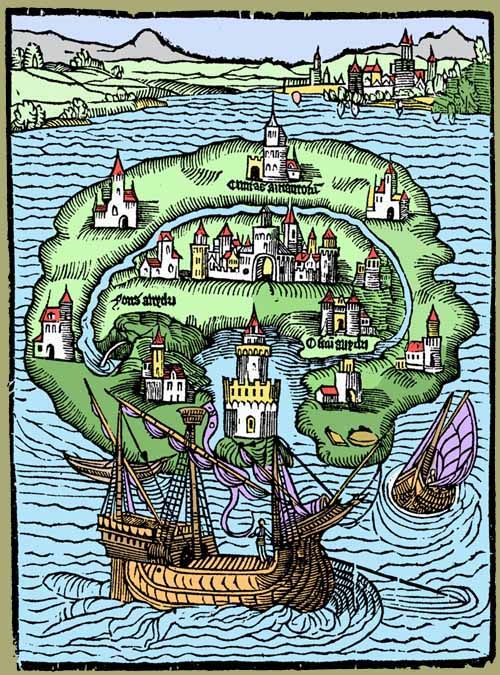
Week 8
Tutor: Mark Knights
This seminar explores the fictions involved in utopias and travel narratives, both for authors and readers. We will think about what was 'true' in such works and whether 'false' has much meaning in this context (or might even be something enjoyable). We will also consider the fictional impulses in early modern Britain that fostered the evolution of the novel.
Required preparation
Please read all the primary sources linked to below; at least one piece of secondary reading from the key texts; and come prepared to talk about one of the topics for up to 10 minutes.
Primary sources
1) The front matter (up to p23) of Thomas More's Utopia (1516)
2) An extract from Henry Neville's Isle of Pines (1668)
3) An extract from Jonathan Swift's Gulliver's Travels (1726)
Full versions of all these texts can be found on EEBO and ECCO.
For a listing of early modern utopias (1600-1720) click here
Key texts
1) The Oxford Handbook of Thomas More's Utopia ed. Cathy Shrank and Phil Withington (2023) - has many useful essays.
2) Gaby Mahlberg,' Historical and Political Contexts of The Isle of Pines', Utopian Studies, 17:1 (2006), pp. 111-129.
Amy Boesky, 'Nation, Misceganation: Membering Utopia in Henry Neville's The Ise of Pines', Texas Studies in Language and Literature 37 (1995), 165-184
3) Kate Loveman, '"Full of improbable lies": Gulliver's Travels and jest books', British Journal for Eighteenth Century Studies, 26 (2003), 15-26
Christopher Fox (ed), The Cambridge Companion to Jonathan Swift (2003), choose either Introduction, ch. 2 (politics and history), or ch. 6 (Swift's saitre and parody)
Seminar questions
In what ways, if at all, were travel narratives and/or Utopias concerned with truth?
Can fiction get closer to the 'truth' than non-fiction?
Does satire deal with truth or fiction?
What fictional impulses can you discern in early modern Britain?
Further reading
Susan Bruce (ed), Three Early Modern Utopias - Thomas More: Utopia/ Francis Bacon: New Atlantis/ Henry Neville: The Isle of Pines (1999) - introduction
Charles W. J. Withers, ‘Disguise—Trust and Truth in Travel Writing’, Terræ Incognitæ, 53.1 (2021) 48-64. Although this is mostly C19th focused it has some interesting ideas that can apply to early modernity. See Johannes Müller and Michiel van Groesen (eds.), Far From the Truth : Distance, Information, and Credibility in the Early Modern World (Hakluyt Society studies in the history of travel, London: Routledge, 2024)
1) Utopia and Utopias
J.C. Davis, Utopia and the ideal society : a study of English utopian writing, 1516-1700 (1981)
Frank Manuel, Utopian Thought in the Western World (1979)
Frank Manuel (ed), Utopias and Utopian Thought (1973)
Nina Chordas, Forms in Early Modern Utopia: The Ethnography of Perfection (2010)
Roland Schaer, Gregory Claeys, and Lyman Sargent, Utopia: the Search for the Ideal Society in the Western World (2000)
Alexandra Verini, English women's spiritual Utopias, 1400-1700 : new kingdoms of womanhood (Palgrave Macmillan, 2023).
2) Neville and his context
Gaby Mahlberg, Henry Neville and English republican culture in the seventeenth century (2009)
Gaby Mahlberg, “The Publishing History of The Isle of Pines.” Utopian Studies, vol. 17, no. 1, 2006, pp. 93–98.
Gaby Mahlberg, 'An Island with Potential: Henry Neville's Isle of Pines', in Utopian Moments ed. Miguel Aviles and J. C. Davis (2012)
Gaby Mahlberg, 'Republicanism as Anti-Patriarchalism', in J. Scott and J Morrow (eds), Liberty, Authority, Formality (2008)
Derek Hughes, Versions of Blackness: Key Texts on Slavery from the Seventeenth Century (Cambridge, 2007)
Robert Appelbaum, Literature and Utopian Politics in Seventeenth Century England (2002)
Amy Boesky, Founding Fictions: Utopias in Early Modern England (Athens: University of Georgia Press, 1996)
3) Gulliver's Travels
Mark Knights, History and Literature in the Age of Defoe and Swift History Compass 3 (2005) 131, 1–20
Howard Erskine-Hill, Jonathan Swift, Gulliver’s Travels (1993)
F.P.Lock, The politics of 'Gulliver's travels' (1980)
Kate Loveman, Reading Fictions 1660-1740: Deception in English Literary and Political Culture (2008)
J. Taugott, ‘A Voyage to Nowhere with Thomas More and Swift: Utopia and the Voyage to the Houyhnhnms’, Sewanee Review (1961)
Brian Vickers, 'The satiric structure of Gulliver's Travels and More's Utopia', in The World of Jonathan Swift, ed. by Brian Vickers (Cambridge: Harvard University Press, 1968), pp. 233-57
4) Fictional impulses
Leonard Davis, Factual Fictions: The Origins of the English Novel (1983).
D Eilon, Faction’s Fictions: Ideological Closure in Swift’s Satire (1991).
Howard Erskine-Hill, ‘Two-Fold Vision in C18th Writing’ English Literary History (1997).
Mark Knights, Representation and Misrepresentation in Later Stuart Britain: Partisanship and Political Culture (2007).
Kate Loveman, Reading Fictions, 1660-1740: Deception in English Literary and Political Culture (Ashgate Publishing, 2008).