
Computer Science News
Dr. Claire Rocks becomes a Foundation Fellow of the Warwick Institute of Engagement
The Warwick Institute of Engagement has announced that Dr. Claire Rocks has been chosen as one of 38 Foundation Fellows. The Warwick Institute of Engagement is a new group within the University of Warwick that aims to champion the future of high quality public engagement. It brings together Warwick’s extensive practical engagement expertise with pioneering academic research.
Dr. Claire Rocks has been a vital part of the Department of Computer Science's outreach team, having organised and run many successful events in the past few years with the aim to raise the profile of Computer Science and introduce it to new demographics. Claire is currently a Co-I on the Play Code Share project which brings Computer Science and the Arts together to teach computing in a creative and playful way.
Dr. Claire Rocks said about her appointment,
I’m delighted to be one of the Foundation Fellow of the Warwick Institute of Engagement and look forward to working with both staff and students to champion high quality public engagement with the fantastic work that we do.
More information on the Department's outreach activities is available.
Dr. Roger Packwood Retires from the Department
Technical Manager Dr. Roger Packwood is retiring from the Department of Computer Science. Roger has been a part of the department longer than most of the buildings have been on campus, including the current Department of Computer Science. Roger provided invaluable support for staff and students in the department and his presence will be very much missed.
Graham Cormode named 2020 ACM Fellow
Prof. Graham Cormode of the Department of Computer Science has been named among the 2020 Association for Computing Machinery (ACM) Fellows, for contributions to computer science. The ACM is the world's leading learned society for computer science. Prof. Cormode is recognised for his contributions to data summarisation and privacy enabling data management and analysis. His work on data streams and sketching has been widely implemented in many high tech companies and organisations.
Warwick Postgraduate Colloquium in Computer Science 2020
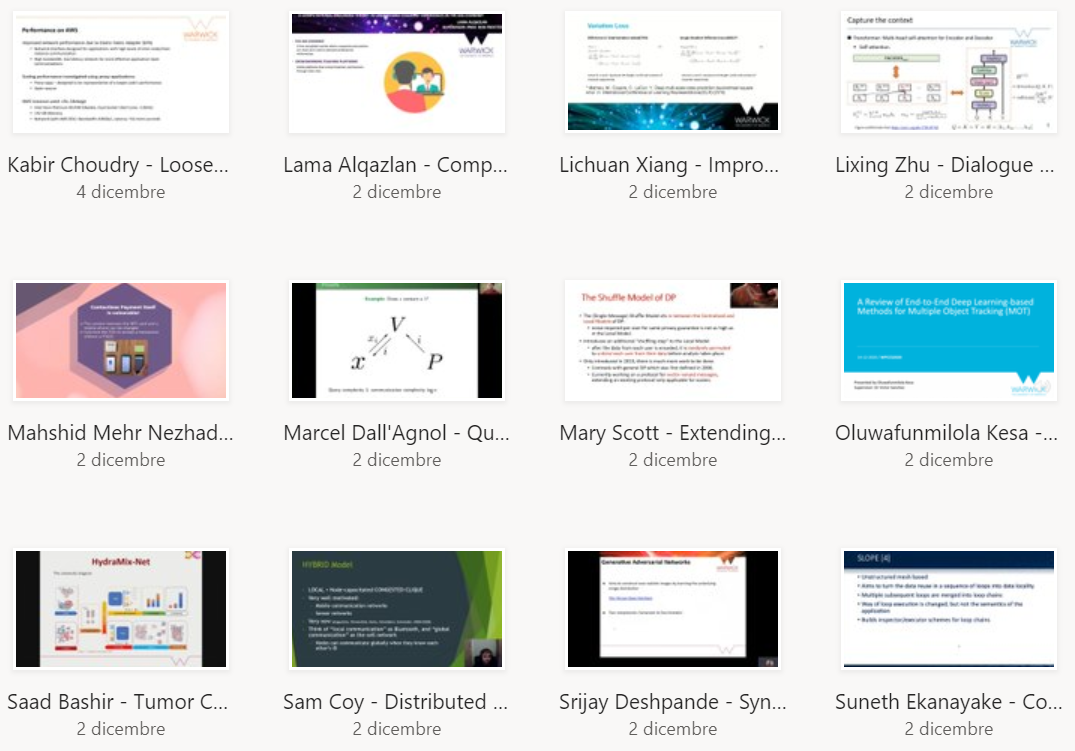
This year’s Warwick Postgraduate Colloquium in Computer Science (WPCCS) was held on Monday 14th December and marked the 18th edition of this beloved event. For the first time in its history, WPCCS took place online, on the communication platform MSTeams, to allow everyone to participate safely during the ongoing COVID-19 pandemic.
A cherished occasion to present one’s research, receive valuable feedback, and create connections within the department to develop new ideas, the Colloquium saw the participation of 50 PhD students who gave presentations spread across seven major themes, showcasing the quality and diversity of the research carried out in the Computer Science Department at Warwick. 22 PhD students also submitted longer, more detailed presentations which were made available to participants and attendees on the official WPCCS MSTeam, so to receive constructive in-depth comments.
EPSRC funding awarded to Prof. Yulan He and Prof. Rob Procter on developing an AI solution for tackling “infodemic”
Prof. Yulan He and Prof. Rob Procter have been awarded funding from the EPSRC under the UKRI’s COVID-19 call. During the COVID-19 pandemic, national and international organisations are using social media and online platforms to communicate information about the virus to the public. However, propagation of misinformation has also become prevalent. This can strongly influence human behaviour and negatively impact public health interventions, so it is vital to detect misinformation in a timely manner. This project aims to develop machine learning algorithms for automatic collection of external evidence relating to COVID-19 and assessment of veracity of claims.
The project is in collaboration with Prof. Maria Liakata and Dr. Arkaitz Zubiaga from the Queen Mary University of London.
Professor Edmund Rolls' 15th book, "Brain Computations: What and How", published by Oxford University Press
Professor Edmund Rolls is pleased to announce the publication of his 15th book "Brain Computations: What and How" by Oxford University Press.
The aim of this book is to elucidate what is computed in different brain systems; and to describe current computational approaches and models of how each of these brain systems computes. Understanding the brain in this way has enormous potential for understanding ourselves better in health and in disease. Potential applications of this understanding are to the treatment of the brain in disease; and to artificial intelligence which will benefit from knowledge of how the brain performs many of its extraordinarily impressive functions.
This book is pioneering in taking this approach to brain function: to consider what is computed by many of our brain systems; and how it is computed. Details can be found here. Professor Rolls notes that the research described in this book has high impact in terms of citations (see here for more information).
High Career Prospects for Warwick Computer Science Graduates
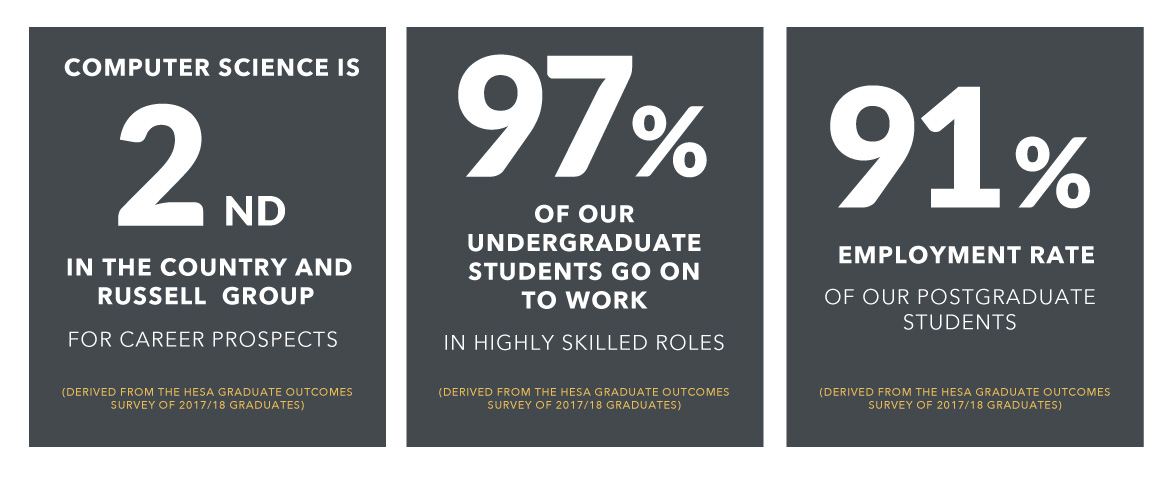
The Graduate Outcomes Survey of 2017/18 Warwick graduates highlighted that:
- Computer Science is 2nd in the country and Russell Group for career prospects
- 97% of our undergraduate students go on to work in highly skilled roles
- 91% employment rate of our postgraduate students
Derived from the Graduate Outcomes survey of 2017/18 graduates, carried out approximately 15 months after completion. Contains HESA data: Copyright Higher Education Statistics Agency Limited 2020. HESA cannot accept responsibility for any inferences or conclusions derived by third parties from its data.