
Computer Science News
University contributing to new advances in cancer diagnosis
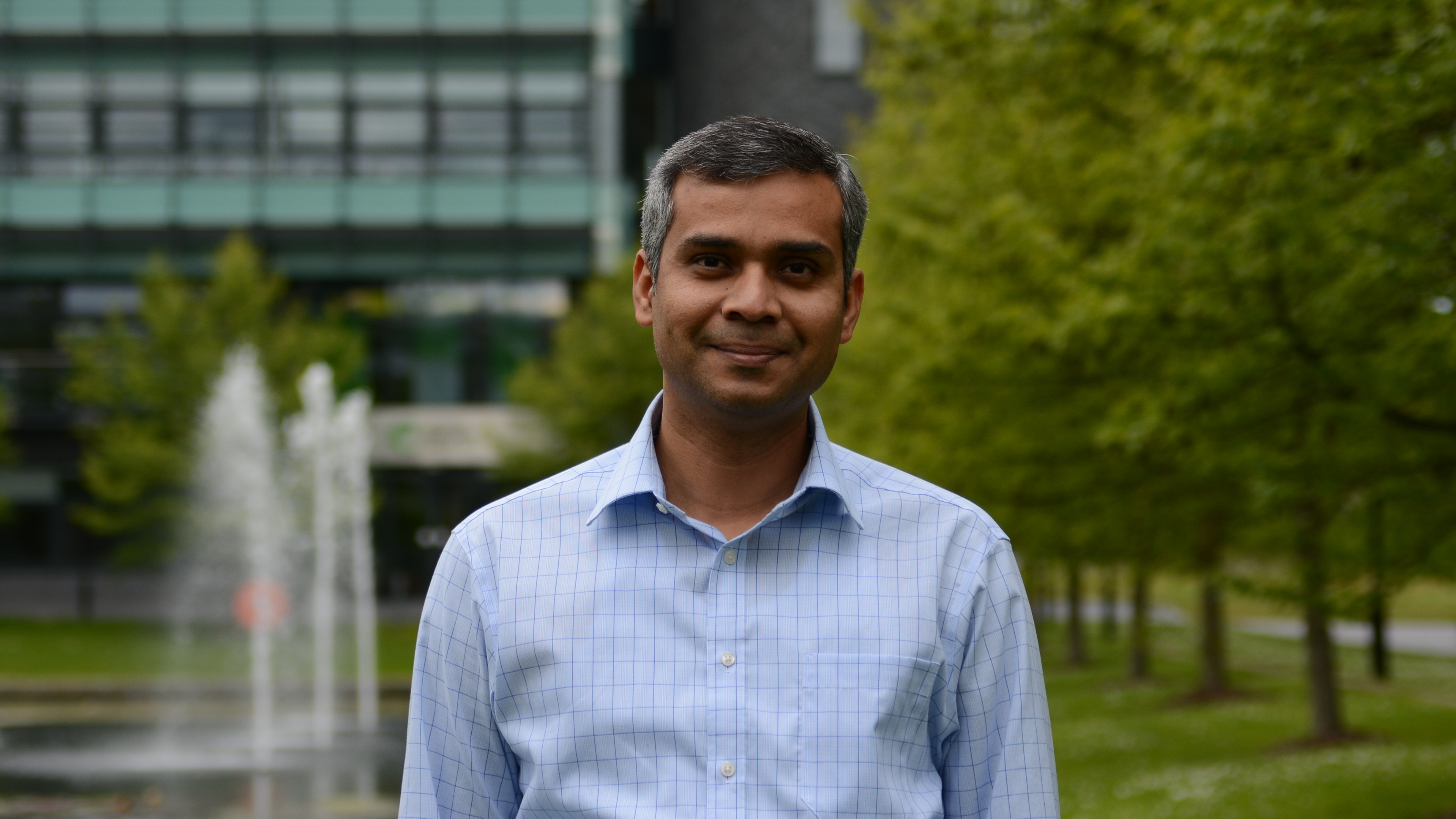
A University of Warwick computer scientist is working with technology that could revolutionise how some cancers are diagnosed.
A high-tech computer system is able to read samples of human tissue and aid pathologists in the identification of minute changes in cells that can indicate cancer is present. More than 10,000 slides were examined in the first phase of the study[1] which shows that pathologists are as good at accurately diagnosing cancer on a computer as they are with a microscope.
Now Professor Nasir Rajpoot is working with University Hospitals Coventry and Warwickshire NHS Trust (UHCW) to develop the next generation of image analytics to use with this technology.
The ground breaking technology has the power to help pathologists grade some types of tumours, including lung, prostate and bladder tumours with precision. In prostate cancer, for example, this could make the difference between someone being offered surgery rather than drug based treatments.
The computer system known as The Omnyx® Precision Solution™, can help pathologists to see the small differences in cells in the same way that they have currently been using a microscope, allowing them to make sound decisions on many aspects of cancer diagnosis.
UHCW is the first in the UK to introduce this kind of innovation to its routine practice, meaning it is already benefitting patients.
The Omnyx system digitises slides which are traditionally placed on a microscope so that pathologists can look at them on a computer. Once on the computer, the UHCW scientists have written programmes which will separate normal from abnormal samples.
Consultant pathologist David Snead said:
“I am delighted that University Hospital, Coventry has led this ground breaking study. This provides even greater evidence that digital pathology really works, and works well. The introduction of digital pathology has fantastic potential benefits for patients. We can expect to be able to read samples more quickly than before, and the big advantage is that we can use the computer to easily manipulate an image or its data. For some patients, this additional information may change how their disease is managed.”
Mamar Gelaye, CEO of Omnyx noted:
“Dr Snead and his team have made a significant contribution to showing the value of digital pathology for both clinicians and patients. We are only at the beginning of harnessing the benefits of digitising pathology services, and we look forward to working with institutions like University Hospitals Coventry and Warwickshire NHS Trust to achieve even greater progress in delivering more accurate and efficient cancer diagnoses.”
Dr Rajpoot said:
“This is a very exciting development in the field of digital pathology. What it means is that we can now move forward with the application of digital pathology image analysis algorithms in a clinical setting. For instance, computer algorithms can automate the process of detecting normal samples so that some routine cases will not need to be looked at by a pathologist at all.
“Together with the team at UHCW, we are looking forward to developing technologies for computer-assisted diagnosis and image analytics for discovering biologically meaningful and clinically relevant signatures of cancer.”
Warwick to research how we prepare for autonomous vehicles
- Investigating how to manage the transition to autonomous vehicles
- Researchers to ask how machine and human intelligence can be combined
- Jaguar Land Rover and EPSRC fund £2m University of Warwick research
The problems surrounding the introduction of autonomous vehicles on public roads are to be addressed by new research led by the University of Warwick.
Despite progress in recent years the researchers argue that there are many unsolved challenges, not least related to how such cars will be accepted by the public.
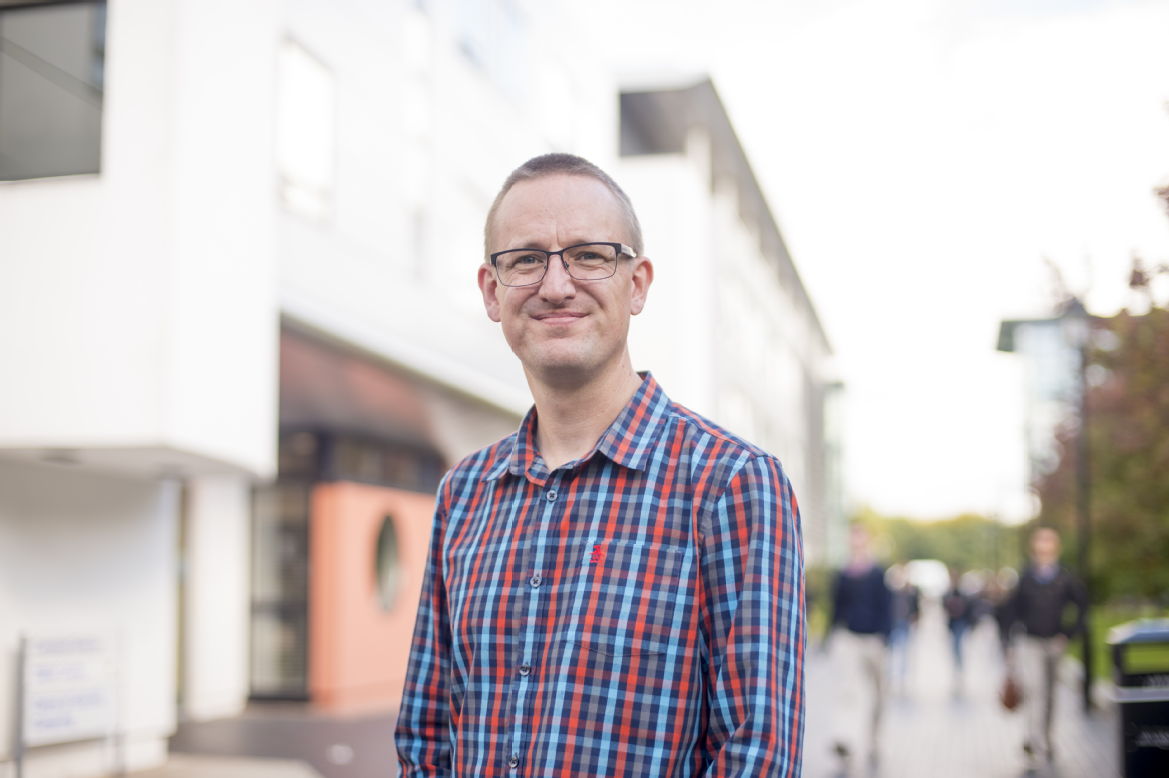
Led by Dr Nathan Griffiths, a Royal Society Industry Fellow in the University of Warwick’s Department of Computer Science, who says that:
“The move to autonomous vehicles is most significant transition in motoring for a century, involving the complex tasks inherent to driving becoming increasingly performed by machine. Individual drivers and their cars will form part of wider and smarter urban transport infrastructure, and the cars of the future will need to be both intelligent and cooperative”.
Dr Griffiths and his co-researchers will investigate:
- How to combine machine and human intelligence to optimise driving
- How to manage the traffic environment through the use of big data
- How to coordinate and control autonomous vehicles on public roads
The opportunities to deliver better safety, traffic efficiency, and more productive and pleasant journeys are enormous, but an automotive revolution on this scale faces great challenges for science and society, argue the Warwick researchers.
There has been little prior research on how autonomous vehicles will fit in with today's manually driven cars, how drivers and occupants will interact with them and how they will run safely in our towns, with pedestrians and cyclists.
The research project began following the launch of strategic partnership between Jaguar Land Rover and the EPSRC, who issued a joint call for research proposals that focussed on developing fully autonomous cars: Towards Autonomy - Smart and Connected Control. Dr Griffiths’ project is one of five selected and Jaguar Land Rover will be leading the collaboration with these successful research groups.
IBM and University of Warwick develop Big Data ethics course

The University of Warwick and IBM will offer researchers guidance through the ethical minefield of using big data and real time analytics.
Emma Uprichard associate professor at the University’s Centre for Interdisciplinary Methodologies (CIM), and co-director of the Warwick Q-Step Centre said:
“Researchers are increasingly turning to online tools with little or no ethical guidance other than some vague semblance that it is important to bear in mind basic key principles. Therefore, thanks to IBM, we will be developing online materials that can be used to develop and deliver successful training sessions in this area.”
Money has been granted by the IBM Faculty Awards which is a competitive worldwide programme intended to foster collaboration between researchers at leading universities worldwide and those in IBM research, development and services organisations.
The three day module will be offered to postgraduate students across CIM, Warwick Business School, computer science, Politics and International Studies (PAIS), and sociology as well as other students from a variety of disciplines that are increasingly using big data. Currently researchers gain 'informed consent' and provide assurances concerning privacy, confidentiality and anonymity when using data for studies. However as there is a diverse range of public and interlinked data available online that can be easily ‘scraped’ and ‘mined’ the ethical situation has become more complex.
Dr Uprichard will be working with colleagues Dr Maria Liakata, computer science, and Dr Arne Strauss, Warwick Business School, to develop the three day workshop on ethics of big data and data linkage. The training will be based on a similar module built and delivered by IBM at the University’s Warwick Business School. Work conducted by IBM into big data ethics will be used to shape the course content.
Professor Christina Hughes, the University of Warwick’s pro-vice-chancellor (teaching and learning) said:
“What have we done here at Warwick is demonstrate how important it is that we invest in this big data for the future of social science and for the future of the UK's contribution internationally to cutting edge – and importantly, ethical - data research and teaching more generally.”
Full story available at:
http://www2.warwick.ac.uk/newsandevents/news/new_big_data
The Alan Turing Institute and Intel to form Strategic Partnership
The Alan Turing Institute and Intel have agreed to form a long term strategic partnership to deliver a research programme focussed on high-performance computing and data analytics.
Researchers from both organisations will work together on the programme alongside co-funded research fellows and software engineers.
Launched this month at the British Library, the Alan Turing Institute research team includes members of the University of Warwick’s Departments of Statistics, Computer Science, Institute of Mathematics, Warwick Data Science Institute, and WMG’s Cyber Security Centre.
In addition, Intel will dedicate a hardware architecture team at the Institute’s facilities so that new algorithms developed by The Alan Turing Institute feed into the design of Intel’s future generations of microprocessors.
As well as conducting research, the partnership will train a new generation of data scientists through The Alan Turing Institute’s doctoral programme, ensuring students are equipped with the latest data science techniques, tools, and methodologies.
Minister for Universities and Science, Jo Johnson
Government is committed to ensuring the UK is the best place in Europe to innovate, patent new ideas and start a business. Big data offers huge potential for innovation which is why Government invested £42m in The Alan Turing Institute to secure the UK’s future in this important field.
I welcome this new strategic partnership with Intel which is testament to the strength of the UK’s research base and an exciting opportunity for growth in our digital economy.
Professor Andrew Blake, Director of The Alan Turing Institute
Intel is a global leader in computing innovation and I am delighted that it has become a strategic partner. This is a great development for the Institute and for data science globally.
Alan Turing was one of the first people to build an electronic computer. The partnership with Intel means that, true to his legacy, the Institute named after him will be contributing to the design of future generations of computers.
The goal of The Alan Turing Institute is to drive scientific and technological discoveries in the use of big data and algorithms, which will create new business opportunities, and accelerate solutions to global challenges. We have, today, taken a significant step towards that goal.
Christian Morales, Corporate Vice President, General Manager Intel EMEA
The Data Scientist is a very captivating and crucial job of the 21st century. With the right combination of people and technology, Big Data has the potential to solve big problems in public health, medicine, science, agriculture and engineering. We are committed to helping The Alan Turing Institute develop a fertile breeding ground for data scientists, with the greater purpose of driving critical data analytics across all industries.
The Alan Turing Institute is a joint venture between the universities of Warwick, Cambridge, Edinburgh, Oxford, UCL and the Engineering and Physical Sciences Research Council (EPSRC). The Institute will promote the development and use of advanced mathematics, computer science, algorithms and big data for human benefit.
DCS goes to Cheltenham
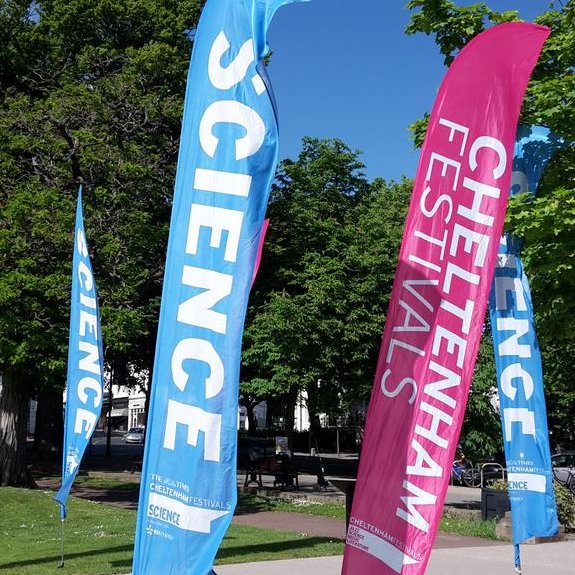
The department went to the Cheltenham Science Festival this year, with hands on demonstrations showcasing Data Science research and other departmental research topics.
Data Science involves finding meaning in large volumes of unstructured data. Its many applications include predicting election results from social media, improving traffic flows and detecting breast cancer.
Computer Science also joined forces with members of the Psychology Department to run a very successful drop-in session exploring different aspects of threat, safety and well-being. Participants joined Warwick staff and students in a variety of research-inspired activities ranging from saving pandas from extinction to detecting dangerous spoof websites.
Rory Cellan-Jones, technology correspondent for the BBC, chaired a session the dangers when Big Data becomes a tool for Big Brother style surveillance. Rory wrote an article about the dangers posed the misuse of Big Data.
Professors Stephen Jarvis and Rob Procter were amongst the experts from Warwick discussing Data Science with members of the public at the free Ideas Café event.
Background Information
The Computer Science department at Warwick is one of the oldest and most established Computer Science Departments in the UK. It offers both a BSc in Data Science and a MSc in Data Analytics.
DIMAP Logic Day 2015
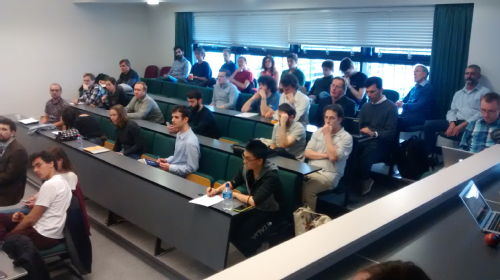
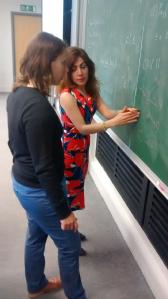
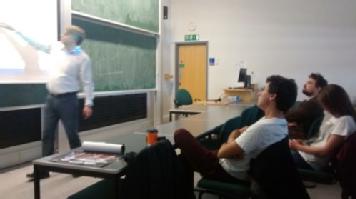
On June 1st 2015, our Division of Theory and Foundations, jointly with DIMAP, organized DIMAP Logic Day 2015. The goal of the event was to bring together the UK community of researchers and graduate students interested in the study of logics, automata and games.
The event had an outstanding list of invited speakers from leading academic institutions and research labs (Nathalie Bertrand, INRIA Rennes; Antonin Kucera, Brno; Slawomir Lasota, Warsaw; Davide Sangiorgi, Bologna, INRIA Sophia Antipolis; Sylvain Schmitz, Cachan, INRIA Saclay, Warwick; James Worrell, Oxford) presenting recent advances in logic in computer science, and attracted over 40 participants from the UK and abroad.
Graham Cormode and Dan Kral awarded ERC Consolidator grants

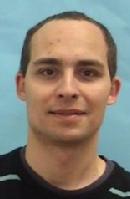
The European Research Council (ERC) has just announced that two Warwick Computer Science Professors, Graham Cormode and Dan Kráľ, have been among the winners of its Consolidator Grant competition. ERC Consolidator Grants is funding 372 top mid-career scientists with €713 million to pursue their best ideas, as part of the European Union Research and Innovation programme Horizon 2020. Grants are worth up to €2.75 million each, with an average of €1.91 million per grant. The funding will enable them to consolidate their research teams and to develop their most innovative ideas.
Graham Cormode has been awarded an ERC Consolidator grant for a project entitled "Small Summaries for Big Data". The project focuses on the area of the design and analysis of compact summaries: data structures which capture key features of the data, and which can be created effectively over distributed data sets. The project will substantially advance the state of the art in data summarization, to the point where accurate and effective summaries are available for a wide array of problems, and can be used seamlessly in applications that process big data.
Dan Kráľ has been awarded an ERC Consolidator grant for a project entitled "Large Discrete Structures". The project will advance theory of combinatorial limits, which combines methods from analysis, combinatorics, computer science, group theory and probability theory to analyze and approximate large discrete structures (such as graphs, which can be used to represent large computer networks). The project will lead to proposing new mathematical methods to represent such discrete structures and to applications of the new methods to specific problems in extremal combinatorics and algorithm design.