
Computer Science News
EATCS Fellowship for Artur Czumaj
Professor Artur Czumaj has been made an EATCS Fellow for "contributions to analysis and design of algorithms, especially to understanding the role of randomization in computer science”.
Dr Sylvain Schmitz joins DCS as Leverhulme Visiting Professor
The department and DIMAP are delighted to welcome Sylvain Schmitz from LSV, ENS Cachan, CNRS and INRIA Saclay, who has joined us this week as Leverhulme Visiting Professor.
Funded by the Leverhulme Trust, Dr Schmitz will spend 6 months at Warwick, collaborating with Dr Ranko Lazic and other colleagues on logics and games for algorithmic verification, and delivering three research lectures.
Warwick University to partner in new Alan Turing Institute
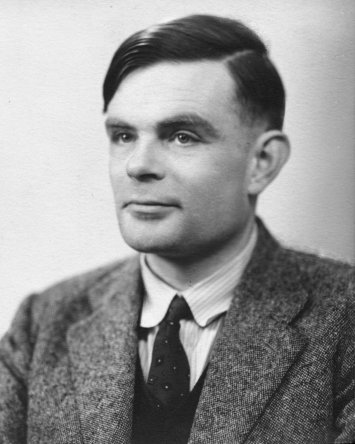
Warwick University is one of only five universities to have been considered worthy of establishing the prestigious £42m Alan Turing Institute for Data Science, thanks to our hard-earned reputation for world-class research.
This means our exceptional researchers from Mathematical Sciences will be at the forefront of the UK’s approach to big data. We’ll help the Institute to meet society’s toughest challenges, and strengthen the links between academia and technology industries.
Using the headquarters at the British Library in London as a base, we’ll use our research strength - as demonstrated by our excellent Research Excellence Framework (REF) performance - to fully exploit the trends and patterns found within huge data sets.
Warwick’s existing activities in data science are already significant. This includes two major EPSRC-funded Science and Innovation centres: Centre for Research in Statistical Methodology and the Centre for Discrete Mathematics and Applications. It also includes three of the new Centres for Doctoral Training (Oxford and Warwick Statistical Programme, Mathematics for Real-World Systems, and Urban Science and Progress), all of which will train highly qualified PhD students in big data and complex modelling. Warwick also holds 3 EPSRC 5-year Programme Grants relevant to this area, and is the only university in the UK to teach an undergraduate degree course in Data Science; Computer Science also leads the highly successful MSc in Data Analytics.
By working alongside the very best, we’ll make the UK a world leader in big data.
What does this mean for Warwick?
The Institute will bring together leaders in advanced mathematics and computing science from the five lead universities and other partners. Its work is expected to encompass a wide range of scientific disciplines and be relevant to a wide range of business sectors.
Professor Stephen Jarvis, Head of Department, Computer Science said:
We are delighted to have been selected as one of the five universities that will establish the world-leading Alan Turing Institute. Mathematical Sciences (Mathematics, Statistics and Computer Science) at Warwick are extremely strong; all three Departments are ranked in the Top 3 for research in the country.
The Turing Institute will be a magnet for world-leading research and application in data science. We are thrilled to be able to shape that future through Warwick’s engagement, and look forward to the many benefits to our postgraduate and undergraduate programmes as a result.
The announcement of our involvement in the Alan Turing Institute is undoubtedly good news, but what does it mean for Warwick? Professor Tim Jones, Pro-Vice Chancellor for Science, Engineering and Medicine explains:
It means Warwick is right at the top table in the area of data science. This is the UK’s strategic priority to pull together the best academics and other partners across the country to tackle the challenges of big data and to exploit the opportunities. There are four other universities in the Institute – Oxford, Cambridge, Edinburgh and UCL – and Warwick will be the fifth. I think that’s a great measure for the quality of our work in the area.
What is Big Data?
Big Data is one of the areas where our research excels thanks, in part, to our world leading mathematics, computer science and statistics departments. Warwick has long prized itself on using interdisciplinary and multidisciplinary approaches to answer the pressing questions of our time, and, as big data throws up such questions, that expertise comes to the fore.
Find out more about what Big Data means at Warwick
Or follow the conversation on twitter at #warwickturing
Cyber Games 3.0: Stockport School takes the prize again!
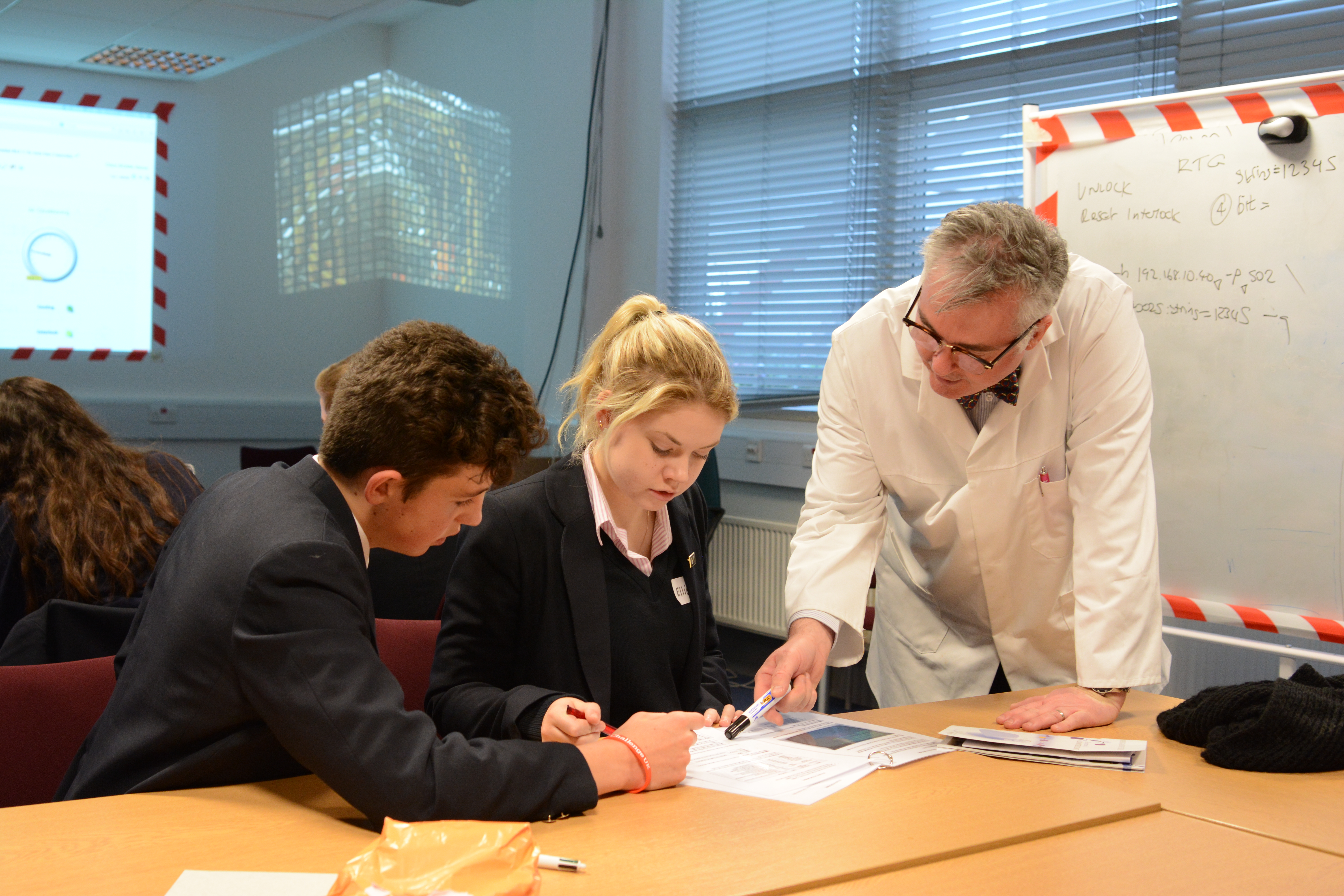
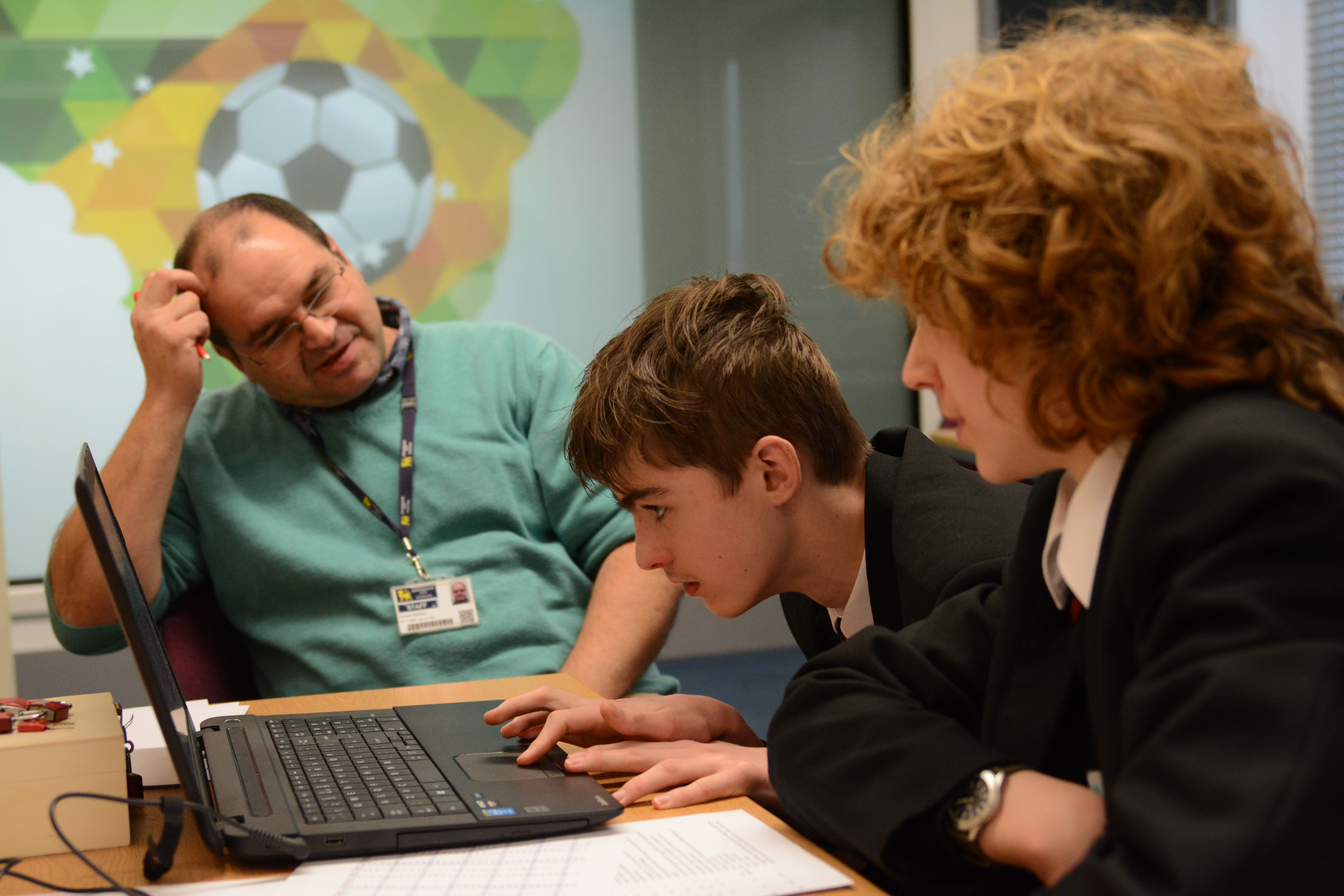
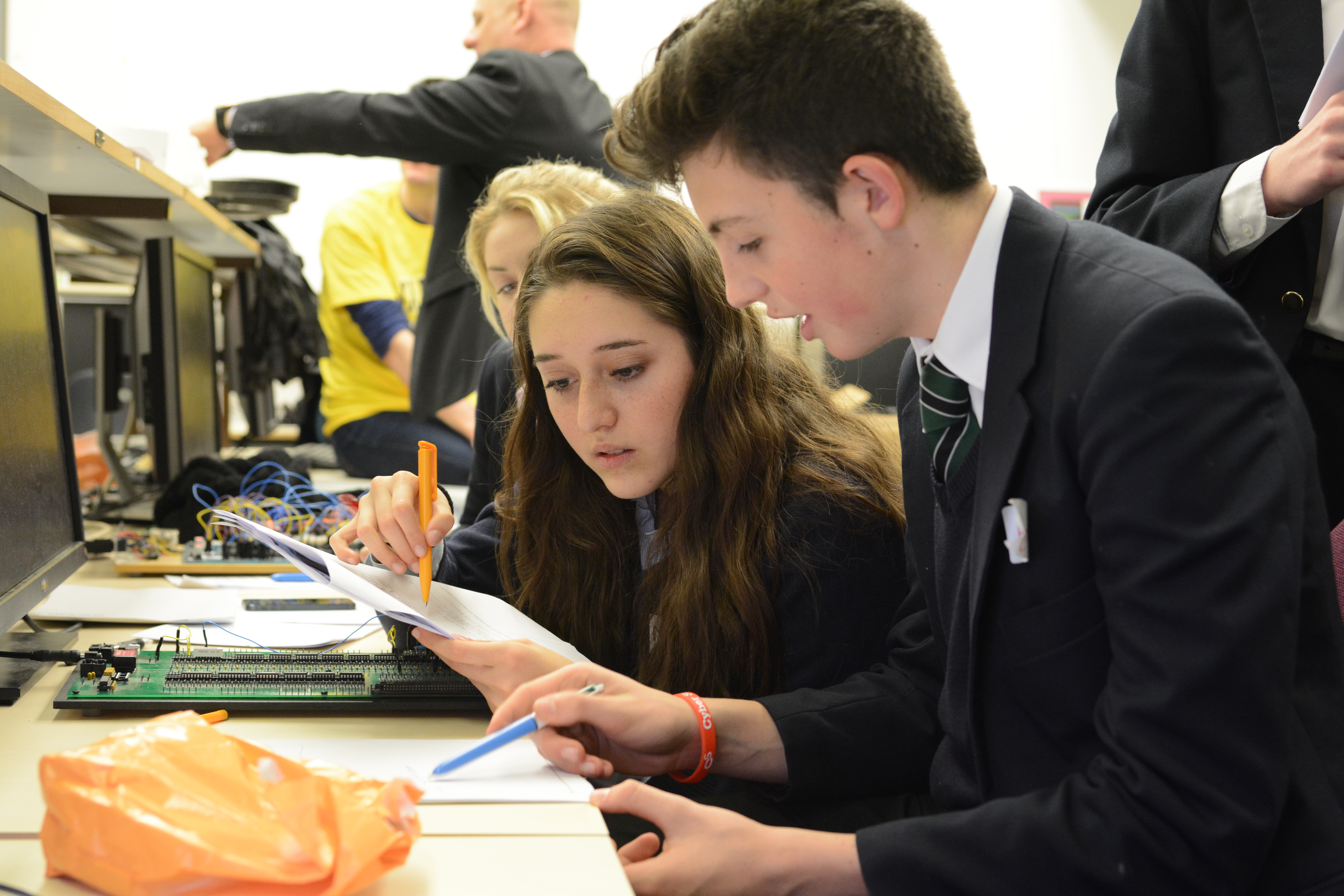
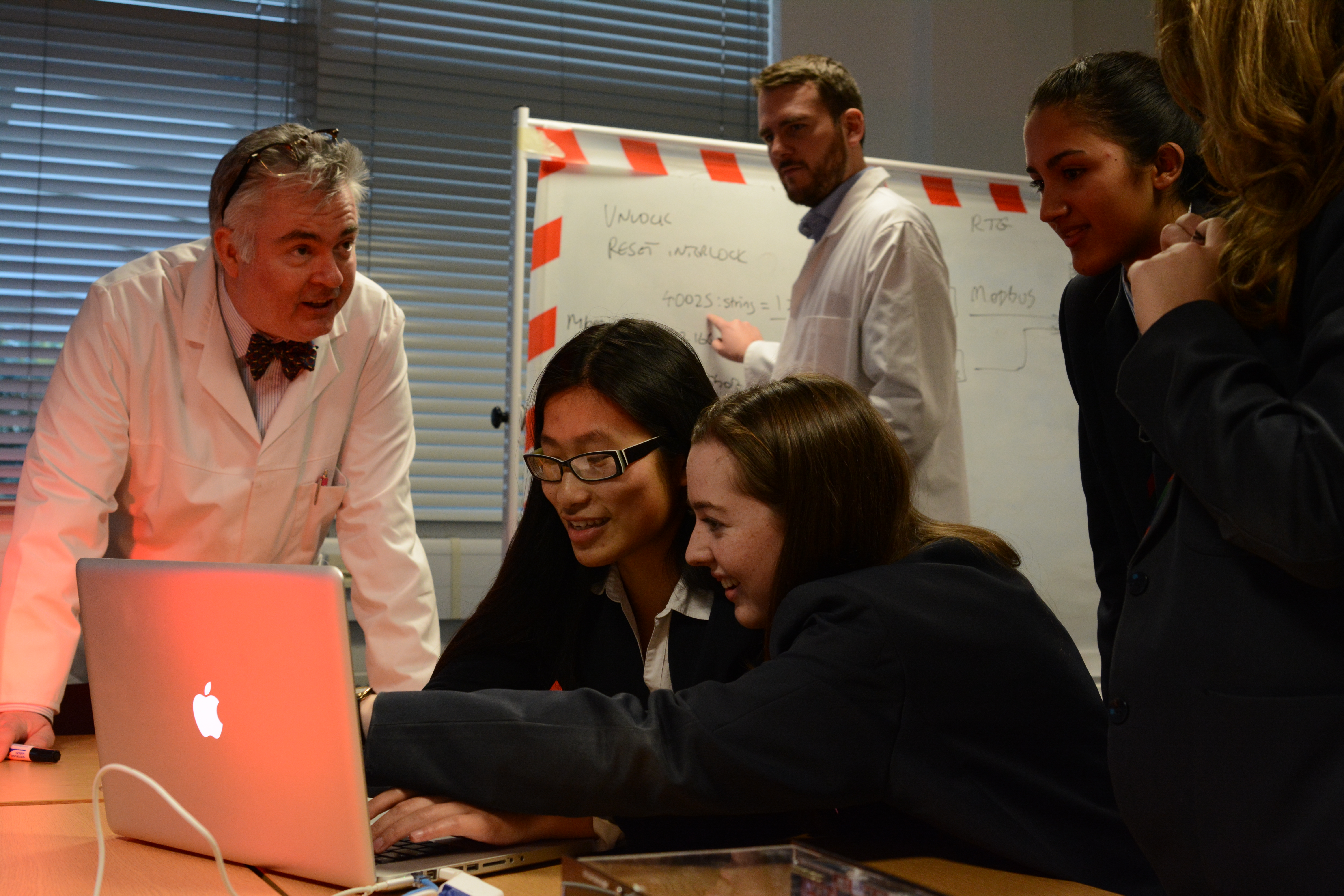
The final of the School Cyber Games, part of the Cyber Security Challenge’s programme for schools, saw Stockport School emerge victorious once again as UK Schools Cyber Security Champions. This was the third time the competition has been run, and the second time the final has been held at the University of Warwick’s Department of Computer Science.
The Cabinet Office-backed competition aims to raise awareness of the excitement of a career in cyber security amongst a new generation of young people in order to address a growing skills shortage in this sector, as well as help teachers tackle the huge changes being made in the computing curriculum in schools.
Eight teams of Key Stage 4 students overcame a series of fun code-breaking and cyber security themed challenges to claim top prizes, including a cash prize of £1,000 and Hexbug robot kits. There were two teams from Stockport School, as well as teams from, The Kings School (Chester), King Edward IV School (Chelmsford), Grimsby Institute, High School for Girls (Gloucester), Hailybury School (Hertfordshire) and Ysgol Maesydderwen (Powys). Each was selected after finishing as the highest scorers from schools all over the country who registered for the first stage of the Cyber Security Challenge’s Schools Programme, an online code-cracking competition.
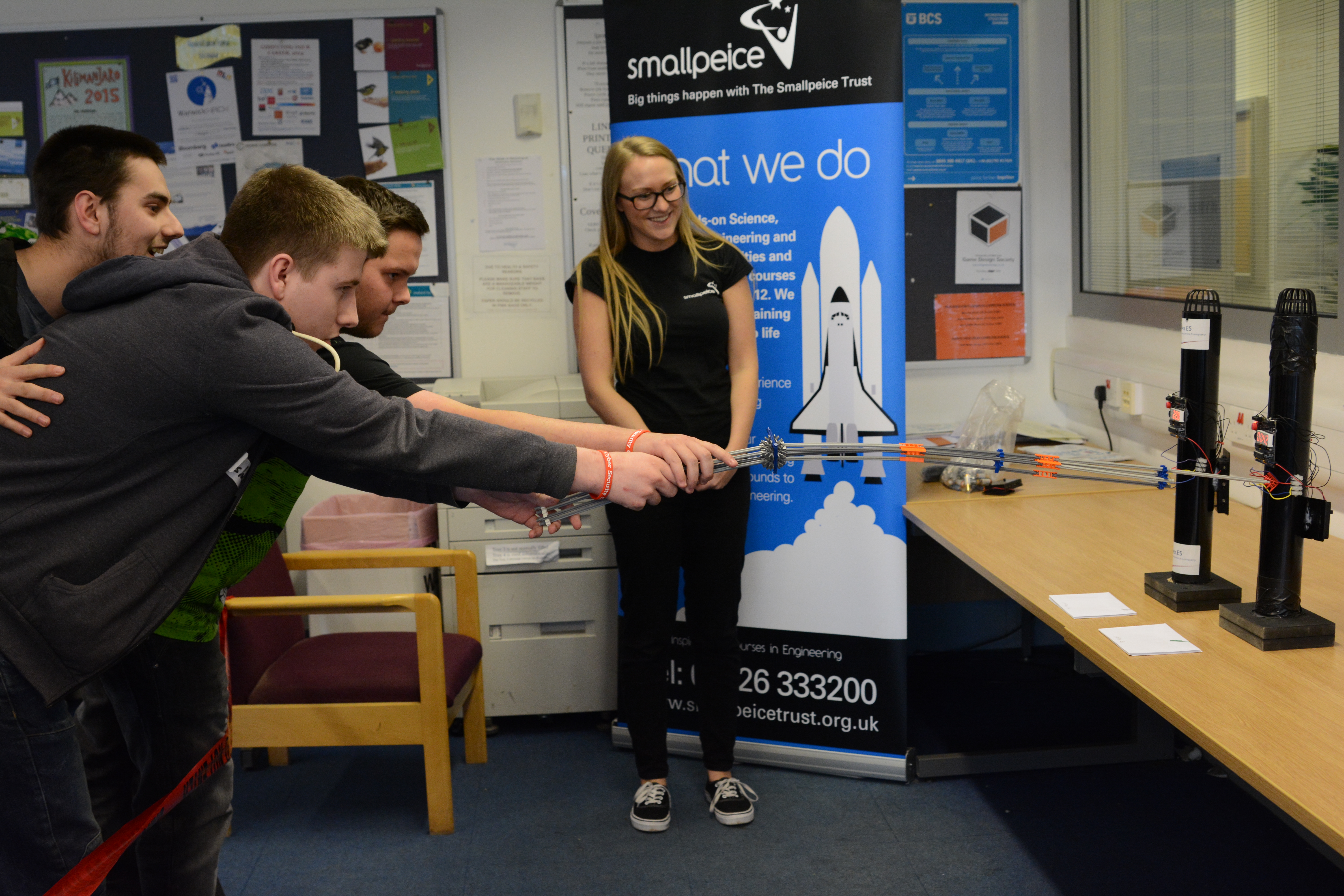
Each challenge was devised by experienced cyber security experts at Cyber Security Challenge sponsors and partners, including BT, Bletchley Park, Birmingham City University, the Cabinet Office, Cisco, CompTIA, MWR/Dataline, Raytheon, The Smallpeice Trust and Warwick Manufacturing Group. Brian Higgins, who co-ordinates the Cyber Security Challenge’s programme for schools, was the Gamesmaster.
On completion of these challenges, the teams then had to put together the clues completing each challenge had given them and crack one final code against the clock to discover the password needed to access the winning computer. The winning team from Stockport School managed to interpret the clues and discover the password in less than two minutes!
There was also a good deal of press attention, including a reports from Newsround and the Guardian (http://www.theguardian.com/education/2015/jan/06/computer-hacking-security-teaching-schools)


Warwick Computer Science Ranked 2nd in UK Research Assessment
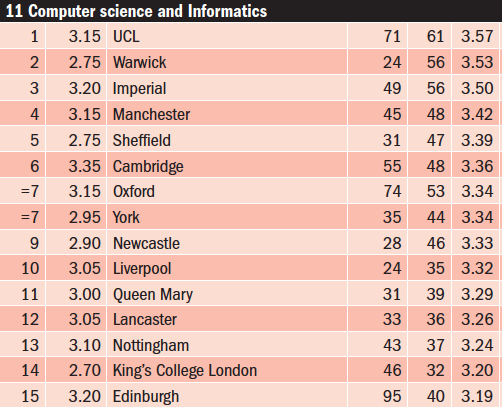
UK universities are evaluated on the quality of their research every six years. The results of the 2014 Research Excellence Framework (REF), announced by the Higher Education Funding Council today, rank Warwick Computer Science 2nd out of 89 UK computing departments.
REF assesses the quality of research outputs (academic papers, software, etc.) and the impact that this research has had (including improvements to society and business). Warwick’s output was ranked the best in the country, while its research impact was ranked joint second (with the University of Cambridge).
Professor Stephen Jarvis, Chair of the Department of Computer Science, commented:
We are delighted with this result. Warwick Computer Science produces world-leading research, both in the theoretical underpinnings of computer science and in its translation to real-world problems. Our work over the past six years has created new businesses, developed new standards, generated IP for new products, underpinned national security and defence, and impacted on social policy in education and health.
This result comes on the back of an excellent year. Warwick has been named University of the Year in The Times and Sunday Times Good University Guide 2015, and Warwick Computer Science was recently ranked as one of the best departments in the world in the 2014 QS Worldwide University Rankings.
Research Excellence Framework 2014: Institutions ranked by Subject
Further Information
Opening: Assistant Professor in Data Science
The Departments of Statistics and Computer Science are seeking a new Assistant Professor in the area of Data Science.
An enthusiastic individual is sought for this unique opportunity to be part of the newly created Warwick Data Science Institute (WDSI), which reflects the commitment of the Department of Statistics and the Department of Computer Science, in collaboration with the Warwick Mathematics Institute, to a coherent methodological approach to the fundamentals of Data Science and the challenges of complex data sets. In addition, the departments of Computer Science and Statistics have created a joint undergraduate degree programme in Data Science, which has recruited its first students in September 2014. You would be naturally involved in this exciting development, which constitutes the first course of its kind in the UK.
You will have knowledge of the current issues in Data Science and the drive to address them at a fundamental level while being part of a collaborative team from researchers across the mathematical sciences at Warwick. You will help shape Warwick’s research and teaching leadership in this fast-developing discipline. This is an opportunity to be part of an exciting collaboration between the Mathematical Science departments at Warwick.
Informal enquires can be addressed to any of Professors Mark Steel (M.Steel@warwick.ac.uk), Stephen Jarvis (S.A.Jarvis@warwick.ac.uk), David Firth (D.Firth@warwick.ac.uk), or Graham Cormode (G.Cormode@warwick.ac.uk), or to any other senior member of the Warwick Computer Science and Statistics departments.
You should have a PhD in Statistics, Computer Science or Mathematics or an equivalent qualification.
It is expected that interviews will take place in January 2015.
Start date: Flexible, although we expect the successful candidate to be in post by 1 October, 2015.
Professor Dan Král wins Philip Leverhulme Prize

Professor Dan Král has been awarded a Philip Leverhulme Prize for his work on combinatorial limits.
Philip Leverhulme Prize is awarded to outstanding scholars who have made a substantial and recognised contribution to their particular field of study, recognised at an international level, and where the expectation is that their greatest achievement is yet to come.
The research focus of the prize, the theory of combinatorial limits, is a recently emerged and rapidly evolving area of mathematics, which led to opening new links between analysis, combinatorics, computer science, group theory and probability theory.The analytic view of large discrete structures resulted in a substantial progress on many notoriously difficult extremal combinatorics questions. It also gave new understanding of aspects of important concepts such as regularity decompositions. Still, many fundamental problems remain widely open. A particularly challenging problem is finding a robust notion of convergence that would unify the existing notions for dense and sparse discrete structures. In relation to extremal combinatorics, problems of a great significance include a full description of low dimensional projections of the body of feasible limit densities or the existence of finitely forcible (determined) configurations in the extremal points of this body as conjectured by Lovász and Szegedy.