
Biomedical Data Analytics News
Multimodal Oncology Agent Study from TIA Centre Internship Wins ISBI 2026 Best Paper Award
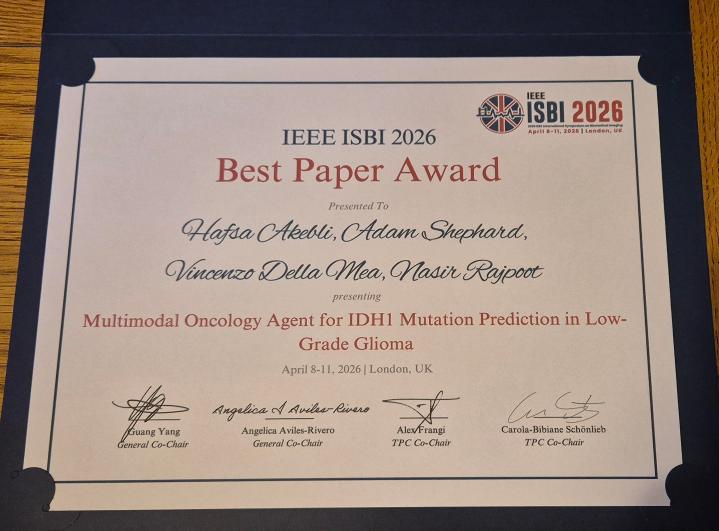
I am Hafsa Akebli, a PhD student at the University of Udine, Italy, and I carried out a two-month research internship between September and November 2025 at the Tissue Image Analytics Centre, University of Warwick, under the co-supervision of Professor Nasir Rajpoot and Dr Adam Shephard. During this visit, I worked on a multimodal oncology agent for IDH1 mutation prediction in low-grade glioma, in collaboration with my PhD supervisor Professor Vincenzo Della Mea. This work led to our paper “Multimodal Oncology Agent for IDH1 Mutation Prediction in Low-Grade Glioma,” which was presented orally at the IEEE International Symposium on Biomedical Imaging (ISBI) 2026 by Dr Adam Shephard. I was very happy to hear that our paper received the Best Paper Award, 1st Place, which was fantastic news for all of us. Our paper was also shortlisted among the Top 20 papers (out of 893 accepted papers from 2,069 submissions) at ISBI 2026. We were invited to submit an extended version of the paper for consideration in Special Section of a top-tiered journal on selected ISBI 2026 contributions.
In the paper, we proposed a Multimodal Oncology Agent (MOA) for IDH1 mutation prediction in low-grade glioma. On a cohort of 488 patient cases from the TCGA-LGG cohort, we combined diagnostic whole-slide images, somatic mutation profiles, and clinical records covering demographic, diagnostic, and treatment information. We designed MOA to reason over structured patient cases and call external tools, including PubMed for biomedical literature, Google Search for web evidence, OncoKB for genomic alteration annotation, and a histology tool developed for IDH1 mutation prediction using slide-level embeddings extracted with the TITAN pathology foundation model. The framework also included a retrieval component based on the MedITron clinical guidelines corpus, filtered for glioma-related documents and stored in a local Chroma database to provide additional medical context during the agent’s reasoning. The agent then integrated the selected tool outputs, retrieved evidence, and additional medical context into an MOA report supporting IDH1 mutation assessment.
To assess the additional value of the MOA-generated reports for IDH1 mutation prediction, reports were first generated for all 488 cases with the histology tool disabled to avoid leakage from the histology-based prediction. The reports were then encoded using a sentence transformer and compared with clinical baselines and the standalone histology tool. A complete agent setting was also evaluated by concatenating the MOA report embeddings with TITAN slide embeddings. The evaluation showed that MOA reports captured mutation-relevant information beyond clinical variables alone, while combining them with histology features gave the strongest performance, indicating that the overall MOA framework can integrate evidence-grounded reasoning with histology tool predictions for more accurate IDH1 mutation prediction.
This collaboration with Professor Nasir Rajpoot and Dr Adam Shephard was very enriching for me. I really appreciate their guidance and feedback, which continue to add real value to the work. We are now working together on the extended journal article, and I hope this will also open the way for further collaborations in the future.
By Hafsa Akebli