
Human-Centred Computing News
ICT PGCE course visits Computer Science
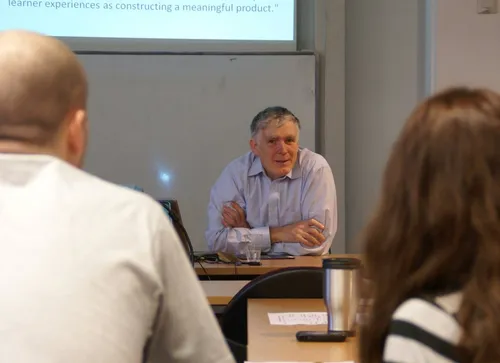
Steve Russ and Meurig Beynon hosted a visit to Computer Science from the cohort of students in Education who are on the ICT initial teacher training course (PGCE). Their lecturer (Mick Hammond) had asked if we could show them something of our 'alternative' approach to computing. Most of the time they were working through part of a workshop that Meurig used at the Constructionism 2010 conference in Paris last August. They were a lively group (about 15 of them came along including Mick himself) and from several discussions it was clear what a very wide-ranging and challenging task an ICT teacher has in today's schools. Some of these budding teachers had worked in the software industry, almost all had a first degree which contained significant programming work. They were just off to do another six weeks of teaching practice in local schools. Whether there would be opportunity, or support, for teaching any programming in their schools, or in their first jobs, appeared to be very uncertain - indeed the desirability and relative importance of such teaching was clearly problematic to many of them. The issues are truly complicated with many stakeholders all pulling in different directions and the Government currently reviewing ICT in a fashion which some feel will weaken support for it further. In such a climate it is clearly very important for the discipline of computing (if there is such a thing) that we can clearly distinguish ICT and computing, and that pupils, parents, teachers and politicians all understand the distinction. The Computing at School movement is working hard to achieve this (among many other worthy aims). They are sponsoring our 6th form conference coming up in March.
Students Visit IBM Hursley
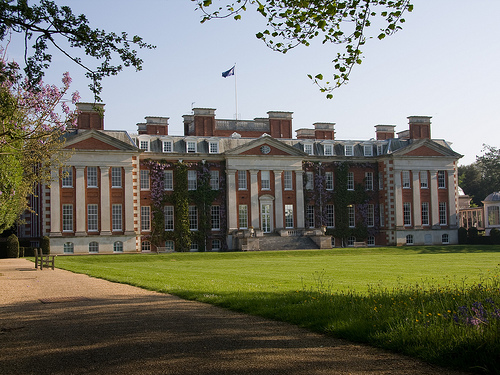
In recent years IBM have regularly invited a group of Warwick computer science students to an 'open day' event held at
their research centre at Hursley. A couple of weeks ago a coach-full of our students (from 1st years to 4th years) attended this year's event. One of those attending, Alex Wilson, picks up the story ...
"After arriving in Hursley we were shown around the beautiful grounds of Hursley House before being introduced to IBM staff and facilities. The Galileo Centre, where we spent most of the day, was filled with interesting exhibitions and demonstrations of technology such as facial profiling and uses of RFID tags. The staff gave us presentations on current technologies and uses, such as in the SMARTer planet scheme – including one employee who had integrated public monitoring with his house through Twitter! During lunch we were able to have personal chats with IBM’s Master Innovators, the people who design the new innovations in technology.
The last part of the day was splitting into groups and working on our own “innovations” – we gave a presentation on uses and how we’d implement it to the rest of the students who came and IBM’s own panel of judges. The winning team received iPods as prizes. The entire day was very fun, interesting, and well worth doing again. A big thank you to IBM for their time and hospitality!"


(Outside Image credit Simon Greig, release under Creative Commons)
Bicentennial Celebration of the Work of Hermann Grassmann (1809 - 1877)
Last week (17th January 2011) saw the publication by Birkhäuser of the Proceedings of a major conference held in 2009 in Potsdam and Szczecin in honour of Hermann Grassmann. The major organiser was Hans-Joachim Petsche (Potsdam) but Steve Russ was a co-organiser, along with Jörg Liesen (Berlin), Albert C. Lewis (Austin, Texas) and Franco Ferrari (Szczecin, Poland). In November 2010 the conference was the first-time winner of a prize awarded by the Brandenburg state for 'Innovative and/or exceptional events'.
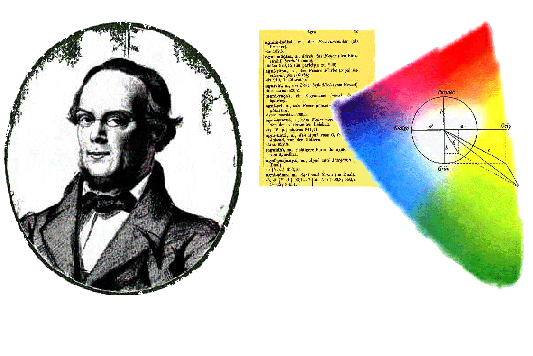
Hermann Grassmann was author of a work 'Extension Theory' (1844 and 1862) which contained much of the theory of vector spaces and linear algebra in a remarkably abstract and modern form which was a forerunner and direct influence for the vector and tensor calculus developed later by Gibbs, Heaviside and others, on Clifford algebras and on the differential forms of E. Cartan. Several papers at the conference testified to the continuing influence and fruitfulness of Grassmann's ideas for mathematics and computing, especially for the visualisation of crystallographic structure and to geometric algebra computing.
The conference saw the publication of an English translation of Petsche's biography of Grassmann for which Steve Russ was a consultant. Steve was a co-editor of the Proceedings volume to which he also contributed a paper 'Concepts and contrasts: Hermann Grassmann and Bernard Bolzano'.