
Life Underwater
Oceans cover seventy percent of Earth’s surface area. A complex landscape of mountains and valleys, plateaus, plains and deep dark trenches is all hidden under a fluid layer that, from the perspective of most of the Universe, is only slightly denser than our deep ocean of atmosphere. Throughout human history, we have harvested the shallows, and looked with curiosity at the deeps. Perhaps unsurprisingly, science fiction has explored the idea that we, as humans, might occupy and exploit the deep oceans.
Indeed, I’ve already looked in Cosmic Stories at the fiction of human adaptation (medical, genetic or technological) to water-breathing, and also at the super-submarines that might open the ocean depths to exploration. An entirely different blog entry could (and may) also be written about alien species under the sea, non-human life, or life on ocean worlds, and I’ve already discussed the kind of surface life that might result from a flooded Earth. Here though, I want to focus on the narratives of human settlement under Earth’s ocean and the questions they pose.
Undersea Outposts
The development of submarines into a reliable and mature form of transport in the twentieth century, and particularly the construction of nuclear submarines which could remain submerged for months at a time, brought the idea of human ocean settlement into the mainstream for the first time. Perhaps unsurprisingly, a number of narratives focussed on the early stages of the process - the need to establish outposts that would develop and refine the technologies required for independent living at depth.
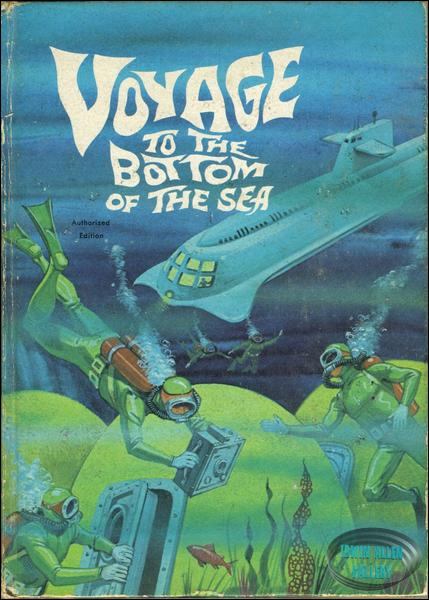
The television series Voyage to the Bottom of the Sea (TV, 1964-1968) is remembered for its super-submarine, the USSN Seaview, its representation of both nuclear fears and nuclear power optimism, and, in the later series, for its more bizarre monster-of-the-week plots. However some of the more intriguing stories instead focus on Seaview’s primary role as a research vessel designed to complement and enhance human ocean utilisation. In the course of the series, Seaview visited a number of underwater settlements which took the form of pressurised capsules occupied by scientists, eccentrics or even small communities. Amongst these were an underwater base occupied by an android attempting to drill a mohole, another in which a scientist was attempting to create fully-aquatic humans and others which were designed for underwater farming or mining.
The personnel of these bases were typically very small - although in part this was likely due to pressure on costs for employing actors and for special effects. The few individuals in each location were also typically resupplied (either with food or oxygen or other consumables) by Seaview or other vessels. However the assumption that these are the stepping stones towards fully submerged communities is clearly demonstrated. An interesting example can be found in the Voyage to the Bottom of the Sea spin-off novel aimed at young readers, written by Raymond F Jones. This begins with Seaview investigating a disastrous earthquake which destroys an “oil city on the continental shelf, nine hundred feet below the surface”. While the “city” in question appears to be staffed by entirely male workers, and hence not a true residential settlement, it features individual pressurised accommodation buildings, and a range of other facilities.
The same sort of small-scale outpost, with a small staff and somewhat dependent on resupply but making efforts towards a closed ecosystem, can be found elsewhere, often in the hand of science-fictional supervillains, for whom their isolation and defensibility appeals. In the James Bond film The Spy Who Loved Me (movie, 1977; dir: Gilbert), the inevitable obscenely-rich-technological-genius antagonist, Karl Stromberg, occupies an underwater base he calls Atlantica in which he aims to sit out a nuclear winter of his own making, and from whose residents he hopes to build a better civilisation. In the UK children’s television series City Beneath the Sea (ABC Television, 1962, written by John Lucarotti), by contrast, the underwater base of Aegiria proves to be a hidden Nazi U-boat base which survived into the post-WWII decades. With its existence revealed by journalists Mark Bannerman and Peter Blake, and the Nazi threat eliminated, Aegiria is later converted to a civilian use as the focus of a mohole project in the sequel serial, Secret Beneath the Sea. Like Atlantica, and by design, Aegiria was able to support a substantial population with minimal contact with the surface, and did so for decades, but was never designed as a truly civilian settlement.
In both these stories, the focus is on the antagonists’ plans for the land and its consequences; although the ocean bases feature prominently, their properties aren’t explored in detail.
By contrast, some of the great science fiction writers took a more serious look at the issues of long term subaquatic settlement and its role in expanding human horizons.

Arthur C Clarke introduced an experimental ocean environment, Deep Sea Lab One, in his 1953 novel Childhood’s End. In this story, aliens appear on Earth, taking control and forbidding space exploration, for reasons initially obscure but soon appearing to focus on humanity’s children. Amongst the few scientific endeavours not seriously impacted by the presence of the alien Overlords is the underwater study of Professor Sullivan:
“A cluster of spheres standing on tripod legs, and joined together by connecting tubes. It looked exactly like the tanks of some chemical plant, and indeed was designed on the same basic principles. The only difference was that here the pressures that had to be resisted were outside, not within.” (pg 102).
While Clarke’s protagonist is a thwarted space explorer, and refuses to see ocean exploration as an acceptable substitute, the true irony here is that the future of exploration for humanity in this novel lies beyond the physical plane entirely.
Indeed Clarke usually focussed on space for colonisation and tended to see the oceans as a frontier and farm for essentially Earth-bound humans. By contrast his fellow author Isaac Asimov presented a more impassioned defence of underwater exploration as an experiment in human habitability. Waterclap, for instance, is a short story (originally published in April 1970 in Worlds of IF magazine) in which Asimov describes a lunar colonist visiting a deep ocean research settlement for the first time. With budgets squeezed almost to the point of non-viability, the visiting space man contemplates a dramatic solution to eliminate the oceanic work as a rival for funding. In the resulting confrontation, the residents of the oceanic colony are forced to make an impassioned defence. Not only do they point out that many of the techniques for living in a closed biosphere developed there can be exported to the Moon, but also that space exploration will involve many environments which have similar requirements for resisting pressure (as in the oceans) rather than keeping it in (as in vacuum). They highlight the atmospheres of gas giants (potentially lucrative mines for volatiles), although they could extend the argument to the oceans now believed to lurk beneath the surface of several of the Solar System’s larger ice moons.
Asimov’s key argument was that explorations of both new environments would ultimately be required, rather than a choice between them. However his conclusion does little to solve the dilemma of from where the requisite funds to support both settlements will come.

A different perspective can be found in Once by Angels Seen, a short story by a slightly less well-known but nonetheless respected science fiction author, Gordon Eklund, which appeared in Galileo magazine in July 1977. This described the same kind of dilemma over funding an underwater scientific research outpost - in this case a pyramidal structure encased in a deep sea dome. Again the protagonist is a former astronaut - in this case, the lone survivor of the first mission to Mars. However in this story the compelling argument being made for the continued funding of the Atlantic Station Three isn’t the aid that it can lend to the space programme, or even undersea farming (although this is mentioned) but the importance of exploring the oceans in their own right, and particularly the tantalising possibility of identifying a well developed but very different form of intelligence in the giant squid of the depths - alien minds on our own planet.
Aquaculture and Resource Utilisation.
One stage beyond the construction of experimental or scientific research outposts under the oceans is the concept of deep ocean resource utilisation, as enabled by small underwater settlements.
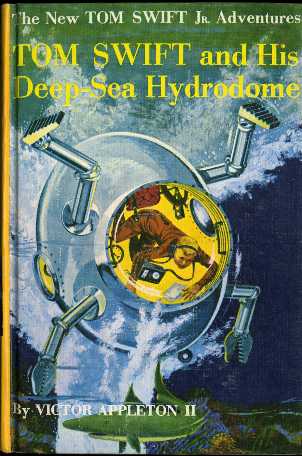
In many fictions, the availability of mineral resources on the ocean bed, or to be filtered from the water, is the driving factor behind establishing a settlement - as we saw in the case of Voyage to the Bottom of the Sea. This, for example, is the motivation in Tom Swift and his Deep-Sea Hydrodome (novel, 1958, Victor Appleton II), which is built to tap an underwater helium geyser - an interesting variation, since helium is both extremely useful and rare on Earth. Oil, coal and metal prospecting form part of the background story for many of the cases already discussed and others which will be mentioned later. However the organic resources of the ocean bed are also significant. Underwater farming to feed an overpopulated surface is the motivating factor in many narratives, as for example in Kenneth Bulmer’s The City Under the Sea (novel, 1957; in which characters are forcibly converted to gill breathers in order to farm).
Arthur C Clarke, already discussed in the context of Childhood’s End, was a keen diver and returned to the ocean elsewhere in his work, notably in The Deep Range (novel, 1957), in which the oceans are harvested for food. To some extent, the protagonist in The Deep Range echoed Asimov’s Waterclap in that he was originally a space explorer inclined to see ocean exploration as a poor second best to outer space, in this case having developed agoraphobia as a result of an accident. However his journey through the novel emphasises his increasing recognition of the importance of the oceans, and the attraction of working underwater in its own right. He discovers a world in which his three-dimensional navigation and skills are equally valuable, and in which marine life is farmed both through plantations of seaweed and through management of migrating herds of fish or cetaceans.
However despite working, and sometimes living, underwater for extended periods, the aquatic farms in The Deep Range are overseen by essentially terrestrial farmers and for the benefit of the starving masses of Earth’s continents (who are fed on seaweed and algae derivatives). The settlement of the ocean for its own sake is incidental at best.
Underwater farming is a key element of many other novels of the mid-twentieth century which address themes of overpopulation and resource exhaustion, and a background feature in many others. Most undersea settlements in science fiction are described as supporting themselves with aquaculture, and many are specifically established, as was the case in The Deep Range, with the goal of feeding the surface population.
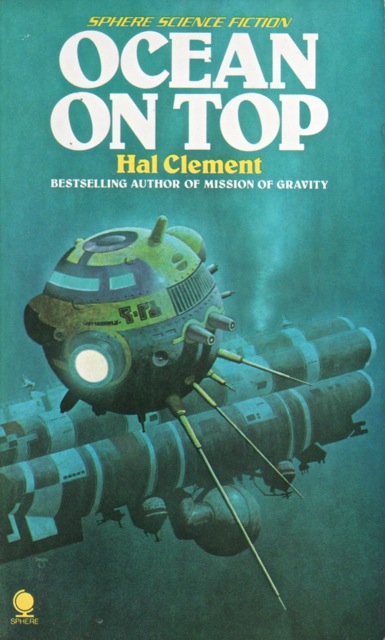
An interesting example of such a small-scale underwater farming settlement can be found in Ocean on Top (Novel, 1976; based on a 1967 magazine serial in Worlds of IF) by hard science fiction writer Hal Clement. This describes a future in which power rationing has become more important than national identity or personal wealth. The protagonist is a member of the Board for power control, newly arrived (against his will) at a secret undersea settlement descending from those who’d tried to escape rationing by finding an alternative way of existing several generations earlier. He views this with suspicion, and the novel describes his attempts to investigate the settlement while assuming that the quality of life in the settlement must be associated by clandestine illegal power consumption. However there proves to be no power excess, merely a self-supporting and closed biosphere of around fifteen thousand people tapping geothermal energy.
As might be expected from a writer of hard SF, much of the focus is on how this group survives, breathing an oxygen-rich liquid which is refreshed by algal photosynthesis. While this enables the group to be self-sufficient, it does limit settlements of this kind to the shallow continental shelf, where light can penetrate to the bottom of the water column, and the protagonist concludes, as others from the Board had done before him, that there was nothing to be gained by sharing word of the utopian settlement with the energy-starved masses.
Cities under the Sea
While many of the undersea mining settlements in fiction begin purely as industrial (and often purely masculine) locations, many fictions suggest that providing residential areas for families would follow and inevitably result in children born underwater, auxiliary services and personnel and eventually a full city infrastructure.
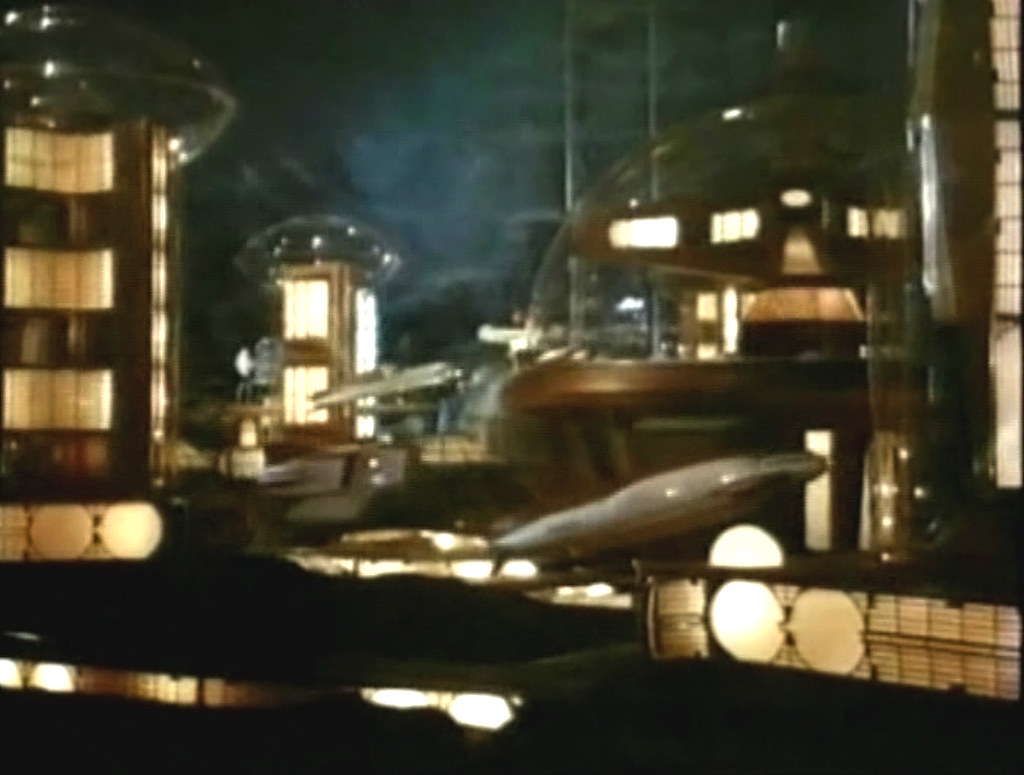
In many science fiction examples, such as in Irwin Allen’s 1971 made-for-television movie City Beneath the Sea (and indeed the unrelated 1962 ABC children’s drama of the same name), the narrative focus is on the establishment and travails of a single large city. Allen’s movie, originally intended as the pilot for a never-commissioned television series, focussed on the newly-established underwater multi-domed city of Pacifica. Rather than being a converted mining station, this is constructed with a large civilian population in mind, including engineers, contractors, scientific researchers and dependents (including children). Themes include deaths due to construction accidents and ultimately a threat from a meteorite (of all things) that seems likely to hit the city. While this last is relatively implausible, the dangers and difficulties of building an entirely new infrastructure and way of life under the waters are a running theme.
This wasn’t a new idea by any means. The early proto-science fiction magazine Science and Invention (edited by SF pioneer Hugo Gernsbach) included a short story called Dr Hackenshaw and the Secret of the Submarine City in January 1924. One of a series of stories by Clement Fézandie which followed the eponymous inventor and his friends, this described a secretly constructed undersea dome, dubbed Submarina:
“To say that Silas was amazed would be to put the matter mildly! He could scarcely believe his eyes as he went from one surprise to another. The streets were filled, not only with laborers, but with clerks, stenographers and other professional people, and even with children. Theatres, moving-picture shows, restaurants and ball rooms advertised their various attractions.”
It’s fascinating to note that, unlike many other stories, this was set in the relatively shallow waters of the North Sea, rather than the deep oceans, and described the discovery and exploitation of North Sea oil wells, as well as extensive aquaculture and underwater coal and mineral mining, many decades before the petrochemical resources of the North Sea was opened for exploitation. Despite its practical objectives however, Submarina is clearly a settled residential community - at least until the catastrophic events which result in the dome flooding at the end of the story.

Set even earlier, although written later, is Captain Nemo and the Underwater City (film, 1969, dir: James Hill), a follow-up to Disney’s earlier successful adaptation of Jules Verne’s 20,000 Leagues under the Sea.
Here a group of shipwrecked survivors are taken by Nemo to his secret domed city of Templemer, where they find a large civilian population of women and children, as well as aquaculture farming and extraction of air and drinking water from sea water (in a process whose waste product is a gold supply so abundant that it is treated as disposable!). Written as proto-steampunk science fiction adventure, the setting here is the nineteenth-century US civil war era. The narrative focus is on the attempts of the survivors to escape Nemo’s benign captivity, although aspects of underwater life are demonstrated, as is a planned expansion into multiple, still larger domes. However everything is threatened when a claustrophobe amongst the shipwrecked group attempts to escape, causing significant damage - although not, in this case, total destruction.
Unfortunately catastrophic dome disasters are common in science fiction. Amphibia City, the titular settlement in the 1962 feature film The Underwater City, to consider another example, is funded in the interests of both aquaculture and providing a first line of military defense, but also at the behest of visionaries. As one of the driving characters notes, while trying to persuade a sceptical engineer that the effort is worthwhile, “Outer space may be more glamorous at the moment. Makes bigger headlines. But in terms of the destiny of mankind, the future, inner space - the undersea world - is infinitely more important than outer space can ever be!”
As with the much earlier story, while initially establishing a viable settlement, the venture is ultimately doomed, in this case proving to be built on unstable ground.
While many of the narratives mentioned thus far describe a single isolated domed city, other fiction considers the possibility of a more extensive and developed undersea culture - often derived from the early outpost and mining stage.
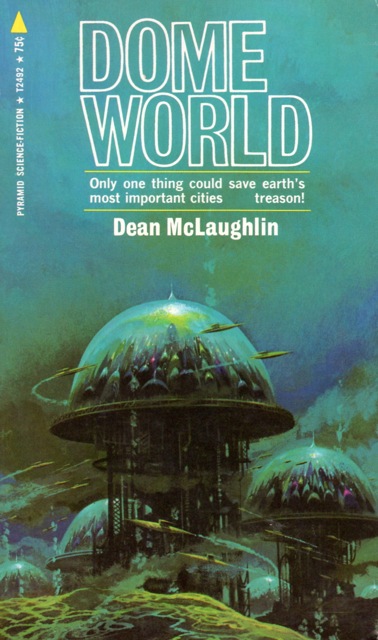
An interesting narrative of such a transition can be found in the 1962 novel Dome World by Dean McLaughlin. The first part of this novel (based on the short story The Man at the Bottom, published in Astounding, March 1958) describes the point at which the domed undersea cities, established primarily as mining bases but hosting civilian populations, realise that asserting independence is the only way they can survive a war between surface nations struggling over territorial claims on undersea resources [1]. As they point out, the incompressibility of water means that direct hits on domes are not required - a powerful explosion anywhere close to a dome would create a pressure wave capable of cracking it. As a result, they have a powerful motivation to assert their independence of (and neutrality in) surface conflicts.
The second part of the novel jumps forwards several decades to a time when the original city domes, now forming a nation-state league, have been complemented by suburbs of small domestic residential zones in private ownership, and when tensions with the mainland are once again rising in temperature. Again the question of sovereignty - how far the territorial and mineral rights claims of any dome extend, and whether a tiny private residential dome has the same rights as a city dome - is central to the tension. In this scenario the mainland is entirely dependent on the deep oceans for mineral resources, particularly rare earth metals, after their depletion on land. On the other hand, those in underwater cities have other priorities and more in common with one another than with land-dwellers of the same nominal nation state.
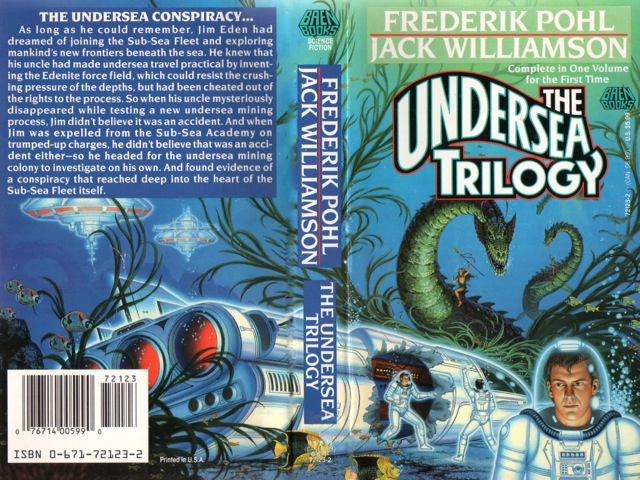
The Undersea Trilogy by Frederick Pohl and Jack Williamson (juvenile novels; Undersea Quest, 1954; Undersea Fleet, 1956; Undersea City, 1958) also considers a scenario only one generation into sub-ocean settlement but nonetheless established and relatively advanced. The protagonist, Jim Eden, is the teenaged nephew of the man who invented Edenite - a wonder material which allows materials to resist deep ocean pressures as long as a current runs through it [2]. Each of the three books follows the same general pattern as many similar coming-of-age science fictions set in space (as exemplified by Robert A Heinlein’s Space Cadet; juvenile novel, 1948). Jim Eden experiences the strict-but-stirring military discipline of a year at the subsea fleet training academy (a supranational but nonetheless military body which appears to be loosely affiliated with the United Nations), discovers some mystery involving his Uncle Stewart, and goes off on an adventure helped by a small group of friends and hindered by opponents including the sons of men obsessed with money or self-interest. Incidents along the way involve dealing with pressure, 3D submarine chases, the vast distances of the oceans and the perils of volcanic rifts.
Despite its relative youth, the undersea culture in these books is extensive, with a new sub-ocean nation state, Marinia, as well as many independent and substantial domed cities. Krakatoa Dome, encountered in the third novel, is described as home to three quarters of a million people, which proves to be a problem when the populace is faced with an urgent need to evacuate. The domed cities are illuminated by ‘troyan lights’ (implied to be akin in some way to neon bulbs), and most are able to process and recover their own oxygen in a closed system. Most are also described as being surrounded by undersea farms (and/or mines), although to what extent the majority of the cities are self-sufficient remains unclear. Despite the mentions of Marinia, and the presence of mayors and elected councils, it is also unclear how uniform the democratic processes are in different domes, and it is certainly apparent that in several locations these processes are corrupted by monetary considerations or by selfish power grabs.
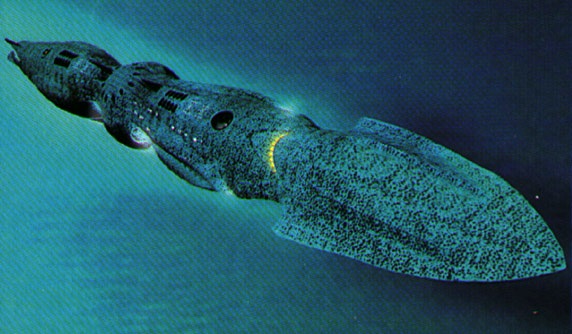
The nascent undersea culture seen in the television series SeaQuest DSV (TV, 1993 - 1996) is similarly ambitious. This series focuses on the titular submarine and her crew, who serve a joint military and exploratory role, occasionally supporting underwater outposts, similar to that of the earlier USSN Seaview in Voyage to the Bottom of the Sea. However while Seaview was a decidedly American vessel, SeaQuest DSV falls under the authority of the United Earth Oceans organisation, or UEO. This is presented as a successor to the United Nations, developed specifically to oversee and maintain peace in a world where the sea floor has been extensively settled - initially by terrestrial nation states and then by spreading undersea settlements. Like many other such scenarios, the initial motivation for underwater establishments was undersea mining and resource utilisation, but territorial issues and disputes led to alliance and nation states becoming established under water. As in The Undersea Trilogy and Dome World, the series is set within the first generation or two of sub-ocean settlement, with conflicts and disagreements on how the situation should be managed - the UEO itself is brand new at the start of the series and was formed as the result of a military clash.
What’s interesting here though is the recognition that a more formal supranational organisation, with its own military and investigation service (which bears comparison with Star Trek’s Federation and Starfleet) might be needed. The balance between authority, exploration, military action and protection of individual liberties is a constant challenge to the crew of SeaQuest and its captain.
Life Underwater
Throughout the science fiction of undersea settlements, common themes emerge.
The first is the fascination with the technical challenges of underwater dwelling. Power supply is crucial in many cases - the deep oceans do not receive any solar irradiation and thus exist in an energy deficient environment. The identification of geothermal power as a possibility helped inspire several examples, notably Clement’s Ocean on Top, and this possibility was boosted by the discovery of deep ocean smokers (hydrothermal vents) in the 1970s. However another power source helped feed the boom in underwater settlement narratives in the 1960s. Many of these narratives fit firmly in the genre of atomic futures, with its optimism about the opportunities opened up by the prospect of cheap, reliable and safe nuclear power, particularly following the launch of the first nuclear powered submarines.
Power is not the only technical requirement for such dwellings. Equally essential is the identification of materials or methods to resist the colossal pressure of the depths, which reach four hundred atmospheres, or almost half a tonne per square centimetre. Most of the narratives discussed here invoke innovative materials, such as Pohl and Williamson’s Edenite, or force fields as in Tom Swift’s repelletron. These are in the long tradition of imaginative materials in science fiction (as I discussed in the context of unobtainium, neutronium and metallic hydrogen in an earlier blog) and show both a recognition of the limitations of our current technologies and a confidence that these limitations will be overcome.
Equally important as a technical challenge is the design and maintenance of closed environments, in which oxygen, carbon dioxide, moisture and all the waste products of humanity (as well as fungal growth such as moulds and potential pest infestations) are controlled. As we’ve seen in the context of space, this remains a challenge which we are yet to fully meet, and while many of the domed underwater settlements described here aspire to self-sufficiency, often through algal photosynthetic air recycling, it’s clear that many of them rely on regular interaction with the surface - notably including a city in Pohl and Williamson’s Underwater Trilogy which is actually constructed with giant snorkels reaching the surface.

Such snorkels may be possible in shallow waters, given sufficiently robust and flexible materials, but would be an undoubted vulnerability. Another such vulnerability comes in the need to maintain a watertight and rigid shell - which renders underwater settlements particularly vulnerable to the risk of nearby volcanism, tectonic instability, or even human-generated explosions, which might fracture the shell with catastrophic results. Unlike on the surface, a relatively minor event can result in extinction for entire populations rather than just a handful. While there are stable regions in the Earth’s oceans, none are invulnerable to quakes (as formed the theme of Undersea City), human aggression (as in Dome World), or human error (as was the case for Templemer in Captain Nemo and the Underwater City or Amphibia in The Underwater City). Given the difficulty of evacuating a large underwater settlement (particularly one that has been kept secret and so has limited egress routes or transport capacity) in short timespans, any of these could be disastrous.
However other themes put less emphasis on the difficulties of underwater settlement and more on its importance.
Running throughout the fiction of the twentieth century is an assumption that population density will rise uncontrollably, and that overpopulation will result in famine and warfare. Recurrent in underwater fiction is the observation that the ocean floor provides substantially more living area than the entire surface area of Earth’s continents, and that both the seabed and the layers above it can be farmed, providing extensive protein and vegetable resources. This, together with the desire for underwater mining and the need of such a large population for additional resources, can be seen as early as Fezandie’s 1924 Secret of the Submarine City, and continued to motivate fiction through to the end of the century.
However alongside this pressing need for more space and resources comes a theme which is still resonant today: the question of ownership, sovereignty and national interest as it applies to the oceans. This, and the resulting conflicts, drive the narrative of Dome World, and lie in the background of many of the other stories discussed here. As recently as January 2026, the Agreement under the United Nations Convention on the Law of the Sea on the Conservation and Sustainable Use of Marine Biological Diversity of Areas beyond National Jurisdiction (or High Seas Treaty) came into force, representing the latest attempt to establish a convention regarding these issues.
With the development in recent decades of plans for increasingly autonomous computer-controlled deep sea mining systems, as well as constant international tension in this area (particularly in regions of Asia), it is clear that many of the questions regarding ocean sovereignty have not been resolved. The focus of the treaty is on biodiversity and environmental protection, the attempt to establish the oceans as something of a human commons (i.e. part of the common property of humanity rather than one nation) has much in common with the attempts of the UN’s Outer Space Treaty to do the same - and faces similar challenges in terms of enforceability and the activities of private commercial interests. It’s interesting to note that later stories, such as Eklund’s Once by Angels Seen or the adventures of SeaQuest DSV tended to lean a little more towards protection of the oceans and the wonder of exploring them in their own right, rather than simply as resource wells to be mined. They also tended to assume that the traditional United Nations would fail to meet the challenge, and a new ocean-focussed organisation like SeaQuest's UEO would be required.

As exemplified by the treaties mentioned above, the parallels between the oceans and outer space form yet another running theme in this fiction. Particularly in the peak Space Age era of the 1960s, but more generally throughout, narratives of underwater settlement have been developed in parallel to those of space exploration and settlement. Sometimes, as in Asimov’s Waterclap, this parallel is made explicit. Indeed, ex-space personnel (including the protagonists in Clarke’s The Deep Range or Eklund’s Once by Angels Seen) are over-represented in the literature discussed here, as, in fact, ex-submariners are similarly over-represented in space literature. The same combination of three-dimensional thinking, technical expertise, courage and adventurous motivation is required in pioneering both environments. Many of the challenges are also similar: the need for enclosed, pressure-resisting, self-sustaining environments with all the material and human issues related to that. However other challenges are different, particularly in the sense of national boundaries and territorial claims, energy supply and also the potentially easier interaction with the habitable surface.
So why, given so many strong themes, many of which are still relevant today, has the fiction of extensive undersea domes and underwater city-states dwindled to become relatively rare in twenty-first century fiction? Some of this is likely due to declining optimism regarding the technical challenges. The promise of cheap and safe nuclear fusion has never been realised. New materials are constantly developed, but - as recent prominent news stories have demonstrated - these can have substantial flaws and none have been as revolutionary or infallible as those described in the optimistic fiction of earlier times. The worst consequences of overpopulation on the surface have not been realised. And the attraction of the oceans as a test bed and pathfinder for space settlement declined as cheap and widespread space exploration failed to live up to the potential envisaged in the 1960s.
In addition, the idea of replacing the depletion of surface resources with depletion of underwater resources became increasingly insupportable towards the end of the twentieth century, as recognition of the importance of biodiversity and natural ecologies was recognised and the limitations of exploiting finite resources was recognised. The prospect of extensive strip mining of the ocean floor, or of entirely managed ocean farm ecologies, is no longer attractive. Instead, while mining projects continue to be developed, the priority for the majority of the public and for futurists (such as SF readers and writers) has shifted towards understanding and preserving the ecologies that already exist, while minimising human impact. This is represented in a much more prevalent fiction of modifying humans to fit the undersea environment, rather than the reverse.
This idea was present in nascent form in some of the fiction mentioned above. It’s worth noting that Hal Clement was significant for *not* housing his settlement in a pressurised environment, but rather describing a bubble of immiscible, heavier-than-water and hyperoxygenated liquid. The fact that breathing this requires humans themselves to be modified, by surgically suppressing the cough reflex, hints at the later trend in SF towards human engineering rather than physical engineering in adapting to the environment. With the development of genetic engineering technologies, such adaptation has come to be seen as fundamentally changing the nature of humanity, and fiction of post-human undersea living (as, for example, in Alastair Reynold’s Blue Remembered Earth) has taken over from the more traditional narratives. Such genetic modification and upbringing would also presumably mitigate many of the more human issues which form part of the fiction of this era: dealing with issues of decompression or atmosphere changes such as the Bends, reactions to confined spaces or to open ones for those raised below, as well as practical issues such as lack of vitamin D (from sunlight on skin) and dependence on oxygen supply.
While concepts for underwater living, mining and resource utilisation continue to be developed, and occasionally attract the interest of commercial entrepreneurs, relatively few make it beyond the drawing board. Many of the technical problems associated with ocean living and explored in fiction have proved unsurmountable (to date), while many of the driving motivations have been reassessed as society has evolved. In this respect, the literature and media of undersea settlement has become something of a record of an earlier, more optimistic time. Despite this, the wonder of the oceans, the sheer extent of their area and the human drive towards exploration means that these stories remain tantalising and possible foretellers of a future just a little delayed beyond their initial expectations. Humans have interacted with the oceans and been fascinated from them since before humanity as we know it came into existence. Perhaps one day, one way or another, we really will make them our home.
“Life Underwater”, Elizabeth Stanway, Cosmic Stories blog, 17th May 2026.
Notes:
[1] Interestingly, for a novel written in the era of apartheid, the primary conflict in Dome World is between the Americas and a South Africa led by black Africans, adding racial tensions to the mix. [Return to text]
[2] The mechanism of Edenite’s abilities, which is described as “turning the ocean pressure back on itself” is best not examined too closely. [Return to text]
The views and opinions expressed here are those of the author and do not necessarily represent those of the University of Warwick. Images have been sourced online, with a source given where possible, and their use here is claimed as fair use.