Dare to be free: Revolt and Reform in Regency England

Dare to be free
Dare to be Free
This (slightly damaged) election leaflet was circulated during the 1774 parliamentary election in Warwick Borough. It rails against ‘placemen’ and vested interests in politics and repeatedly raises the ideas of liberty, independence and freedom for Britons, which the anonymous author of the leaflet argues have their roots in the Magna Carta and 1688 Glorious Revolution.
One of the demands of the author is for a return to triennial parliaments (i.e. elections every three years). These were first introduced in 1641, abolished in 1664 (after the restoration of the monarchy following the Civil War), and then briefly reintroduced between 1694-1716. The latter period, sometimes known as the 'Rage of Party', was a politically turbulent time, characterised by a rapid turnover of governments and rising factionalism between two new political groups - the Whigs and Tories.
This document is from a small collection of political ephemera included in the 'Miscellaneous collection'; document reference: MSS.21/1330/2Link opens in a new window.
More examples of election leaflets from the late 18th and early 19th century are included in our online collection of Warwickshire political ephemera, 1774-1874Link opens in a new window. This includes items from the archive collections of the Modern Records Centre and Warwickshire County Record Office.


England in 1819
Trial for an assault on the 16th of August 1819
On 16th of August 1819, an estimated 60,000-80,000 men, women and children gathered in St Peter's Field, Manchester, to attend a meeting in support of parliamentary reform to be addressed by the orator Henry Hunt. In the weeks before, contingents from local towns and villages had practiced marching on the moors to ensure that the procession would be orderly. As the day started there was a party atmosphere as groups paraded into the centre of Manchester, accompanied by music and carrying banners with slogans in support of universal suffrage and liberty.
Many in the local establishment regarded the reformers as a potentially revolutionary threat to the established order, and regarded the practices on the moors to be the drilling of a paramilitary army. In preparation for riot or armed rebellion, the Manchester magistrates had arranged for a large military contingent to be on standby, including members of the Manchester Yeomanry (a volunteer militia unit captained by a local millowner), the 15th Hussars (a regular army unit) and the Cheshire Yeomanry (another local militia unit). Despite the peaceful conduct of the gathering, local magistrates read the Riot Act and sent in the Manchester Yeomanry, on horseback and armed with sabres, to arrest the speakers. As the crowd panicked, the Chairman of the magistrates sent in the 15th Hussars and Cheshire Yeomanry, to 'rescue' the Manchester Yeomanry from the unarmed demonstrators. Individuals holding banners were particularly targeted by the swordwielding cavalrymen.
The total number of deaths caused by the events in St Peter's Field is unknown but is estimated to be between 10-20, hundreds more were injured. The first casualty of the day was a 2 year old child - William Fildes - killed after he was knocked from the arms of his mother by a member of the Manchester Yeomanry.
The immediate government response to Peterloo was to crack down on dissent by passing six punitive laws - the Training Prevention Act (making non-governmental military training illegal), the Seizure of Arms Act (giving local magistrates the right to search private property for weapons, including powers of confiscation and arrest), the Misdemeanors Act (speeding up court proceedings), the Seditious Meetings Act (criminalising public meetings of more than 50 people on "church or state" matters unless they had authorisation from a magistrate), the Blasphemous and Seditious Libels Act (increasing sentences for writers), and the Newspaper and Stamp Duties Act (increasing and extending taxation on newspapers and journals). Leading figures involved with the St Peter's Field meeting, including James Wroe, editor of the Manchester Observer, and Henry Hunt, the headline speaker, were arrested and convicted of sedition. Ordinary demonstrators could also suffer retribution - cases of refusal of medical treatment and dismissals from employment were cited in the aftermath of the massacre.
Newspapers, including The Times, had reporters present at St Peter's Field and as reports of the massacre spread public condemnation was widespread. The name 'Peterloo', mockingly coined by James Wroe, was used to contrast the actions of soldiers at the Battle of Waterloo in 1815 with the events four years later at St Peter's Field. Critical pamphlets, such as those issued by William HoneLink opens in a new window, sold widely and commemorative souvenirs - including handkerchiefs, pottery and medals - were bought as symbols of support for reform.
In 1822 Thomas Redford, a Middleton hatter, brought a court case against members of the Manchester Yeomanry for injuries from a sabre received during the Peterloo Massacre. The trial became, in effect, a public enquiry into the events of 16 August 1819. The published report of the case includes detailed eyewitness statements by participants on both sides and a map (shown below) of the site. The defendants were found not guilty, as the public meeting at St Peter’s Field was considered to be an illegal gathering, and their costs were found by the government. This copy of the report is included in the University of Warwick Library Special Collections; (reference: DA 537 R3), and can be read in full through Warwick Digital CollectionsLink opens in a new window.


Combination
Journeymen Cabinet Makers of Belfast, 1788-1830
Many branches of national trade unions were preceded by local trades clubs, such as this 'Cabinet Club' formed by Belfast cabinet makers. Journeymen were skilled workers who had served an apprenticeship but who were not 'masters' (employers). One of the earliest trade union documents in our archives, this book includes the rules, a list of members and some minutes of meetings of the Belfast craft union. The volume is one of several items produced by early woodworkers' trade clubs which were collected by the Amalgamated Society of Woodworkers (document reference: MSS.78/TC/Bel/1/1). It can be read in full through our online catalogueLink opens in a new window.


Reform!!!
The People’s Manual, 1831
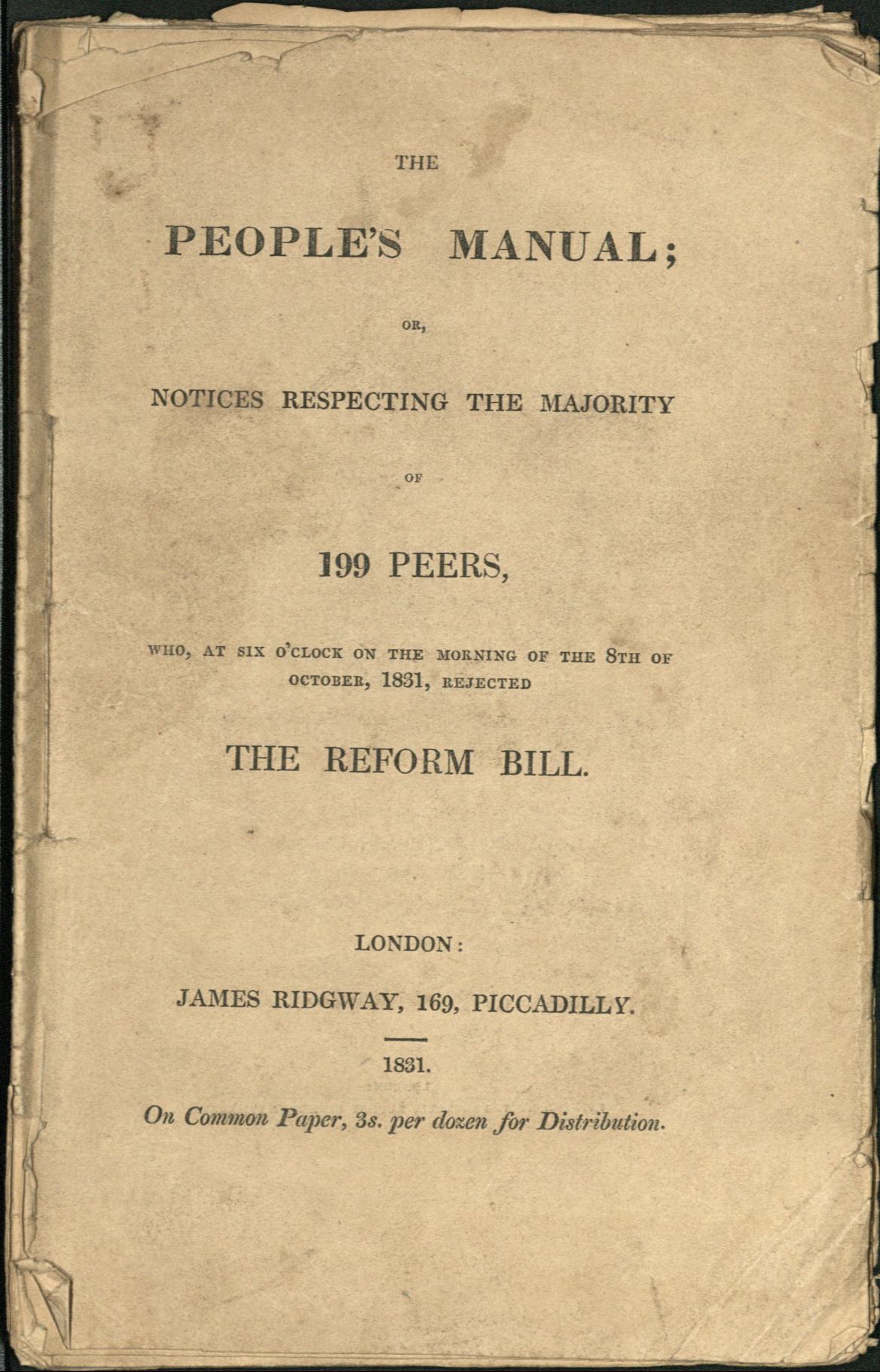
In 1831 and 1832 three attempts were made to pass the Reform Bill, a piece of legislation which contained measures to extend the franchise and tackle abuses in the political system. The first, in a House of Commons with a Tory (largely anti-reform) majority but a Whig (pro-reform) Prime Minister, floundered in March 1831. In response, the Prime Minister Lord Grey called a general election and the Whigs won a landslide victory, regarded as a public mandate for political reform. The second Reform Bill passed through the House of Commons and was referred up to the House of Lords, who rejected it in October 1831. The rejection triggered public violence, including riots in Bristol, Nottingham, Birmingham and Derby (residences of several of the Peers who had opposed the Bill were targeted). The House of Commons passed a motion of confidence in the government, a new session of parliament was called and a third attempt was made to pass the Reform Bill. The period between the introduction of the third Bill in December 1831 and its passing into law in June 1832 was one of great political turbulence - Prime Minister Lord Grey resigned and was replaced by the Duke of Wellington, after the King refused to stack the House of Lords with new Whig peers who would support reform; faced with public agitation, a run on the banks and a failure to get enough support to form a Tory government, the Duke of Wellington in turn resigned; and the King recalled Lord Grey to form a new Whig ministry, with the tacit agreement that new lords could be appointed to get the Bill through parliament. With the encouragement of the Duke of Wellington, and before the composition of the upper chamber could be changed, the recalcitrant lords finally passed the Bill, and the Reform Act received royal assent on 7 June 1832.
'The People's Manual' was circulated in 1831, following the defeat of the second Reform Bill in the House of Lords. The pamphlet contains a series of short, hostile biographical profiles of the 199 Peers who had blocked the legislation.
The manual is included in the University of Warwick Library Special Collections (reference: DA540.P3) and can be read in fullLink opens in a new window through our online collection of Warwickshire political ephemera, 1774-1874.