
Unique Prints: Authenticity and Authorship in Virgil’s Works
By Angus Harker, Academic Partner for Special Collections Scoping Project, 2nd December 2025
Angus Harker, Academic Partner for Special Collections Scoping Project, shares incredible insights into the works of Roman poet, Virgil after a rare discovery in the University's Special Collections.
Over the last few weeks we have uncovered a rare edition of the Roman poet Virgil’s entire works in our Special Collections (http://webcat.warwick.ac.uk/record=b3066349~S15), printed entirely in Latin in 1824, in Edinburgh. It is a version which is as problematic as it is obscure.
It was acquired by the library in 2013 from the late Robert Cummings, along with several other items. Its condition is very poor; the book cover has disintegrated, and several quires have detached from the main body. Remarkably though, the contents itself are still intact, allowing us to glimpse into the printing history of this mysterious book.
The title page is by far the most intriguing part of the copy. It was printed by Duncan Stevenson, who is fashioned as an ‘academic printer’ to the University of Edinburgh at the bottom of the page. This appears to be a relatively recent venture for Stevenson; previously, he was the proprietor, printer, and publisher, of the Beacon newspaper, financed by several Tory backers at the start of 1821 (The War of Words – The Rise and Fall of The Beacon Newspaper). This newspaper was set up during the cataclysmic “war of words” that existed in the very intense political climate in Britain in the 1820s, providing one of several footnotes in the nation’s quest for the extension of the franchise. This newspaper lasted until 22 September of the same year before it was brought down by mounting libel cases from the figures that it had pilloried for months (as all respectable publications do). Presumably, a change of pace was then needed for Duncan, one that aligned with his pro-institutional lean.

Whilst tangential, this information does colour the production of our Virgil copy. Based on the preface, it appears to be based on a second edition of Charles de la Rue’s Delphin edition of Virgil’s entire works (one of the first books labelled under the “Delphin” series), which immediately arouses suspicion; Charles de la Rue is only credited with compiling one edition.
To accentuate this authenticity, the title page notes the inclusion of a metrical key (which has allegedly ‘never before been published’), something which is reinforced with the editor’s preface, along with the correction of ‘six hundred errors from the Index of Vocabularies’ – yet another bold claim, which we’ll get to later. A brief comparison of this page with an American edition printed in the same year helps to highlight the differences in each print:

Picture of the American edition here Virgil's Opera Early American Imprint 1824 Carey and Lea Edition Folding Map | #1904770910
image 2 (the title page)
Another difference is that the Edinburgh edition is not printed from a stereotype, something which implies that it is not copied from some other source material. The editor’s preface adds that the metrical key is for the benefit of novices, which angles the edition towards students at either school level, or university. This is reinforced by the inclusion of a vocabulary index at the end, which – considering where the page numbers are organised on the pages – appears to have been pulled from a different source that was circulating at the time.
For this copy, I’ve liaised with Edinburgh University’s rare books librarian, Elizabeth Quarmby Lawrence, a person whom I owe much in elucidating me on the history of these books. The title page indicates that this edition was worked on by William Duncan E. C. P., who is not the professor of natural philosophy from the University of Aberdeen (Prof. William Duncan Marischal College). As Elizabeth extrapolated, this would be the same William Duncan who had written several introductions to classical pieces of work in the 1820s and 1830s (#10 - Clavis homerica ... - Full View | HathiTrust Digital Library; Decerpta ex ... Metamorphoseon libris, with Engl. notes by G. Ferguson - Publius Ovidius Naso - Google Books). In addition, despite Duncan Stevenson being printer for the Edinburgh University Press, this does not necessarily mean that it was printed for use by the university, as the press was independently run. The bottom of the title page lists a bunch of booksellers that the edition is sold to, which, when considering Elizabeth’s knowledge, suggests that the edition was aimed at a wider circulation amongst students and novices of Latin.
Elizabeth also pointed me towards the prevalence of the Valpy series of Delphin Classics that had begun in 1819 in England, edited by George Dyer (Delphin Classics (A. J. Valpy) - Book Series List). It does look like the recency of Valpy’s series may have spurred on this Edinburgh print. It suggests that this Edinburgh copy exists as a competing source of legitimacy when there was renewed interest in reprinting the Delphin classics.
For all its promises, the copy is a let-down when it comes to execution. The editor’s preface is put after the preface to the second edition, which is either an unusual decision or an amateur mistake. The index of vocabularies is a mess, with four pages from the introduction quired backwards in-between pages 195-196, and four more between 198-199. I liaised with a professor I studied under during my Master’s at Warwick, Dr Rich Rabone, and he pointed out that this was likely because the printers had accidentally picked up paper for the index that was only blank on one side, and had on the other side the end of the introduction.
For all its promises of correcting issues in the index, in actuality it added to them - and much like Stevenson’s previous foray into libellous newspapering, the illusion of authenticity unwinds near the end. In 1843, there is another “second” edition print of Virgil’s entire works that looks to be based on the 1824 edition (P. Vergilii Maronis opera : interpretatione et notis illustravit Carolus Ruaeus ; jussu christianissimi regis, ad usum serenissimi Delphini ; juxta ipsius auctoris editionem parisiensem ; huic editioni accessit index accuratissimus, ante editis longe locupletior ; accessit insuper clavis metricovirgiliana, sive difficultatum praecipuarum in Virgilii versificatione solutio ; nunquam antea edita, studio et cura Gulielmi Duncan : Virgil : Free Download, Borrow, and Streaming : Internet Archive), now printed by Oliver & Boyd. Its metrical key is not split between the start and the end, and it puts its editorial preface at the beginning. The change in printers appears to indicate the confidence that Edinburgh University Press had in Stevenson’s 1824 print.
Nonetheless, the copy does have its charms. There is a map at the start to be used to help chart Aeneas’ journey from Troy, crafted by W. H. Lizars, a well-known copperplate engraver (William Home Lizars | National Galleries of Scotland). In addition, the choice to reprint a second edition in 1843 does suggest a modicum of success in the 1824 edition, even if the change of printer seems to have been done to restore authenticity in the work.
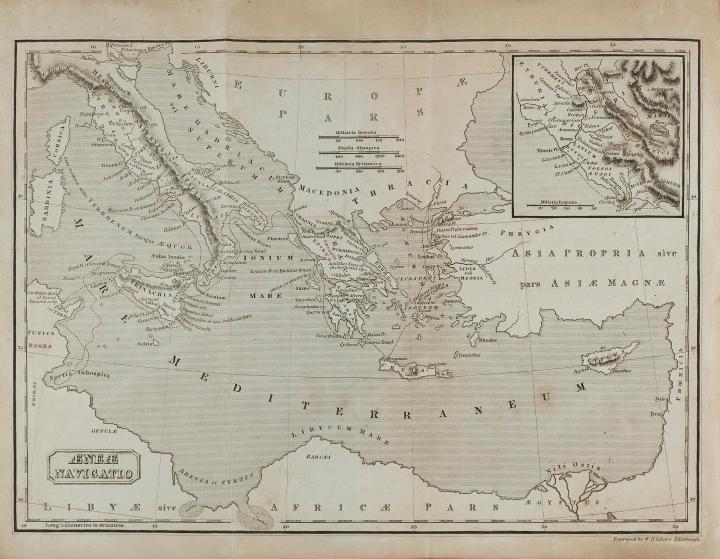
Ultimately, this print tells us more about the life of the printer than of Virgil’s work, or even Charles de la Rue’s translation of it. Stevenson, despite the change from the Beacon to printing classical books, still competed for legitimacy, just in a different environment – and was still happy to make bold claims with questionable results. There was still, in a sense, a war of words, but it had moved from politics to the classroom.
This book is currently on display for the ‘Tricky Texts’ exhibition in the MRC, running from the 1st December to 26th January.
References/For Further Reading:
- Chalmers, John, 'The War of Words - The Rise and Fall of The Beacon Newspaper', Book of the Old Edinburgh Club, New Series 12 (2016), pp. 37-46, <The War of Words – The Rise and Fall of The Beacon Newspaper> [accessed 08/10/2025]
- No Author, ‘Clavis Homerica…’, HathiTrust, n.d., <#10 - Clavis homerica ... - Full View | HathiTrust Digital Library> [accessed 08/10/2025]
- No Author, ‘List of Educational Works’, in Decerpta ex … Meatmorphoseon libris, edited by G. Ferguson (Edinburgh: Oliver & Boyd, 1840), pp. 1-24 [14], <Decerpta ex ... Metamorphoseon libris, with Engl. notes by G. Ferguson - Publius Ovidius Naso - Google Books> [accessed 08/10/2025]
- No author, 'Stevenson, Duncan & Company', CERL Thesaurus, 14th March 2014, <https://data.cerl.org/thesaurus/cni00058443> [accessed 03/09/2025]
- No Author, ‘Virgil’s Opera Early American Imprint 1824 Carey and Lea Edition Folding Map’, WorthPoint, n.d., <Virgil's Opera Early American Imprint 1824 Carey and Lea Edition Folding Map | #1904770910> [accessed 08/10/2025]
- No Author, ‘William Duncan’, University of Aberdeen, n.d., <Prof. William Duncan Marischal College> [accessed 08/10/2025]
- No Author, ‘William Home Lizars’, National Galleries, n.d., <William Home Lizars | National Galleries of Scotland> [accessed 08/10/2025]
-
Virgil, P. Vergilii Maronis opera, Delphin Classics, edited by William Duncan E. C. P., 2nd or subsequent edition (Edinburgh: Oliver and Boyd, 1843), < P. Vergilii Maronis opera : interpretatione et notis illustravit Carolus Ruaeus ; jussu christianissimi regis, ad usum serenissimi Delphini ; juxta ipsius auctoris editionem parisiensem ; huic editioni accessit index accuratissimus, ante editis longe locupletior ; accessit insuper clavis metricovirgiliana, sive difficultatum praecipuarum in Virgilii versificatione solutio ; nunquam antea edita, studio et cura Gulielmi Duncan : Virgil : Free Download, Borrow, and Streaming : Internet Archive> [accessed 08/10/2025]
-
Virgil, P. Virgilii Maronis opera, Delphin Classics, edited by William Duncan E. C. P., 2nd Edition (Edinburgh: Duncan Stevenson, 1824), http://webcat.warwick.ac.uk/record=b3066349~S15, [accessed 08/10/2025]
-
Wagner, David Paul, ‘Delphin Classics’, Publishing History, n.d., <Delphin Classics (A. J. Valpy) - Book Series List> [accessed 08/10/2025]