
60 in 60: Warwick's Diamond Anniversary in 60 Images
Introduction
In October 1965 the first undergraduates arrived at the University of Warwick campus on Gibbet Hill to begin their studies. The Main Site was yet to open, and when it did, it was occupied by very few buildings. These were designed by the firm Yorke Rosenberg Mardall in a modernist style – imposing, impersonal and at odds with their rural surroundings. Over time, the landscape of the campus altered as new buildings by other architects appeared, responding to the needs of a growing student population and the establishment of increasing numbers of academic departments. Soon, the buildings designed by YRM were sitting alongside strikingly different constructions such as the Arts Centre, Social Science complex and Students’ Union, as well as student flats and halls of residence – each in a different style. Successive development plans, starting in 1994, allowed the Main Site to be reshaped and reimagined still further, enabling Warwick to offer more to its staff and students in terms of places to research, live, congregate, and relax.
Today, however, any visitor soon realizes that Warwick is about more than just its buildings – being as much a space for the enjoyment and appreciation of nature as it is a place for teaching and learning. It is hoped that the photographs in the first half of this online exhibition illustrate how the style of campus architecture evolved over time, whilst also helping to create a sense of what it must have been like to study on campus in earlier decades.
The remainder of the images cover all aspects of student life – from activism, academic study, and accommodation, to sport and leisure. It is interesting to note in some of the photographs how technology has influenced the physical spaces occupied by students over the years.
What all the images show, above all, is how Warwick is an institution which never stands still and which isn’t afraid to reinvent itself. These images have appeared in two exhibitions organized this year by the Library and Modern Records Centre – ‘The Changing Face of Campus’ and ‘Student Life’. This exhibition aims to capture some of the photographs and materials used in these exhibitions, and provide a glimpse of what is held in the University’s own archives.
You can also browse digitised copies of:


1.)
A popular photograph which has long been associated with Warwick University. A version of it was reproduced on the cover of the University’s Guide to First Degree Courses for 1980/81.
[Archive Reference number: UWA/Photos/VI.D/6]

2.)
Construction work being carried out on East Site at the top of Gibbet Hill Road. Early undergraduates at the University studied on the small campus there until the University’ permanent buildings on the Main Site were completed.
[Archive Reference number: Accession UWA/23/3519 Box 2 (1964-5 Album ]

3.)
Library Road taking shape. Its position in the campus plan was chosen so that it aligned with the spires of Coventry’s cathedrals.
[Archive Reference number: UWA/Photos/II.A.1/1/067]

4.)
Construction work underway on Main Campus’s Science Buildings with the Library in the background.
[Archive Reference number: UWA/Photos/II.A.6/1/107)

5.)
A plan of the University Site from the Prospectus of First Degree Courses 1969-70. The key to the plan reveals the lack of accommodation for students and Arts subjects alike.
[Archive Reference number: UWA/PUB/4/6]

6.)
The Library Building, which was placed at the centre of the original development plans for the University. Architects: Yorke Rosenberg Mardall.
[Archive Reference number: UWA/Photos/II.A.6/1/102]

7.)
The Mathematics Institute on the University’s East Site.
[Archive Reference number: UWA/Photos/II.B.1/1/010]

8.)
One of the Maths Houses built on the East Site in 1969 to accommodate conference delegates and researchers visiting Warwick from other institutions. There are seven in total (five three-bedroom houses and two one-bedroom flats).
[Archive Reference number: UWA/Photos/II.B.1/1/043]

9.)
The Arts Block (later known as the Humanities Building). Its architects were Yorke Rosenberg Mardall.
[Archive Reference: UWA/Photos/II.A.2/1/033]

10.)
East Site: The temporary home of the University when it first opened. The first University buildings on this site were low-storey and compact, contrasting greatly with the imposing rectangular office blocks designed by Yorke Rosenberg Mardall which began to appear across Warwick’s Main Campus as the sixties drew to a close.
[Archive Reference: UWA/Photos/II.B.2/1/015 ]

11.)
The Science Block in Library Road. Architects: Yorke Rosenberg Mardall
[Archive Reference number: UWA/Photos/II.A.1/1/007]

12.)
An aerial view of campus from the University’s Guide to First Degree Courses 1983-84.
[Archive Reference number: UWA/PUB/4/20]

13.)
The main entrance to the Warwick Arts Centre. Nine years after the University opened its doors to the first undergraduates, the Arts Centre welcomed its first audience members in October 1974. With its angular, irregular outline, the Arts Centre, designed by the Renton Howard Wood Levin Partnership, was a complete departure from Yorke Rosenberg Mardall’s style of building (see Images 6, 9 and 11).
[Archive Reference number: UWA/Photos/II.C.2/1/011]

14.)
This image of the Warwick Arts Centre was used in a leaflet commemorating the opening of the Jack Martin Residences on 7th September 1988 in order to illustrate other places on campus which had also benefited from the Martin family benefaction. (Jack Martin – who was originally from Coventry - made his fortune by buying the rights to Smirnoff Vodka in 1939). As well as supporting the development of the Arts Centre, their money was used to build some of the first student residences on campus and foster Anglo-American relations by funding staff and student visits to the United States. In this image you can clearly see the outside ramp which in those days led into the Sculpture Court.
[Archive Reference number: UWA/PUB/ACC/6/1]

15.)
By the late 1990s, the Sculpture Court outside the Film Theatre had transformed into a foyer space. Many alumni will remember the striking pink carpet seen here which was used throughout the upper storey of the Arts Centre!
[Archive Reference number: Box 135 of University Press Cuttings]

16.)
Liliane Lijn’s White Koan outside the Warwick Arts Centre in the late 1990s. It can still be found there today – although the area outside the Arts Centre has been dramatically renovated in recent years.
[Archive Reference number: Box 135 of University Press Cuttings]

17.)
The new exterior of Warwick Arts Centre. Veronica Ryan’s Breadfruit sculpture (seen on the right-hand side) was installed outside its entrance in February 2024.

18.)
The first in a series of images which document drama at Warwick. Drama has always had a strong presence at Warwick. Even before the establishment of the Arts Centre and the Department of Theatre Studies in 1974/5, performances had taken place in locations such as the ground floor lounge of Benefactors, and the Drama Society had not only put on shows, but also invited individual speakers and theatre groups to campus. Warwick even had its own Café Theatre group which entertained audiences at Arts Centres across the country, while beyond campus, students took part in productions staged in local studio theatres.
This photograph shows students from the Theatre Studies Department in a production of Plautus' Pseudolus which took place in 1990-91 as part of Warwick’s 25th anniversary celebrations. The title character is a slave who outsmarts his more powerful master. The students are Tony Chapman, Kate Jackson and Phil Rees.
[Archive Reference number: UWA/Photos/IV.A.1/3/043 ]

19.)
In March 1988 the Joint School of Theatre Studies in Association with the Warwick University Student Drama Society mounted a production of Plautus’s comedy Casina in the Warwick Arts Centre. It was translated and directed by staff member Richard C. Beacham and performed on a wooden stage similar to those used by the Romans themselves. This flyer was recently discovered alongside a press release relating to the production in the University Archive.
[Archive Reference number UWA/PUB/PR/1/3: folder for 3 Oct 1987 - Sep 1988]

20.)
A scene from Casina. Following a reunion to mark 50 years of Warwick’s Theatre and Performance Studies this year, the programme for the production was recently deposited with the University Archive, allowing us to find out more about it. It explains how the female characters “take over the plot of the play, and determine its outcome, cleverly and skilfully manipulating their would-be oppressors: the men”. Fans of Gavin and Stacey will recognize the actress Ruth Jones in this photograph.
[Archive Reference number: UWA/Photos/IV.A.1/3/042]

21.)
The next section looks at student accommodation and we begin with the first study bedrooms to be constructed on campus: Rootes Halls of Residence. Today, both First Years and Returning Undergraduates can live there.
[Archive Reference number: UWA/Photos/II.D.1.1/RefC2029/1]

22.)
Whitefields Flats, designed by Goodman and Short.
[Archive Reference number: UWA/Photos/II.D.3/1/013]

23.)
The sculpture 3B Series I by Bernard Schottlander seen in this photograph is made of painted steel – not an unusual choice of medium for someone who came to England in 1939 and worked as a welder during the Second World War. Having changed career to become a full-time sculptor in 1963, he began teaching at London’s St. Martin’s School of Art in the same year Warwick was established, and 3B Series I was completed three years later. This image was used on the cover of the Guide to First Degree Courses for 1972-3, and while the sculpture still resides in the same location, Red Square would be unrecognizable to those who were at Warwick in the 1970s because it is more lawn than square these days.
[Archive Reference number: UWA/Photos/II.D.1/1/042]

24.)
A staged publicity photograph showing the interior of Rootes Residences from early on in the University’s history. The view from the window shows construction work still underway on a nearby block!
[Archive Reference number: UWA/Photos/II.D.1/1/079 ]

25.)
One of the photographs from the Guide to First Degree Courses 1983-4 used to illustrate on-campus accommodation.
[Archive Reference number: UWA/Photos/IV.B.1/2/006]

26.)
This photograph of a student kitchen was used in the Guide to First Degree Courses 1982-3
[Archive Reference number: UWA/Photos/IV.B.1/2/024]

27.)
A student in her study bedroom in Jack Martins Residences during the 1990s.
[Archive Reference number: UWA/Photos/II.D.7/1/35]

28.)
Trips to the supermarket are a major part of student life!
[Archive Reference number: UWA/Photos/II.C.9/1/002 ]

29.)
The original Students’ Union Building (later renamed Students’ Union South)
[Archive Reference number: UWA/Photos/II.D.10-1/004]

30.)
Societies Fayre inside the Market Place of the Students’ Union Building. This image appeared in the Undergraduate Prospectus for 1998-9.
[Archive Reference number: Box 137 of University Press Cuttings]

31.)
Students’ Union North which opened in October 1998. It was designed to accommodate Sabbatical Officers and Union administrators, as well as banks, a chemist and an entertainments venue.
[Archive Reference number: UWA/Photos/II.D.10.1/059]

32.)
It isn’t often that student ephemera makes its way into the University Archive but this poster did! The President’s Ball was an annual special event at Warwick.
[Archive Reference number: UWA/DUTTON/1/15]

33.)
By contrast, this page, taken from the campus publication The Word, advertises one of the Students’ Unions more regular offerings - ‘Boogie Nights’.
[Printed versions of The Word can be found using the Archive Reference number UWA/PUB/WO]

34.)
A photograph taken in one of the University bars.
[Archive Reference number: UWA/Photos/IV.B.1/3/014]

35.)
In the nineties, there was a range of places to eat and drink on campus. Three restaurants - Rootes, Gibbet Hill and Westwood - existed alongside the fastfood outlet Airfare and the Rootes Airport Bar (both situated in the Rootes Social Building) as well as the Milking Parlour. Westwood, meanwhile, was home to the Westwood Galley and Surfers.
[Archive Reference number: UWA/Photos/II.G.2/1/031]

36.)
A photograph taken during a postgraduate seminar in the Statistics Department.
[Archive Reference number: UWA/Photos/IV.A.1/3/046 ]

37.)
A laboratory on the East Site Campus
[Archive Reference number: UWA/Photos/II.B.2/1/32]

38.)
Testing a research vehicle on a rolling road in the Department of Engineering. This photograph appeared in the Guide to First Degree Courses for 1974-5. Today, vehicle solution projects are worked on in the National Automotive Innovation Centre – a partnership between the Warwick Manufacturing Group, JLR and Tata Motors European Technical Centre –at its base in the Prof. Lord Bhattacharyya Building.
[Archive Reference number: UWA/Photos/IV.A.1/3/15]

39.)
A Postgraduate Student from Engineering Sciences working on the measurement of eye rotation.
[Archive Reference number: UWA/Photos/IV.A.1/3/3]

40.)
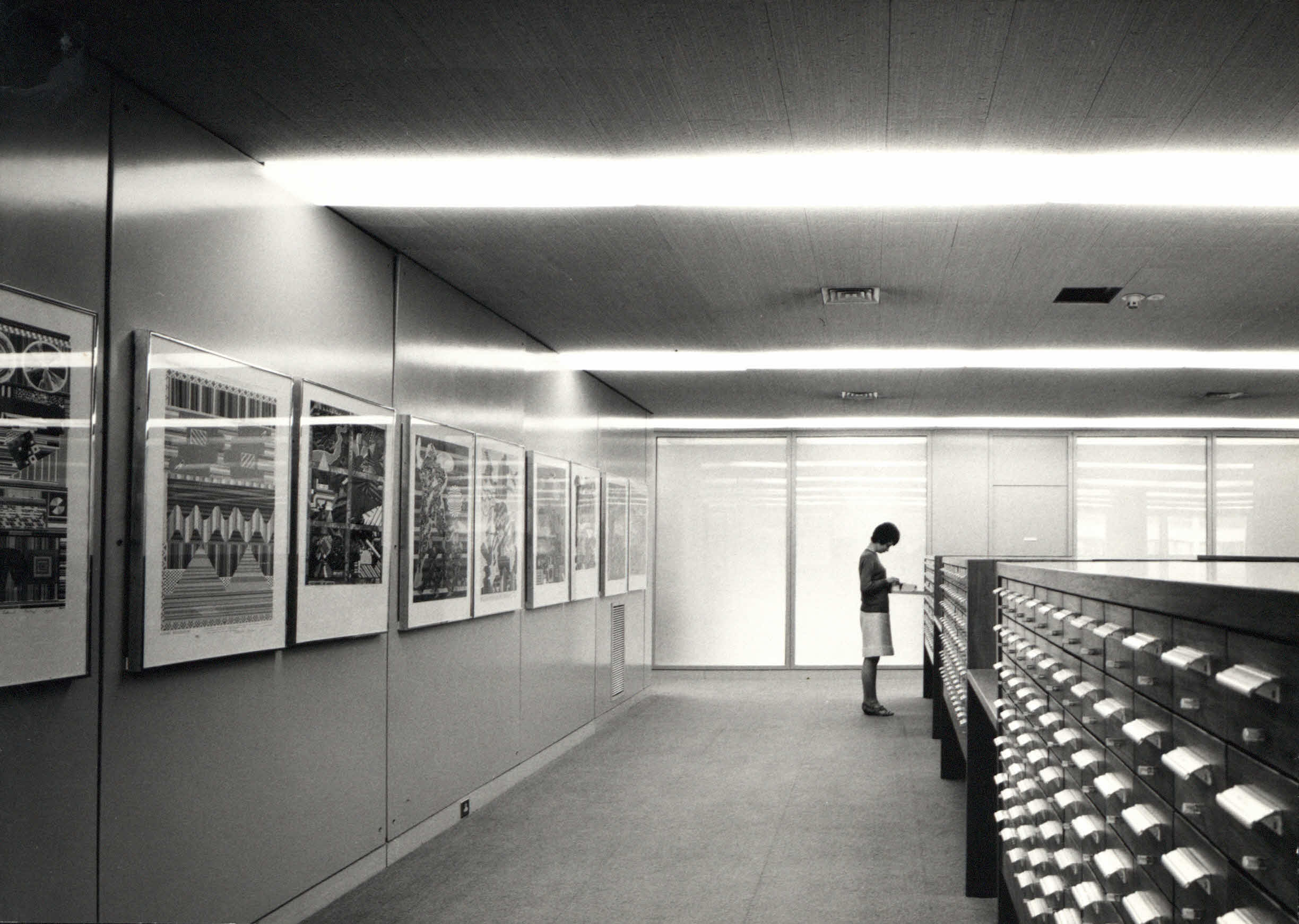
Card catalogues in the Main Library. On the wall hang screenprints by Eduardo Paolozzi. Assembling Reminders for a Particular Purpose and Futurism at Lenabo (both completed in 1965) can be seen closest to the camera – just two of the seventeen works by him that are part of the University Art Collection. They would have brought colour to the building’s minimalist interior, whilst complementing its style.
[Archive Reference number: UWA/Photos/II.A.6/1/023]
41.)
One of the Library’s microfiche readers.
[Archive Reference number: UWA/Photos/II.A.6.1/057a]

42.)
The Library’s Listening Room.
[Archive Reference number: UWA/Photos/II.A.6.1/055]

43.)
An MA class in Women’s Studies. Terry Lovell, Senior Lecturer in Sociology, is seated in the centre of the photograph which was taken in c.1987.
[Archive Reference number: UWA/Photos/VI.D/6/152]

44.)
A photograph which acts as a reminder of how the University has had to adapt to changes in technology over the decades. Rooms full of desktop computers are now a thing of the past. It comes from the University’s Undergraduate Prospectus for 1999.

45.)
In recent years, the University of Warwick Library has developed services, spaces and support to meet the specific needs of different customer communities.
One of its most successful ventures has been the award-winning Learning Grid, a dynamic, flexible learning environment aimed specifically at undergraduates and taught postgraduates which is based in University House. When it opened in 2004 these information screens in the Learning Grid would have regarded as hi-tech. Just over twenty years later, smartphones have made such equipment redundant.
[Archive Reference number: Accession UWA/X20/3236]

46.)
Back in the early 2000s the Main Library underwent a huge amount of remodelling and the First Floor (shown here) underwent extensive changes to support individual and group working.
[Archive Reference number: Accession UWA/X20/3236]

47.)
Students at an anti-Vietnam protest on campus in October 1967 9 (the banner in the photograph reads ‘Warwick University Condemns U.S. Aggression in Vietnam’). It was held to coincide with a visit to Warwick University by the American Ambassador, Mr. David Bruce, who was there to open the new Benefactors Hall of Residence. Both British and American students took part in the protest which made the front page of the first ever issue of Warwick’s student newspaper Campus – the predecessor to The Warwick Boar.
[Archive Reference number: UWA/Photos/IV.B.3/1]

48.)
Ray Earwicker was the fourth editor of The Warwick Boar and held the position for a single term in 1974-5. His successor was Janice Stegall – the paper’s first female editor.
[Archive Reference: UWA/Photos/VI.D/6/0052]

49.)
Like The Warwick Boar, ‘Radio Warwick’ is another of piece of Warwick history still going strong today. It was established by two students in 1970 – Ian Black and David Davis – and its transmitter, aerials and some of the studio equipment was designed and created by an Engineering student as a final year project. In 1974-5 it was broadcasting travel documentaries, recordings of music and drama productions, campus news, discussions and record requests and by 1976 had moved from a hut on campus to the top floor of the Students’ Union building.
[Archive Reference number: UWA/Photos/IV.B.1/3/001]

50.)
Another photograph of Radio Warwick or W963 taken in 1991.
[Archive Reference number: UWA/Photos/IV.B.1/3/002]

51.)
By 1990 W963 was one of the biggest and most active societies on campus. This photograph of W963 was used in the Undergraduate Prospectus for 1998.
[Archive Reference number: UWA/PUB/4.32/020]

52.)
Education students at Warwick demanding fair pay for teachers.
[Archive Reference number: UWA/Photos/IV.B.1.3/17]

53.)
According to The Warwick Boar, Warwick students achieved the world record for the ‘Largest Pillow Fight’ in March 2004, only for it to be taken away from them in the same week by an American University.
[Archive Reference number: UWA/Photos/V.B.30/23]

54.)
Sport is also an important part of many students’ lives while they are at Warwick. This image of the was used in the Guide To First Degree Courses 1976-7 with the caption ‘Climbing in the gymnasium’. These days, those using the Sports and Wellness Hub’s Climbing Centre can choose from the among the following: a 15m climbing wall, bouldering and two speed climbing walls.
[Archive Reference number: UWA/PUB/4/13/093]

55.)
There has been a netball team at Warwick since 1967. According to a recent Boar article online, today’s University of Warwick Women’s Netball Club (UWWNC) is as much about ‘charity and community outreach’ as it is sport.
[Archive Reference number: UWA/Photos/IV.B.2/1/036 ]

56.)
This image of Warwick University’s Football Team was found among the pages of Warwick’s Guide To First Degree Courses 1984-85.
[Archive Reference number: UWA/PUB/4/21/017]

57.)
Between the 16th and 17th March 1985, the seventh British National Indoor Ultimate Frisbee Championship was held at the University’s Sports Centre, with 81 matches taking place during the course of the weekend. The men’s final was won by the University’s Frisbee Club – the Warwick Bears – who beat favourites Battersea Boleros, and they were awarded the trophy by Warwick’s Vice-Chancellor Jack Butterworth.
[Archive Reference number: UWA/Photos/IV.B.2/1/001]

58.)
Warwick’s Rugby Team.
[Archive Reference number: UWA/Photos/IV.B.2/1/055]

59.)
A member of the Joint Swimming and Water Polo Club, whose other name is the Warwick University Fish Force – or W.U.F.F for short! References to it in the University Archive go back as far as 1971/2.
[Archive Reference number: UWA/Photos/II.G.5/1/034 ]

60.)
Our final image shows how campus used to look until very recently. It was taken in the late 2000s.
