Organise material for your research and assignments to ensure you can communicate your findings with confidence.
Organising research material effectively ensures that useful sources, data, and search activity can be stored, retrieved, and used effectively throughout the research process. It involves managing references, files, and research data in a structured way, while also understanding the ethical, legal, and practical considerations associated with their use. This broad skillset comprises several sub-skills that are developed as you, or your students, progress through the different stages of study.
Teaching this skill? Read on to see the learning objectives associated with each level or click here to skip straight to our teaching case studies.
Select the boxes below to view the learning objectives for each level.
Learning objectives
Maintain simple records of where useful research material is located to enable accurate reference to it in the future.
Save useful search results within Library Search, and within Databases. Understand that although searching is an iterative process, saving useful results can facilitate accurate record keeping and citation.
Demonstrate how to access sources published online ethically and according to their Terms of use
Store research material in a clear and organised digital filing system. For example, develop the habit of creating distinct folders for different modules and storing files for different assignments within those.
Understand how to make digital storage systems resilient, by backing up research material habitually.
Understand what counts as Sensitive or personal data. Understand why that data must be anonymised, and what the basic requirements are for storing and using it safely for academic work.
Resources and activities
Take this Library Online Course – specifically the section called Organising Your Research.
Look at this guidance from the Stanford Centre for Teaching and Learning on organising your digital workspace. Explore Microsoft’s guidance on using OneDrive for storage; OneDrive can be accessed for free (see here).
Look at ICO’s guidance to learn about what personal data is.
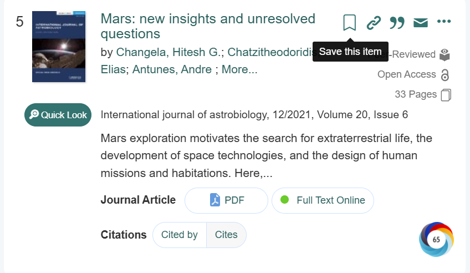
Access Library Search and log in. Run a search for a topic that interests you, find a piece that you might want to read later, and save it within Library Search, using the ‘save’ button:
Explore where you would need to go to find the saved item later. Consider whether it would be useful to keep a separate record of the reference and how you might do that.
Learning objectives
Make informed decisions about the use, sharing, and reuse of information by interpreting the terms of use, licensing conditions, and copyright restrictions associated with different sources.
Save and manage search strategies within databases, recognising that saved searches can be repeated, refined, and adapted as the project develops.
Develop systematic approaches for storing, organising, and managing references and associated research materials.
Implement strategies to minimise Data loss, including routine backups and the use of sustainable file formats that support future access.
Explain the purpose of Research ethics approval and how ethical review processes apply to different research activities.
Apply ethical and legal principles when working with sensitive or personal data, making informed decisions about anonymisation, secure storage, and controlled handling throughout the research process.
Interpret dataset licensing conditions and apply them when making decisions about data reuse, sharing, and citation.
Share research data using methods that support security, access control, and compliance with ethical, legal, and institutional requirements.
Resources and activities
Read the ‘For Students’ page of the Copyright guide. Understand the copyright status of three different sources you have used recently.
Audit your current project files. Identify any materials that may be at risk due to inadequate backup or proprietary file formats.
Locate an openly accessible dataset using WRAP or a similar repository. Identify what kind of licence allows you to access the data and what conditions are imposed.
Learn more about the ethical approval process here. Identify which kinds of project require ethical approval.
Review the ‘Preserve and Share’ page of the Research Data Management guide to learn more about data handling, preservation, and sharing.
Run a search in a database relevant to your discipline; save it for posterity. Revisit it after making changes to your research question or keywords and reflect on how the search develops over time.
Learning objectives
Establish reliable routines around the location, storage and management of research material. Use appropriate file structures and thorough documentation to support Transparency and Reproducibility.
Set up and manage alerts within search tools and databases to remain informed about emerging publications and developments within the field and supplement regular searching.
Utilise Reference management software to organise references. Apply appropriate categorisation, tagging, and annotation strategies to support retrieval and synthesis throughout the research process.
Where appropriate, implement aData management plan (DMP) which supports secure storage, preservation, access control, and responsible stewardship across the duration of a project.
Where necessary, incorporate appropriate data management plans into the ethical approval applications.
Interpret and assess data-licensing conditions in depth, including Permissions, Restrictions, and Obligations. Ensure that all reuse and sharing of datasets complies with these requirements throughout each project.
Critically evaluate when data is sensitive or personal. Apply robust, legally compliant practices for anonymisation, secure storage, and the long-term management of data throughout the research lifecycle.
Critically evaluate the data management implications of using AI tools within research workflows, taking data protection, confidentiality, the security of sensitive or personal data, and intellectual property into account.
Resources and activities
Learn about reference management software here. Attend one of our EndNote or Zotero workshops to learn more.
Learn about the benefits of data management planning here. Use the DPMOnline platform to prepare a data management plan if necessary.
If you manage, organise, and protect research data as part of your project, you may wish to join the Research Data Stewardship network. Express an interest here.
Read about the SafePod Network here. The Library hosts a SafePod for use accessing sensitive data for research purposes.
Review University guidance on the use of AI tools. Consider the implications of sharing research materials with external AI systems.
Try this now!
Explore the capacity to set up alerts in a search tool or database that you use frequently. Set up an alert to be informed of new publications in a given research area.
Teaching staff
Being a well organised researcher means keeping track of material located during the research process, and understanding the ethics and obligations associated with handling and managing research material. Like the other skills set out in this framework, this skill is best developed in the context of a student’s discipline.
The Research and Academic Services division can work with you to identify the skills most relevant to your students, design activities using subject-specific examples and resources, and embed teaching within your module or programme.
The Library offer an Introduction to Referencing workshop, which introduces the process of referencing sources to all students working at an undergraduate level. The session helps students to establish good practice early on. In the session, the importance of having a robust system for the storage of research material is emphasised.
As part of the introductory weeks of the Master’s in Education Reconstruction, two integrated Library sessions are offered. The first introduces the skills of searching and to the kinds of Library resources available at Warwick. Students are taught how to develop a search strategy, and then implement their strategy in subject-specialist and interdisciplinary databases. This is followed by a second session on reference management, in which students are taught to export citations from search tools into a reference management software such as EndNote or Zotero, and what to do with exported citations. This includes using an appropriate filing system to maintain an organised online reference library, tagging references, and searching within the software.
As part of the Centre for Interdisciplinary Methodologies’ Dissertation programme, the CIM Librarian delivered sessions on finding materials for your dissertation, which covered literature searching, and the Research Data Officer delivered a session on managing research data.
As part of an Applied Linguistics research group project, a two-part session was run for an international research group conducting a multi-continent scoping review. The first session covered search techniques and database use, including filtering, exclusion criteria, and saving searches and results. Participants were given the opportunity to try searching their chosen databases, and were shown how to explore and analyse their results using inbuilt features, where available. This is followed by a demonstration of citation export, and a demonstration of the use of reference management software (Zotero).
Contact us
We are developing the teaching provision (and case studies) arising from this framework on an ongoing basis. Please get in touch if you have any feedback, or would like to propose a session as part of your programme: contact us.