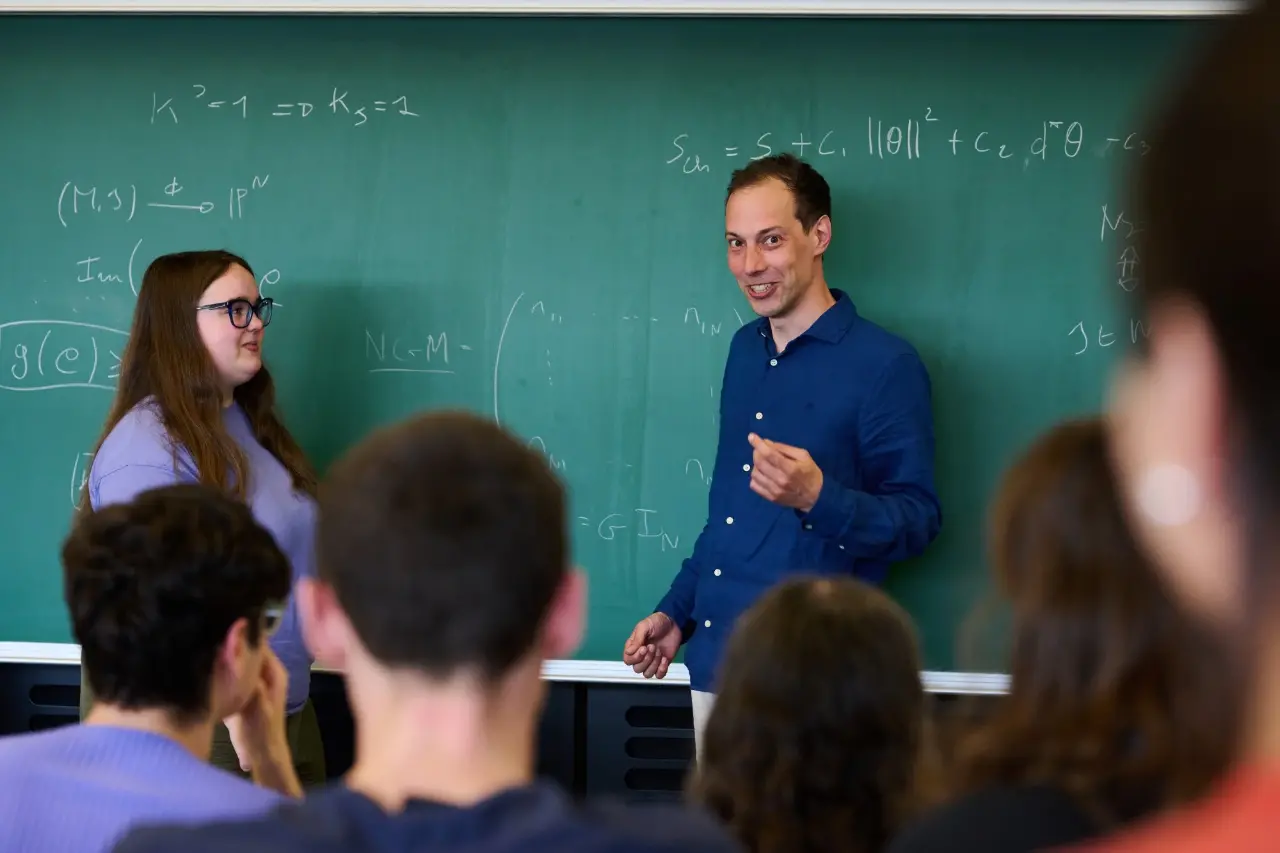
The MPhil/PhD in Mathematics offers an intellectually stimulating and dynamic research course. Study at the University of Warwick's Mathematics Institute, an international centre of research excellence, ranked 3rd for research power and 3rd for the number of 4* research outputs in REF 2021 (amongst UK universities) and is ranked in the top 30 globally (QS Rankings 2026).
It's truly challenging to point out any flaws in this program. My experience at Warwick has been amazing. The support I received was invaluable on every level. I believe it's the community that makes this institution great!
Dr Spyros Garouniatis
Warwick Mathematics PhD 2026
Mathematics at Warwick covers the full spectrum of mathematics and its applications. The Mathematics Postgraduate Degrees are appropriate for students with a strong and broad mathematical background who wish to engage in advanced mathematical techniques and attack mathematical research problems in their postgraduate work.
All students are required to undergo training in Year One and are encouraged to make use of further training opportunities available in subsequent years. Training ranges from gaining a broader knowledge of mathematics through taught modules, seminars and workshops, to enhancing your professional and transferrable skills. Our PhD students undertake high quality original research and are being well-prepared for a career, either in academia or elsewhere.
Students are initially registered as MPhil and required to complete a series of modules in their first year (from a very wide selection of bespoke modules), with assessment including an oral examination component. Upon the successful completion of these modules, students are required to complete a research project before being formally upgraded to PhD student at the end of the first year.
Training will be supplemented with attendance to seminars, cohort building activities, research integrity training and additional transferable skills training.
Entry requirements
First Class Honours undergraduate integrated Master's (4-year) degree from a UK university in Mathematics or a science degree with high mathematical content, or the equivalent qualification and grade from a non-UK university.
Alternatively, applicants who have a First in a Bachelor's degree AND a Distinction in a postgraduate Master's degree would be considered.
IELTS overall score of 6.5, minimum component scores not below 6.0
Please adjust your country as required:
We welcome applications from students with other internationally recognised qualifications. For more information, please visit the international entry requirements page.
We typically ask for two academic references for research courses.
You will be asked to include an email address for your referee(s) when submitting your application and we will contact them for you.
There are no additional entry requirements for this course.
Research themes
The mathematics department covers a wide range of research areas in mathematics and its applications.
You may also wish to explore the research interest of current Warwick academics.
Supervisors and proposals
There are several routes to finding a PhD supervisor at University of Warwick. Searching for a supervisor and submitting a research proposal will look different depending on the opportunity you are applying for. Below you’ll find guidance from the department about what is required for this course.
For more general advice, including top tips for finding and contacting a potential supervisor, and what to include in your research proposal visit the university’s guidance webpages.
The 'Find A Supervisor' link below will allow you to explore the research interests of academics within the department. Please include in your application the names of potential supervisors, with interests aligned with yours, or people you would like to work with.
The mathematics department, unlike some other departments, does not require students to make any arrangements with any potential supervisors before applying, though of course you are welcome to contact them directly and discuss your interests and any potential projects they may offer.
Warwick academics can supervise thesis research in a wide range of topics in mathematics and its applications.
The mathematics department covers a wide range of research areas in mathematics and its applications.
Research proposal guidance
In many cases, applicants have not settled on a specific area or project and have rather broad interests. If that is the case, this document can be used to describe your interests, your background on those areas, and what attracts you to those topics for example. This will help in assessing your application and help us determine potential supervisors and projects that you might be interested in.
Tuition fees are payable for each year of your course at the start of the academic year, or at the start of your course, if later. Academic fees cover the cost of tuition, examinations and assessment and some student amenities.
We carry out an initial fee status assessment based on the information you provide in your application. Students will be classified as Home or Overseas fee status. Your fee status determines tuition fees, and what financial support and scholarships may be available. If you receive an offer, your fee status will be clearly stated alongside the tuition fee information.
Do you need your fee classification to be reviewed?
If you believe that your fee status has been classified incorrectly, you can complete a fee status assessment questionnaire. Please follow the instructions in your offer information and provide the documents needed to reassess your status.
As well as tuition fees and living expenses, some courses may require you to cover the cost of research trips in the UK and overseas. In addition, you should consider the more general costs below:
Access to research material that is not available via university resources
Printing and binding a personal copy of your dissertation
Robe hire for your degree ceremony
Find out about the different funding routes available, including; postgraduate loans, scholarships, fee awards and academic department bursaries.
(NSS calculated average for the Russell Group in mathematics, 2024)
World-class research within a vibrant academic community.
Why study with us?
Join an international centre of excellence that offers cutting-edge research within a large and thriving culture of interactions across the mathematical sciences. You’ll benefit from a flexible and rigorous curriculum, taught by internationally recognised researchers in an environment specifically designed to encourage curiosity and collaboration.
Our department is ranked in the top 30 globally (QS Rankings 2026), and 99% of our Mathematical Sciences research is classed as world-leading or internationally excellent (REF 2021). Studying as a postgraduate student with us will deepen your passion for mathematics and set you up for a range of successful careers.
You’ll be based in our purpose-built Zeeman Building, designed by mathematicians for mathematicians.
Found at the heart of campus, the building features large lecture theatres, dedicated supervision areas and plenty of space where you can work through ideas with collaborators and staff.
Our 100+ cohort of postgraduate students spans the spectrum of mathematics and are part of a thriving, world-renowned academic community - working closely with almost 100 pioneering academics.
Life at Warwick
This is where your journey begins. Our campus is the heart of it all. It’s more than just a campus - it's the places you visit, the people you meet, the fun that you have; the experiences you have here will be transformative.
Within a close-knit community of staff and students from all over the world, discover a campus alive with possibilities.
Our campus is where all the elements of your student experience come together in one place. You won't be short of ways to spend your time on campus - whether it's visiting Warwick Arts Centre, using our incredible sports facilities, socialising in our bars, nightclub and cafés, or enjoying an open-air event. Or if you need some peace and quiet, you can explore lakes, woodland and green spaces just a few minutes’ walk from central campus.
Follow our students around campus on our social channels to see their experiences first-hand.
Teaching facilities
Our campus is designed to cater for all of your learning needs. You will benefit from a variety of flexible, well-equipped study spaces and teaching facilities across the University.
Oculus, our outstanding learning hub, houses state-of-the-art lecture theatres and innovative social learning and network areas
Different study spaces offering you flexible individual and group study spaces, computers, printing and scanning facilities, multimedia resources and more
Supporting you
Our continuous support network is here to help you adjust to student life and to ensure you can easily access advice on many different issues. These may include managing your finances and workload, and settling into shared accommodation. We also have specialist disability and mental health support teams.
Whether you live on campus or off campus, in private accommodation in the well-serviced local area, you’ll be part of a community to get the most from your experience at Warwick.
Societies and sports play a huge part in community life at Warwick. With over 300 to choose from, getting involved is one of the easiest ways to make friends and share in experiences. Whether you’re into films, martial arts, astronomy, gaming or musical theatre, you can instantly connect with people with similar interests.
Your university experience is defined by far more than your course or the career path you follow. At Warwick, it’s where you discover who you could become.
68th
Warwick is ranked 68th in the world and top 10 in all major UK league tables
Our alumni community still call Warwick home. From a few hundred in 1965 to more than 310,000 alumni, and it's ever-growing.
As Warwick graduates, our students have access to employability support for two years after graduation, including access to careers appointments, job vacancies and professional networks.
Applications for courses starting in academic year 2026/27 are now open.
For research courses that start in September and October 2027, the application deadline for students who require a visa to study in the UK is 2 August 2027.
For courses starting at other times of year we recommend that you submit your application a minimum of 3 months prior to your intended start date.
This should allow sufficient time to complete the admissions process and to obtain a visa to study in the UK if required. We will still accept late applications, however cannot guarantee that the application will be processed in time to complete the admissions process if received late or there are a number of conditions to meet.
If applying late please include your degree certificates and transcripts, English proficiency evidence (if needed) and ensure referees can submit references promptly to allow time for CAS and visa processing (if applicable).
This information is applicable for 2027 entry. Given the interval between the publication of courses and enrolment, some of the information may change. It is important to check our website before you apply. Please read our web page 'Important information to consider before making an application' in advance of applying to Warwick.
Next steps
Explore your future university further at an upcoming event, online or in-person. Can't join? Receive regular email updates or ask current students and staff questions about life at Warwick.