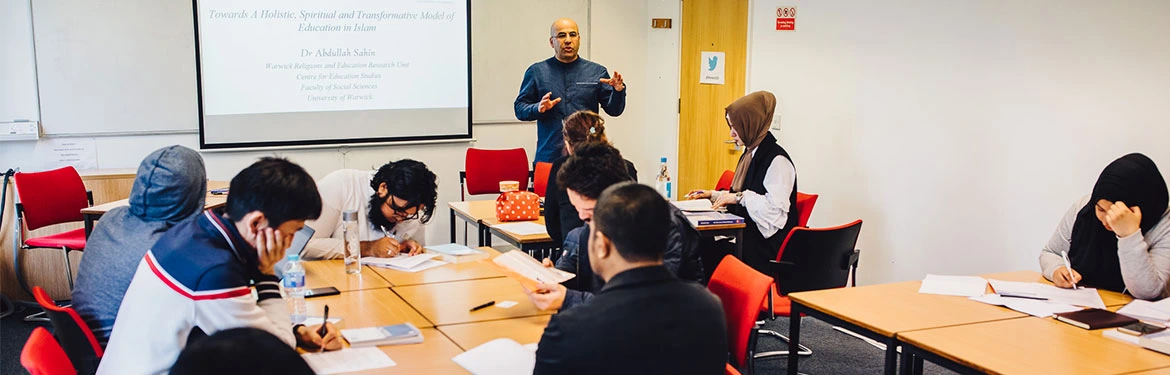
Explore faith-embedded education engaging with mainstream higher education through building transformative pedagogical competence.
This pioneering access course is the first of its kind to be offered at a UK university. It aspires to bridge the gap between the educational cultures of traditional Islamic seminaries and modern higher education. It is open to those who are interested in exploring the Muslim faith and its diverse educational traditions. You will critically explore narratives of education in Islam and engage with modern educational theory and models of pedagogical practice. You will gain essential research skills to identify and pursue further academic study in the field.
The PGA facilitates profound reflective engagement with the ways education is understood in both the Muslim tradition and the Western intellectual tradition. What I have learned from this course has been truly transformative and has changed me for life.
Muhammad Bhuta
Alumnus PGA
Modules
Build an in-depth understanding of the fundamentals of Islamic education, including its teachings, values, and traditions, through critical dialogue with modern educational theory and pedagogical practice.
Contemporary perspectives: Examine the role of Islamic education in modern multicultural societies and explore the pedagogical gap between traditional Muslim seminaries/Islamic schools and mainstream higher education.
Comparative skills: Critically compare how education is imagined in Islamic and Western secular traditions of education and pedagogical practice.
Scholarship skills: Develop the academic skills needed for further study and reflective professional practice.
Progression opportunities: Continue your studies by progressing to our PGCert in Islamic Education or MA Islamic Education: Theory and Practice.
Note that information found by following the links to the module catalogue is subject to change for future years of study, as we evolve our courses in response to the latest developments in academia and industry.
Teaching and learning
Grow your skills through expert guidance and flexible learning.
Online study available: learn from anywhere in the world
Research-led learning: critically explore educational values, theory and teaching practice
Learner-centred approach: develop reflective and inquiry-based approaches to education
Applied understanding: explore teaching and learning across a range of Muslim educational settings
Students on both modules are taught together (hybrid teaching). The overall
class size is typically 20-30 students.
This module is typically taught over ten weeks, with each session lasting 3
hours.
The course is assessed through a critical review and an essay. You will be guided to select the appropriate materials for completing your critical review essay.
Entry requirements
2:2 undergraduate degree (or equivalent) or Islamic Seminary Training having teaching experience within formal and informal community based educational settings (Islamic schools and supplementary education sector like Madrassas and Maktabs).
IELTS overall score of 7.0, minimum component scores of two at 6.0/6.5 and the rest at 7.0 or above.
Please adjust your country as required:
We welcome applications from students with other internationally recognised qualifications. For more information, please visit the international entry requirements page.
We typically ask for one academic reference for taught courses.
You will be asked to include an email address for your referee(s) when submitting your application and we will contact them for you.
The PGA in Islamic Education welcomes applications from both home and international students. The programme is delivered through face-to-face and flexible synchronous online learning modes.
International students will ordinarily undertake the programme online and will be charged the equivalent home fee rate. All applicants will be interviewed by the Course Leader to assess their suitability for the programme and ensure they have the required proficiencies for successful participation in the course.
Fees and scholarships
Tuition fees are payable for each year of your course at the start of the academic year, or at the start of your course, if later. Academic fees cover the cost of tuition, examinations and assessment and some student amenities.
We carry out an initial fee status assessment based on the information you provide in your application. Students will be classified as Home or Overseas fee status. Your fee status determines tuition fees, and what financial support and scholarships may be available. If you receive an offer, your fee status will be clearly stated alongside the tuition fee information.
Do you need your fee classification to be reviewed?
If you believe that your fee status has been classified incorrectly, you can complete a fee status assessment questionnaire. Please follow the instructions in your offer information and provide the documents needed to reassess your status.
As well as tuition fees and living expenses, some courses may require you to cover the cost of field trips or costs associated with travel abroad.
For departmental specific costs, please see the list of core and optional core modules with hyperlinks to our Module Catalogue, where module-related costs are detailed. Associated costs can be found on the Study tab for each module listed in the Module Catalogue (please note most of the module content applies to 2026/27 year of study).
Information about module specific costs should be considered in conjunction with the more general costs below:
Core text books
Printer credits
Dissertation binding
Robe hire for your degree ceremony
Dissertations and Assignments are only submitted digitally. However, students may wish to print and bind their dissertation for their own purposes. Students on some courses will have a final poster presentation as part of their project and the printing of posters may be at the students’ expense.
Find out about the different funding routes available, including; postgraduate loans, scholarships, fee awards and academic department bursaries.
Explore the power of education to transform lives.
Why study with us?
Join us to explore one of society’s most powerful forces for change. Education shapes how we think, participate and connect with the world - from classrooms and communities to prisons and pubs. Drawing on disciplines including sociology, psychology, history and philosophy, you’ll investigate the big questions around why, how and who we educate.
Challenge assumptions, broaden perspectives and rethink education beyond conventional boundaries as part of a rich and supportive research environment. Take advantage of opportunities to engage in an interdisciplinary academic community and collaborate with leading researchers across education and the social sciences.
You’ll have access to dedicated facilities, including a common room where students can work independently, collaborate on group projects, or simply relax. Based in the Social Sciences Building at the centre of campus, Education Studies is close to the Library, Warwick Arts Centre and the main lecture theatres of Ramphal, Oculus and FAB buildings - placing you at the heart of Warwick’s vibrant academic community and close to a range of study and learning spaces.
If you’re studying online, you can still access all of the same academic and student support.
Careers
Our degrees equip you with the skills and experiences needed to excel in your career. With access to exceptional career services, industry connections, and global opportunities, we’ll inspire and help you to aim high and achieve your goals. Our guidance ensures you graduate as a well-rounded professional ready for lifelong success.
Previous graduates from the Department of Education Studies have pursued occupations such as the following*:
Authors, writers and translators
Business and financial project management professionals
Charitable organisation managers and directors
Education advisor and school inspectors
Education managers and leaders
Primary, secondary and higher education teaching professionals
Higher level teaching assistants
Nursery education teaching professionals
Officers in armed forces
Social and humanities scientists
Social workers
Welfare and housing associate professionals
Youth and community workers
Graduates of this course would be well equipped to work in leadership positions relating to early years and children’s education, in addition to informal and non-formal educational institutions and organisations, including but not limited to NGOs, charities, local government educational provision.
Derived from the Graduate Outcomes survey, view details
*Derived from the Graduate Outcomes survey, 2021/22, carried out approximately 15 months after completion of studies.
Conducted annually, Graduate Outcomes collects information on the activities and perspectives of graduates. Contains HESA data: Copyright Jisc 2024. Jisc cannot accept responsibility for any inferences or conclusions derived by third parties from its data.
Your career path is unique to you. Our university careers team offer personalised support to help you develop your skills, plan your career path, and get experience at any point during your time at Warwick, and after graduation.
The dedicated, professionally qualified Senior Careers Consultant we work with offers impartial advice and guidance together with workshops and events throughout the year. Previous examples of workshops and events include:
Careers in Education
Careers with Children and Young People
Warwick careers fairs throughout the year
Meet Your Alumni: real-life career stories from the Department of Education Studies Alumni
While this course does not offer a formal work placement, postgraduate taught students at Warwick can self-source internships and work experience to complete alongside their studies, subject to visa conditions and the 20‑hour weekly limit for full‑time students.
Opportunities can vary in length and location, including in the UK, online and internationally. Postgraduate students find that shorter, remote and/or flexible opportunities work best around their studies, often seeking opportunities over the summer when teaching decreases and the focus moves to final dissertations and projects - although this can vary depending on the nature of the course and personal preference.
Support available:
The Internships, Placements and Work Experience team provide workshops to help you to source and prepare for work opportunities, and organise peer-to-peer support so you can hear about other students’ placement experiences.
The WorkReady Toolkit guides you through the whole process, from sourcing to completing work placements.
Our Work Experience Bursary can help you cover costs if undertaking unpaid work experience.
Part-time work allows you to gain experience and additional financial support, with opportunities advertised on Warwick’s careers portal, myAdvantage and Unitemps.
Warwick students worked 286,295 paid hours via Unitemps in 25/26.
Access short-term international study, work or volunteering abroad experiences, without extending the length of your studies (duration is typically between 3 days and 12 weeks), with opportunity to apply for funding.
Students can apply to TeamWork, a four-week part-time online international experience programme, helping them to gain work experience and improve their employability skills.
Volunteer for projects which support the local community through the award-winning Warwick Volunteers.
Getting involved in societies and sports teams, especially on exec teams.
In 25/26 our jobs portal advertised 1577 12-month placements, work experience opportunities, vacation employment and volunteering from 564 employers.
Whilst there is lots of support available at the University to help, students themselves are responsible for finding and securing a suitable internship or work experience. You will also be responsible for ensuring opportunities meet visa requirements, do not exceed the universities advised 20 hours per week for full-time students and for balancing extra-curricular activity with your studies.
This is where your journey begins. Our campus is the heart of it all. It’s more than just a campus - it's the places you visit, the people you meet, the fun that you have; the experiences you have here will be transformative.
Within a close-knit community of staff and students from all over the world, discover a campus alive with possibilities.
Our campus is where all the elements of your student experience come together in one place. You won't be short of ways to spend your time on campus - whether it's visiting Warwick Arts Centre, using our incredible sports facilities, socialising in our bars, nightclub and cafés, or enjoying an open-air event. Or if you need some peace and quiet, you can explore lakes, woodland and green spaces just a few minutes’ walk from central campus.
Follow our students around campus on our social channels to see their experiences first-hand.
Teaching facilities
Our campus is designed to cater for all of your learning needs. You will benefit from a variety of flexible, well-equipped study spaces and teaching facilities across the University.
Oculus, our outstanding learning hub, houses state-of-the-art lecture theatres and innovative social learning and network areas
Different study spaces offering you flexible individual and group study spaces, computers, printing and scanning facilities, multimedia resources and more
Supporting you
Our continuous support network is here to help you adjust to student life and to ensure you can easily access advice on many different issues. These may include managing your finances and workload, and settling into shared accommodation. We also have specialist disability and mental health support teams.
Whether you live on campus or off campus, in private accommodation in the well-serviced local area, you’ll be part of a community to get the most from your experience at Warwick.
Societies and sports play a huge part in community life at Warwick. With over 300 to choose from, getting involved is one of the easiest ways to make friends and share in experiences. Whether you’re into films, martial arts, astronomy, gaming or musical theatre, you can instantly connect with people with similar interests.
Your university experience is defined by far more than your course or the career path you follow. At Warwick, it’s where you discover who you could become.
68th
Warwick is ranked 68th in the world and top 10 in all major UK league tables
Our alumni community still call Warwick home. From a few hundred in 1965 to more than 310,000 alumni, and it's ever-growing.
As Warwick graduates, our students have access to employability support for two years after graduation, including access to careers appointments, job vacancies and professional networks.
Applications for courses starting in September and October 2027 are now open.
The on-time deadline for taught postgraduate courses starting in September/October 2027 is 2 August 2027.
We will still accept late applications, however cannot guarantee that the application will be processed in time to complete the admissions process if received in September or there are a number of conditions to meet.
If applying late please include your degree certificates and transcripts, English proficiency evidence (if needed) and ensure referees can submit references promptly to allow time for CAS and visa processing (if applicable).
This information is applicable for 2027 entry. Given the interval between the publication of courses and enrolment, some of the information may change. It is important to check our website before you apply. Please read our web page 'Important information to consider before making an application' in advance of applying to Warwick.
Next steps
Explore your future university further at an upcoming event, online or in-person. Can't join? Receive regular email updates or ask current students and staff questions about life at Warwick.