
Human-Centred Computing News
Warwick Postgraduate Colloquium in Computer Science 2017
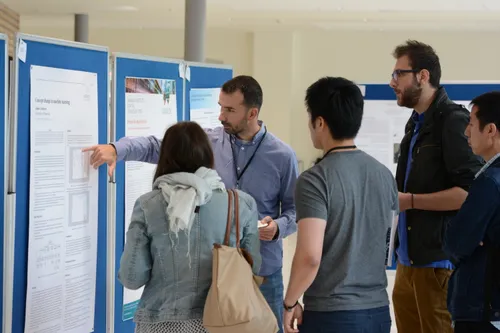
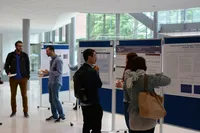
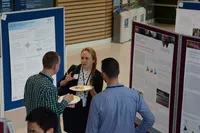
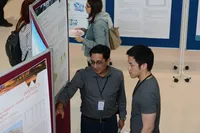
This year’s Warwick Postgraduate Colloquium in Computer Science (WPCCS) was held on Friday 30th June.
The event brought together postgraduate researchers from Computer Science and the CDT in Urban Science and Progress, and was held for the first time in the Oculus. This year, in addition to the student talks, the event also included both staff talks and external guest speakers.
The event was a huge success, with over fifty students and staff attending to both present and learn what their colleagues are researching. Thank you to all who attended and participated, and we look forward to seeing you next year!
To find out more about WPCCS 2017 or to provide feedback, please visit http://www2.warwick.ac.uk/fac/sci/dcs/research/wpccs/wpccs17/

Ranko Lazic appointed Leverhulme Research Fellow
 Dr Ranko Lazic has been awarded a Leverhulme Research Fellowship for the 2017/18 academic year, to work on the Petri nets reachability conjecture.
Petri nets, also known as vector addition systems, are one of the most prominent models of concurrency, and their study is a vibrant research area. They have been used to discover bugs and eliminate vulnerabilities in network protocols, concurrent software, business processes, hardware circuits, and control systems.
Professor Artur Czumaj, head of the Foundations of Computer Science research group, has commented:
This prestigious fellowship will further strengthen the internationally leading research in theoretical computer science at Warwick, which recently has been also greatly boosted by the new permanent appointments of Dr Sayan Bhattacharya and Dr Dmitry Chistikov.
Dmitry Chistikov joins the Department as a new Assistant Professor
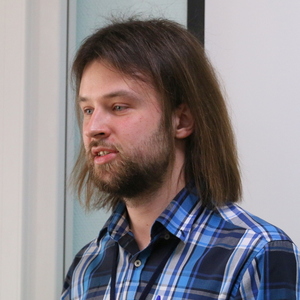 The Department is welcoming our new Assistant Professor Dmitry Chistikov, who will be associated with the Division of Theory and Foundations (FoCS) and the Centre for Discrete Mathematics and its Applications (DIMAP).
After obtaining his Candidate of Sciences (equivalent to PhD) degree at the Department of Computational Mathematics and Cybernetics of Moscow State University, Dmitry was a postdoctoral researcher at the Max Planck Institute for Software Systems, as wel as at the University of Oxford.
The general area of Dmitry's research is theoretical computer science. In particular, he is interested in theoretical foundations of verification: its algorithmic aspects (decision and counting problems) as well as combinatorial aspects (extremal properties and characteristics of mathematical models of computation).
For more information about Dmitry's research, please see his web page.