Human-Centred Computing News
Warwick mathematician awarded prestigious mathematics award
 We offer our warmest congratulations to Professor Martin Hairer, Regius Professor of Mathematics in Warwick’s Mathematics Institute, who has has been awarded the Fields Medal, the world’s most prestigious mathematics award, for his "Outstanding contributions to the theory of stochastic partial differential equations, and in particular for the creation of a theory of regularity structures for such equations."
The Fields Medal is awarded every four years on the occasion of the International Congress of Mathematicians to recognize outstanding mathematical achievement for existing work and for the promise of future achievement. The Medal is internationally regarded as the world’s most prestigious award in the field of mathematics.
Lei Shi receives top award at UMAP'14
Lei Shi, a doctoral student in the Department of Computer Science at Warwick, has received a top award for his work at UMAP, the premier international conference for researchers and practitioners working on systems that adapt to individual users.
UMAP 2014 was held in Aalborg, Denmark on the 7-11 July 2014. The conference spans a wide scope of topics related to user modeling, adaptation and personalization, and was sponsored by Microsoft Reasearch and the NSF.
Lei will begin a Warwick Institute of Advanced Study (IAS) Early Career Fellowship in October. More information on his work can be found at http://www.shilei.io
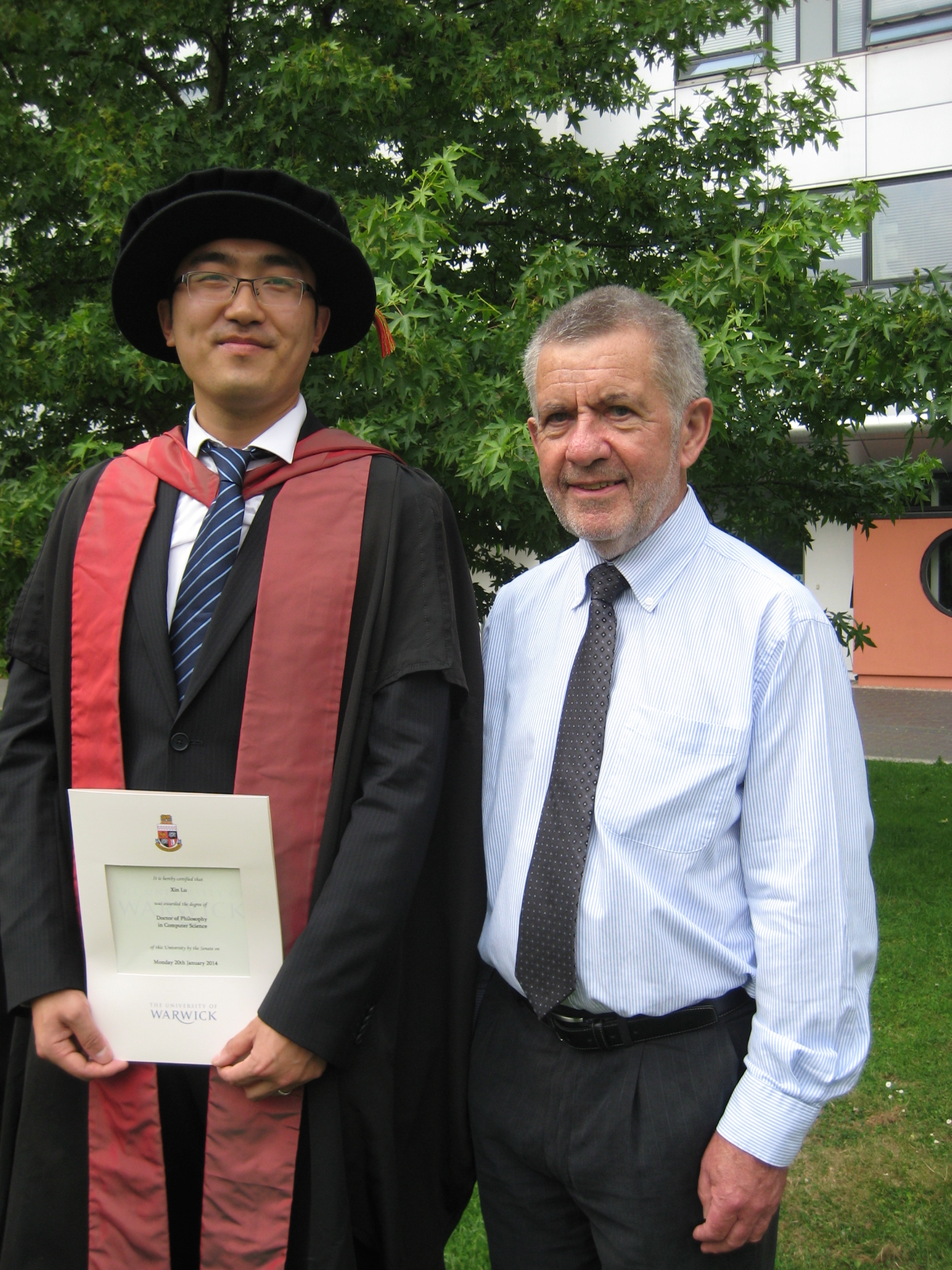
Xin Lu wins Science Faculty Prize
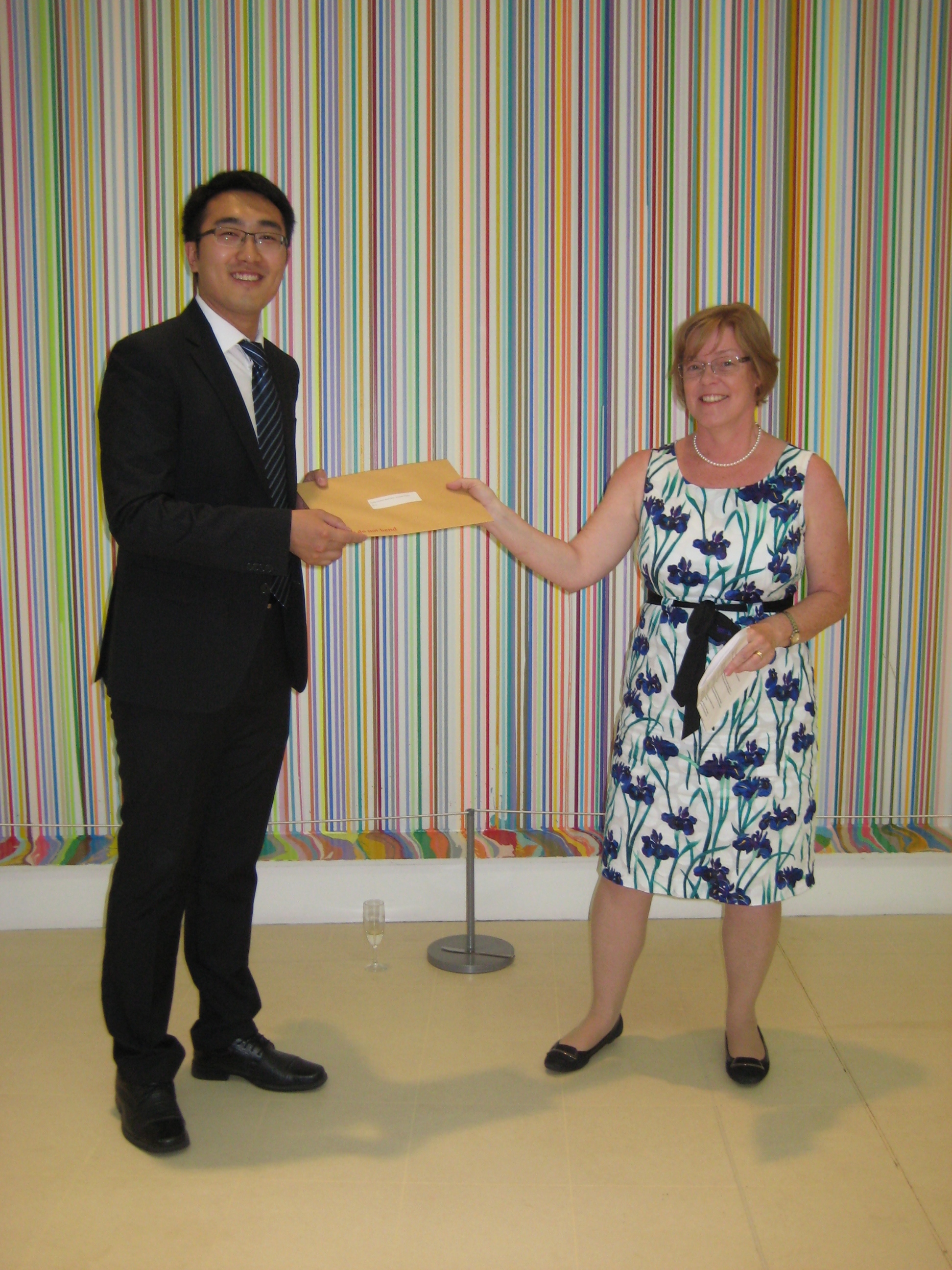
We congratulate Xin Lu who has been awarded the Science Faculty Prize for the Best PhD Thesis in Computer Science. Xin’s thesis, entitled “Efficient algorithms for scalable video coding” and supervised by Graham Martin, was examined by Professor Mohammed Ghanbari, a leading international authority and IEEE medal winner for his pioneering work on scalable video coding. Professor Ghanbari acknowledged that Xin’s research output represented a significant contribution to the field. The results have also been published in a number of international conference and journal papers, including the IEEE Transactions on Circuits and Systems for Video Technology.
Xin Lu’s PhD degree was conferred by the University Chancellor at the Degree Congregation last Friday, and the Faculty Prize was presented by Professor Pam Thomas, Chair of the Faculty of Science, at a special event held in the Zeeman building on 23rd July. Xin Lu has now returned to China to continue his work as a lecturer at the Harbin Institute of Technology, one of the top ten universities in the country.