
Human-Centred Computing News
Department of Computer Science wins BCS Education Bursary
The Department of Computer Science at Warwick University has been successful in applying for a BCS Education Bursary to provide support for ICT and Computing teachers. The department is 1 of only 31 institutions to receive the funding from over 200 applications.
The teaching of Computer Science in schools is undergoing major change. In response to teaching of ICT described as "demotivating and dull", Education Secretary Michael Gove announced the scrapping of the existing ICT curriculum in January and, more recently, plans to axe ICT teacher training courses next year.
‘Introduction to Computer Programming and Concepts’ is designed to provide much needed support for teachers, helping them get to grips with key Computer Science concepts and develop programming skills. We will be providing a supportive environment, teachers will have the opportunity to learn skills and learn from each other
The course will consist of six 3-hour events spread between November 2012 and April 2013.
The course is also supported by Computing At School and The Network of Excellence.
Daniel Kral joins the Department of Computer Science as a new Professor

Daniel Kral joins the Department of Computer Science and the Warwick Mathematics Institute as a new Professor in October 2012. He is affiliated with the DIMAP Centre and with the FoCS Research group.
Daniel obtained his PhD in Computer Science in 2004 from Charles University, Prague, Czech Republic. Then he spent time as a postdoc at the Technical University Berlin, visiting assistant professor and Fulbright scholar at the Georgia Institute of Technology, Atlanta, researcher at the Institute for Theoretical Computer Science, Charles University, Prague, and finally a tenured associate professor post at the Department of Applied Mathematics and Computer Science Institute, Charles University, Prague.
Daniel's primary research interest lies on the boundary of discrete mathematics, combinatorics, and algorithms design. More detailed list of his interest includes extremal combinatorics and dense combinatorial objects, use of combinatorial optimization techniques in graph theory, structural graph theory, in particular, graph coloring, graph and matroid decompositions and their algorithmic applications. He published around 100 journal papers in leading international journals, including publications in Advances in Mathematics, Combinatorica, Computational Complexity, Israel Journal of Mathematics, Journal of Combinatorial Theory Series A and B, Journal of Graph Theory and SIAM Journal on Discrete Mathematics. Conference publication include those at FOCS, ICALP, SODA and STACS conferences. Daniel's research has been highly recognised by the number of invited plenary talks at international conferences, he has been awarded the prestigious European Prize in Combinatorics in 2011, and he is the recipient of ERC Starting Grant 2010 »Classes of Combinatorial Objects - from Structure to Algorithms«.
For more information about Daniel's research please visit his homepage.
Congratulations to Anna Adamaszek for completing her PhD
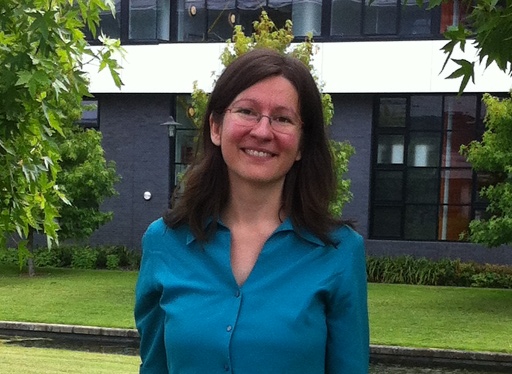
Anna Adamaszek successfully completed her PhD with the Thesis entitled "Approximation Algorithms for Geometric, Caching and Scheduling Problems", under the supervision of Prof Artur Czumaj.
Anna's PhD focuses on the study of approximation algorithms for optimization problems, one of the core areas of modern theoretical computer science. She has obtained research results in two areas: geometric optimisation algorithms and online algorithms. In the first topic, she presented new approximation algorithms for the capacitated location routing problem and the capacitated network design problem in the Euclidean plane. For online algorithms, she made a major progress in the study of two well known caching and scheduling problems: the generalized caching problem and the reordering buffer management problem. Her research has been presented in several most prestigious conferences in the field, including STOC'2011, ICALP'2011, and SODA'2012.
After completing PhD in Warwick, Ania moved to Germany, where she has been awarded a prestigious Lise-Meitner-Award postdoctoral fellowship at the Max-Planck-Institut für Informatik in Saarbrücken.