
News
See below for the latest news from the Warwick Crop Centre.
For our latest publications see Crop Centre in Print
New Centre For Crop Health and Protection (CHAP) established in UK
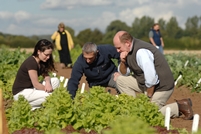 The 24 March 2016 saw the launch of a new Centre for Crop Health and Protection (CHAP) established under the government’s Agri-Tech strategy, which was initiated in 2013 to ensure that its investment in agriculture delivers material benefits for society and the economy in the UK and overseas.
CHAP will lead the way in developing solutions to the challenges facing world agriculture, bringing together the best expertise, knowledge and insight from leading research organisations and industries in the sector. This collaboration between academia and industry will, for the first time, give farmers access to the best and most sustainable technologies, strategies and protocols to improve crop performance, making a real difference at the farm gate.
University of Warwick researchers will be developing novel control technologies to tackle a range of pests and diseases that are responsible for significant crop losses in fresh produce. The number of active ingredients available to growers is decreasing all the time, so the demand for novel control technologies with minimal environmental impacts has never been greater. Potential new products and approaches to their application will be evaluated and refined in Warwick’s controlled environment and field trial facilities, and integrated into commercially viable crop management strategies.
New AHDB-funded project on cavity spot led by John Clarkson
FV 391a - Carrots: Development of artificial inoculation techniques for cavity spot caused by Pythium violae.
Cavity spot caused principally by P. violae is the major disease of carrots in the UK. Management of the disease relies on the fungicide metalaxyl-M although its efficacy is variable. The reliance on this single fungicide is of major concern to the industry as its future efficacy and sustainability is uncertain. To address this, previous AHDB Horticulture projects have evaluated potential new control measures including fungicides, biological control treatments, calcium applications and biofumigation. However, progress has been severely hampered by a lack of sufficient disease levels in many of these trials and hence new treatments have not been clearly identified. This project will test different growth media and conditions for P. violae inoculum production and define appropriate rates required for symptom development in pot and field grown carrots. The feasibility of large scale production of inoculum using solid state fermentation will also be evaluated.