
News
See below for the latest news from the Warwick Crop Centre.
For our latest publications see Crop Centre in Print
GARNish newsletter puts spotlight on plant science at Warwick
 The latest GARNish newsletter highlights plant science in Life Sciences, profiling the work of our academics.
'Plant science research at the University of Warwick is characterised by the breadth of expertise - from fundamental molecular mechanisms to projects with direct application to industry. We have world-class basic science in signalling, gene regulation, development, plant– environment (microbes, virus, soil) interactions, and evolution through to pest management, crop genetics and genomics underpinning the development of new varieties.'
Read the newsletter (pdf)
New collaborative food systems learning programme funded by HEFCE
The University of Warwick is a partner in an exciting new initiative, the Innovative Food Systems Teaching and Learning (IFSTAL) programme, designed to improve post-graduate level knowledge and understanding of the food system. Through IFSTAL, students will be equipped with the knowledge, skills and opportunities needed for them to be more effective in the workplace. This will allow them to address the systemic failings in food systems which have resulted in about one billion people being hungry, two billion lacking sufficient nutrients, and over two billion overweight or obese.
With core funding from the Higher Education Funding Council for England (HEFCE), IFSTAL will bring together expertise and experience of faculty and students from five leading higher education institutions. Post-graduate students at these institutions, with an interest in ‘food systems’, will have the opportunity to participate and become part of the IFSTAL community.
Participating institutions are the University of Oxford (lead institution), City University-London, University of Reading, University of Warwick and the Leverhulme Centre for Integrative Research on Agriculture and Health (LCIRAH, comprising researchers from the Royal Veterinary College, the London School of Hygiene and Tropical Medicine, and the School of Oriental and African Studies).
School of Life Sciences awarded over £1.3m to research food security
Researchers from the University of Warwick’s School of Life Sciences (SLS) have been awarded over £1.36m in grants to further their work into food security.
The BBSRC Horticulture and Potato Initiative (HAPI) grants include substantial cash and in-kind contributions from industrial partners and will be used to support work into how to improve pest and disease control and post-harvest quality.
Commenting on the grants Professor Laura Green, Head of SLS, said:
“The BBSRC HAPI grants will help ensure that the University of Warwick’s School Life Sciences continues to play a leading role in improving food production globally. The Warwick HAPI-funded projects will result in substantial impacts on the horticulture industry by translating research findings into solutions that benefit several stages in the food supply chain, including farmers, processors and retailers.”
Insecticide-based brassica seed treatment to help protect against Turnip yellows virus, estimated to save the industry £58M in 2015
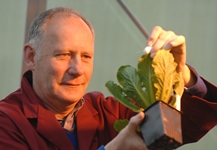 Research by Dr John Walsh from the School of Life Sciences, funded by the Horticultural Development Company, has provided the scientific evidence required to justify an Emergency Crop Protection Authorisation enabling the use of an insecticide-based seed treatment in the UK.
John’s research demonstrated the role played by peach-potato aphid in carrying Turnip yellows virus (TuYV), the most damaging of all viruses transmitted by aphids in brassica crops, which results in yield losses and tipburn after storage. The seed treatment technique protects plants from aphid attack for up to ten weeks after planting and effectively reduces and delays TuYV infections.
The Brassica Growers Association estimated that this has saved the industry around £58M in 2015 due to the reduced requirement for additional insecticide treatments, and prevention of yield and storage losses. Current research funded by BBSRC is based on developing an integrated strategy for control of TuYV in crops.