
News
See below for the latest news from the Warwick Crop Centre.
For our latest publications see Crop Centre in Print
100k BBSRC award to boost real-world impact of bioscience research
The School of Life Sciences has been awarded a £100,000 grant to help its research create a bigger impact in society and the wider economy.
The BBSRC Sparking Impact award will enable scientists to better understand the needs of wider society, for example in the worlds of business, agriculture, charities or health.
Paul Neve to share expertise at Australia's inaugural herbicide resistance conference
 Leading international weed scientist Paul Neve heads a team of researchers in the United Kingdom trying to unlock the secrets of evolution of herbicide resistance.
This fundamental scientific effort has widespread implications for grain producers around the world in managing and slowing the onset of resistance. Of particular interest is whether the common practice of using low dose, or below label, rates of herbicides actually contributes to more rapid development of herbicide resistance.
This will be the focus of Dr Neve’s presentation to Australia’s inaugural herbicide resistance conference – the Global Herbicide Resistance Challenge – sponsored by the Grains Research and Development Corporation (GRDC). The conference will be held at the Esplanade Hotel in Fremantle from February 18 to 22 and brings together top international scientists and major chemical companies.
Major issues to be discussed include the threat of herbicide resistance and its impact on global grain production, alternatives to chemical weed control and latest gene modification advances.
For more information or to register for the Global Herbicide Resistance Challenge, visit www.herbicideresistanceconference.com.au
 , or contact conference chair Lisa Mayer at AHRI, Phone: 08 6488 7870 or email: lisa.mayer@uwa.edu.au.
Scientific fertilization is important to the development of China's agriculture
Dr Clive Rahn, an Associate Fellow at Warwick Crop Centre, recently went to the Northwest Agriculture and Forestry University of Science and Technology in Shaanxi Province, China .The trip was part of an academic exchange during the Agricultural High Technology Fair in Yangling.
As part of his visit, Dr Rahn met with members of the UK- China Sustainable Agriculture Innovation Network (SAIN), which provides a framework for the development and implementation of collaboration on sustainable agriculture between the UK and China.
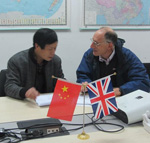
Dr Clive Rahn with Prof Tong Yanan (Secretariat of the China office),
SAIN office, Yangling.
Clive was also interviewed by Wu Dun of the Shaanxi Daily. In the article Dr Rahn identified some of the key issues in China’s agricultural practices:
- In the Chinese countryside, farmers mostly continue to use the traditional fertilization methods,. which lead to blind over-fertilization with very serious environmental consequences. Few farmers use modern scientific fertilization methods, that are available, which recommend fertilizer applications matched to plant demand thus reducing the amounts of waste. Blind over-fertilization not only increases the cost of production but damages soil quality, and leads to pollution.
- The expansion of the area of China’s greenhouse is fast, and increasing. There are large amounts of irrigation and all kinds of fertilizers used, which also make the problems of excessive irrigation and fertilization more serious. This leads to more nitrate leaching and groundwater pollution.
- Farmers don’t know what to do when faced with the myriad of fertilizers available from the complex fertilizer market.
- Whilst the advanced-technology of ‘Agricultural High Technology Fair’ looks seemingly close to farmers, the ‘last step’ to the transfer knowledge farmers is very difficult.
These issues show that disseminating best practice about scientific fertilization is particularly important and urgent in China's agricultural development.
Clive was able to inform the Shaanxi Daily that the European Union has established many laws and regulations, such as the Nitrate Directive and Water Framework Directive. Each country within Europe has refined its laws and regulations to suit local conditions. The times when chemical fertilizer can be applied are strictly regulated and protected by law in Nitrate Vulnerable Zones and English farmers have a national Crop Fertilizer Recommendation Handbook.
Although the Chinese government has started to promote the measuring of soil nitrogen and other schemes for better fertilization, Clive emphasized the need for improved knowledge transfer from researchers to farmers.
For more details on SAIN see http://www.sainonline.org/English.html
The Shaanxi Daily interview (in Chinese)