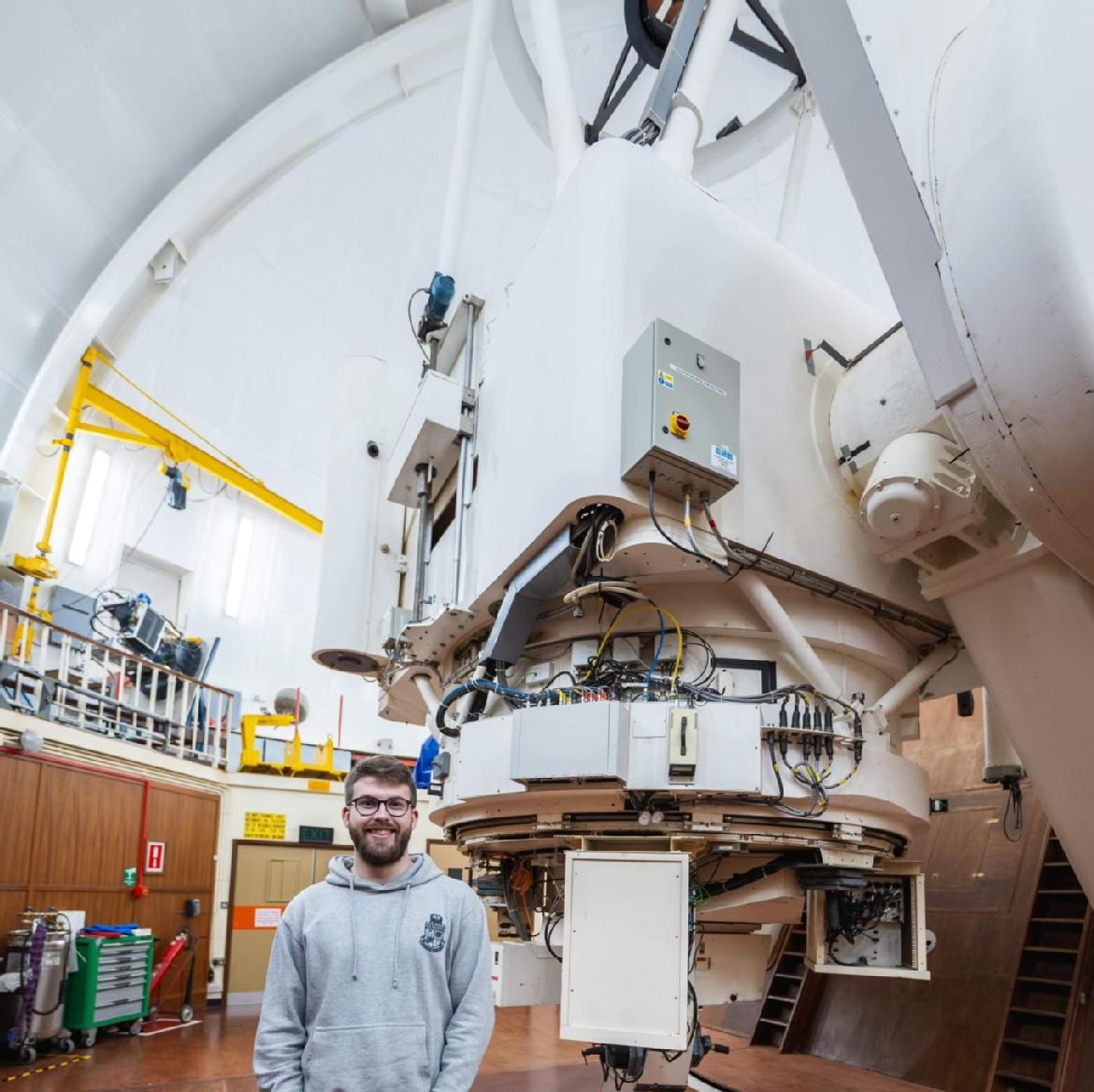
Ben Davies
About me
I am a final year PhD student, supervised by David BrownLink opens in a new window. My research focuses on detecting and characterising circumbinary planets from space-based transiting planet surveys, particularly using data from the TESSLink opens in a new window mission.
Current research
Circumbinary planets (CBPs) are planets that orbit both components of a stellar binary. Currently, only 14 transiting CBPs have been discovered, while thousands of transiting planets have been discovered orbiting around single stars. This discrepancy is partially due to observational bias, but also due to their orbital properties; CBPs tend to have long periods, due to orbital stability constraints, and their orbital planes precess such that a CBP can oscillate between transiting and non-transiting orbital configurations on timescales of decades. My research aims to develop a better understanding of these planetary systems by increasing the population of transiting CBPs, developing techniques to enable more efficient detection of these planets, and determining their characteristics. This primarily involves analysing data from space-based surveys, particularly TESS, as well as archival/follow-up observations to characterise planet candidates. Increasing the number of confirmed CBPs will not only help us understand the statistics of the CBP population, and how they fit into the population of exoplanets, but will also help us to understand their complex formation processes and dynamical history.
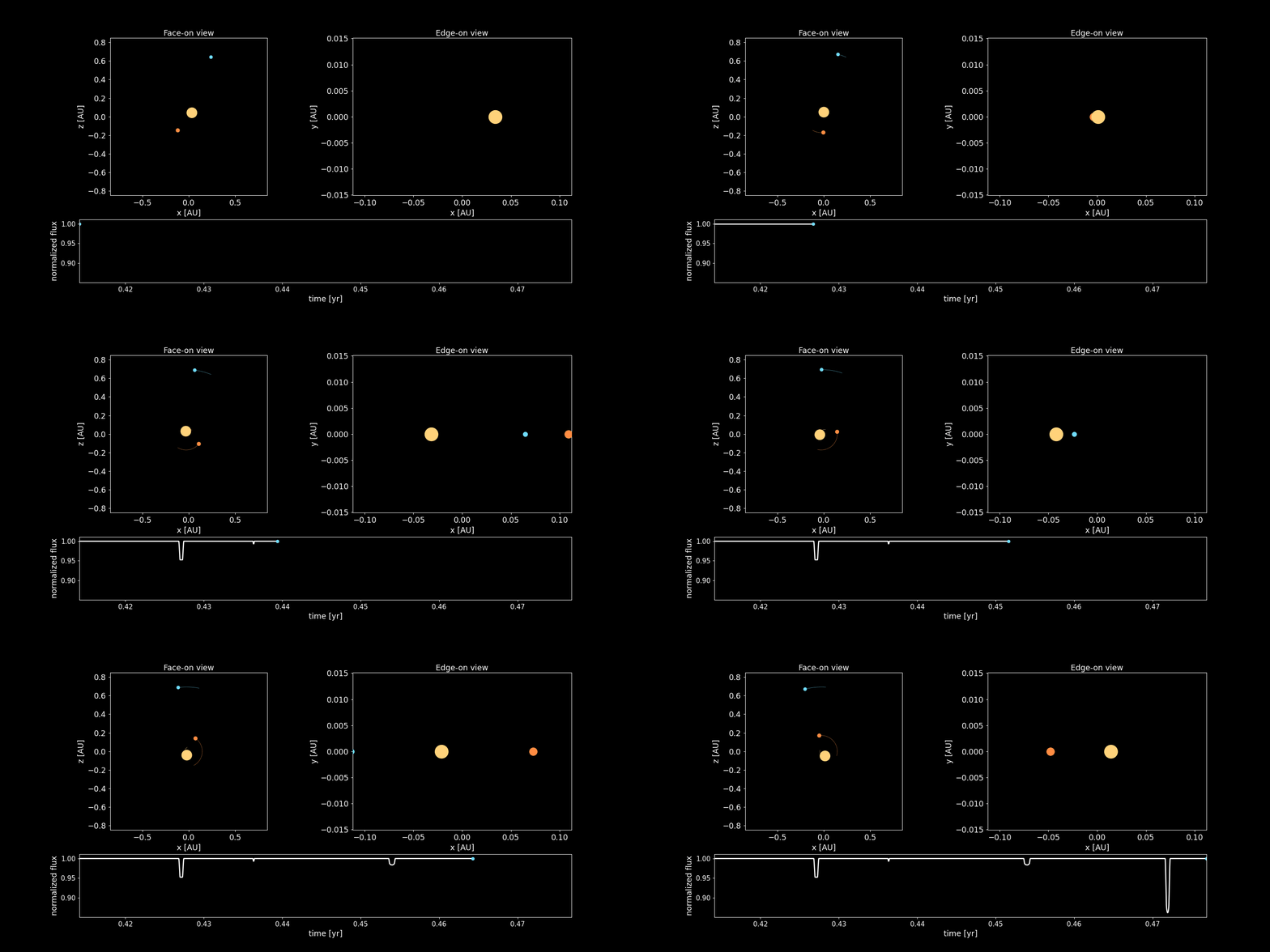
The below GIF highlights the geometry of a CBP system. The primary star (largest circle in the top two panels, yellow) and secondary star (smaller, orange circle) orbit each other, while the planet (blue circle) orbits the centre of mass of the stellar binary. The bottom panel shows gives an idea of what a light curve of a CBP system looks like. In this particular scenario, we see deep secondary and primary eclipses, at the beginning and end of the light curve, respectively. Since these dominate the morphology of the light curve, these must be removed from the data in order to detect transiting CBPs effectively. The light curve also contains a "one-two punch", whereby the planet transits the secondary and the primary star in the same conjunction. This can be seen in the light curve as a short-duration, tiny dip as the CBP transits the secondary, followed by a long-duration, deeper transit across the primary star. These, as well as strong transit timing and duration variations, are the smoking-gun signatures of these planets.
To aid in the detection of these planets, I developed a Python package called mono-cbpLink opens in a new window, which identifies and vets candidate CBP transit events in TESS light curves of eclipsing binaries. We applied this to the TESS Eclipsing Binary CatalogueLink opens in a new window, finding one candidate CBP transit. You can read more about this search, as well as how mono-cbp works and how effective it is at identifying the known transiting CBPs, in our recent paperLink opens in a new window. The eventual aim is to use this code to re-evaluate the occurrence rate of CBPs based on TESS data.
Past research projects
- Characterising exocomets in the far-UV (supervisor: Paul Strøm) - MPhys project (2022)
- White dwarfs as tracers of stellar and galactic evolution: analysing the first data from SDSS-V (supervisor: Boris Gänsicke) - Undergraduate summer project (2021)
- Spectroscopic characterisation of exoplanet atmospheres: benchmarking analysis techniques (supervisor: Matteo Brogi) - Undergraduate summer project (2020)
Teaching and outreach
- PX146: Key Skills for Physics - Senior Graduate Teaching Assistant
- Manager and volunteer for Warwick Mobile Planetarium
- Carried out a research project in a local state school as part of the OrbytsLink opens in a new window project
Conferences and workshops
- PLATO ESP 2026, University of Warwick (16th-18th September 2026, presented a poster)
- Multiple Planet Systems, Sofia University (31st August-4th September 2026, presented a talkLink opens in a new window)
- UKExoM 2026, University of Bristol (30 March-2 April 2026, presented a poster)
- Exploring Tatooine and Beyond: Circumbinary Planets with ESA Missions (10-12 December 2025, presented a talkLink opens in a new window)
- The formation and long-term evolution of circumbinary planetary systems across the H-R diagram (12-17 January 2025, presented a talkLink opens in a new window)
- Celebrating 21 Years of Astronomy at Warwick, University of Warwick (4-6 September 2024, attended)
- TESS Science Conference III, Massachusetts Institute of Technology (29 July-2 August 2024, presented a poster)Link opens in a new window
- Summer School in Statistics for Astronomers, Penn State University (3-7 June 2024, attended online)
- ESP2024: PLATO Planetary Systems - From Formation to Observed Architectures, Catania Astrophysical Observatory (14-16 May 2024, attended online)
- UKExoM 2024, University of Birmingham (9-11 April 2024, presented a posterLink opens in a new window)
- STFC Introductory Summer School in Astronomy 2023, University of Hull (28-31 August 2023, attended)
Publications
Leading
- B. D. R. Davies et al. "Finding Circumbinary Planets: A Semi-Automated Transit Search of TESS Eclipsing BinariesLink opens in a new window", MNRAS 548, 4 (June 2026)
Contributing
- B. Godson (incl. B. D. R. Davies) et al. "The Gravitational-wave Optical Transient Observer (GOTO) Fast Analysis and Spectroscopy of Transients (FAST) SurveysLink opens in a new window", MNRAS 552, 3 (November 2026)
- J. T. Williams (incl. B. D. R. Davies) et al. "Discovery of a second-generation planet candidate accreting onto a white dwarfLink opens in a new window", Nat. Astron. (Advanced Online Publication, October 2026)
- I. Apergis (incl. B. D. R. Davies) et al. "NGTS-39 b: a 58 d transiting warm Jupiter in an eccentric orbit", MNRAS 550, 2 (August 2026)
- T. Rodel (incl. B. D. R. Davies) et al. "TIC-65910228 b / NGTS-38 b, a 180 d transiting warm super-Jupiter", MNRAS 549, 4 (July 2026)
- T. L. Killestein (incl. B. Davies) et al. "SN 2024cld: unveiling the complex mass-loss histories of evolved supergiant progenitors to core collapse supernovaeLink opens in a new window", MNRAS 548, 2 (May 2026)
- L. Makrygianni (incl. B. D. R. Davies) et al. "The Double Tidal Disruption Event AT 2022dbl Implies that at Least Some "Standard" Optical Tidal Disruption Events Are Partial DisruptionsLink opens in a new window", ApJL 987, 1, L20 (July 2025)
- K. Inight (incl. B. D. R. Davies) et al. "Cataclysmic Variables from Sloan Digital Sky Survey – V. The search for period bouncers continuesLink opens in a new window", MNRAS 525, 3, 3597 (November 2023)