
Research News & Highlights
ALMA imaging of the M-dwarf Fomalhaut C's debris disc
Patrick F. Cronin-Coltsmann, Grant M. Kennedy, Paul Kalas, Julien Milli, Cathie J. Clarke, Gaspard Duchêne, Jane Greaves, Samantha M. Lawler, Jean-François Lestrade, Brenda C. Matthews, Andrew Shannon, Mark C. Wyatt
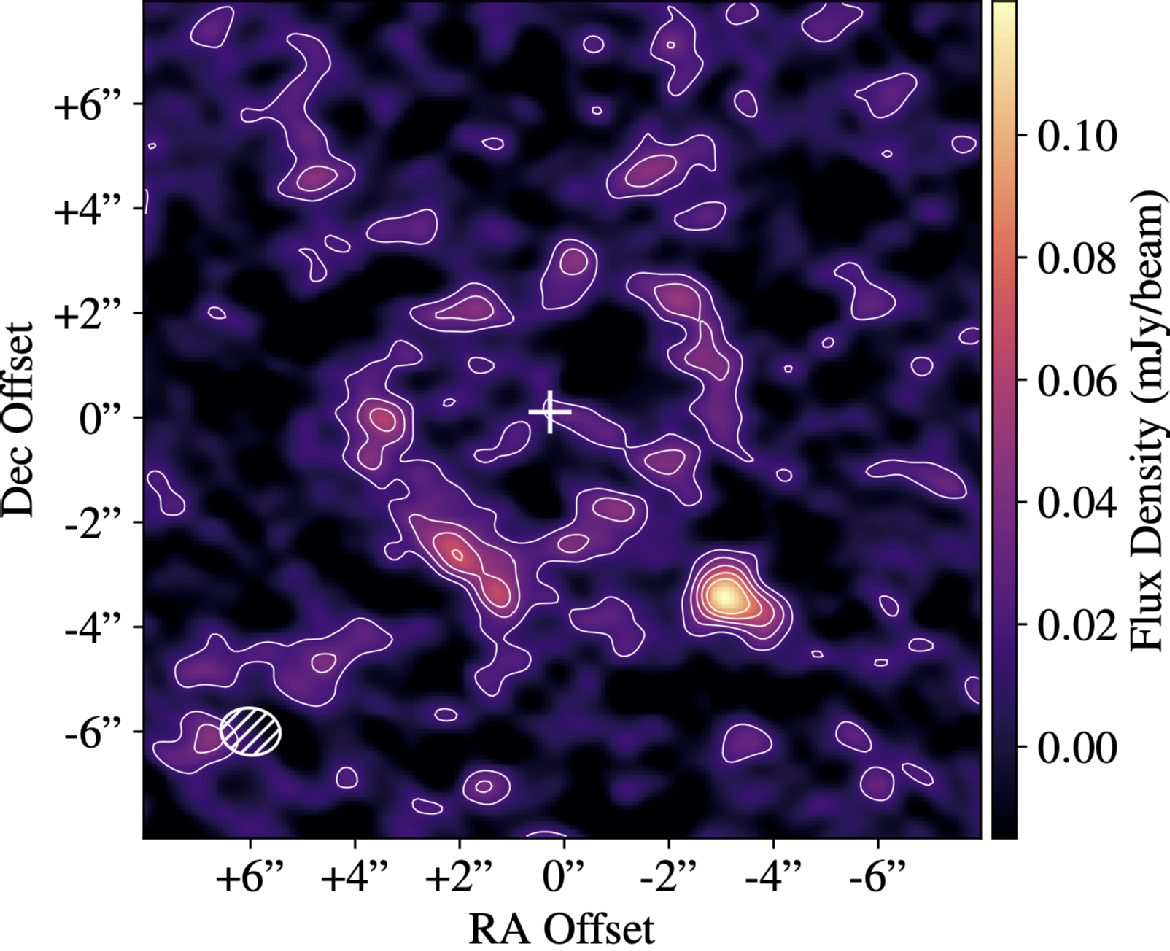
Fomalhaut C (LP 876-10) is a low mass M4V star in the intriguing Fomalhaut triple system and, like Fomalhaut A, possesses a debris disc. It is one of very few nearby M-dwarfs known to host a debris disc and of these has by far the lowest stellar mass. We present new resolved observations of the debris disc around Fomalhaut C with the Atacama Large Millimetre Array which allow us to model its properties and investigate the system's unique history. The ring has a radius of 26 au and a narrow full width at half maximum of at most 4.2 au. We find a 3σ upper limit on the eccentricity of 0.14, neither confirming nor ruling out previous dynamic interactions with Fomalhaut A that could have affected Fomalhaut C's disc. We detect no 12CO J=3-2 emission in the system and do not detect the disc in scattered light with HST/STIS or VLT/SPHERE. We find the original Herschel detection to be consistent with our ALMA model's radial size. We place the disc in the context of the wider debris disc population and find that its radius is as expected from previous disc radius-host luminosity trends. Higher signal-to-noise observations of the system would be required to further constrain the disc properties and provide further insight to the history of the Fomalhaut triple system as a whole.
UKEXOM 2021
Sahl Rowther -- Giant Planets Can Suppress Gravitational Instabilities In Protoplanetary Discs
The work covered in this talk is described in Rowther et al. 2020.
KITP Online Conference: White Dwarfs from Physics to Astrophysics
Christopher Manser -- Gaseous planetary discs around white dwarfs
Five Years After HL Tau
Sahl Rowther -- Are Gravitationally Unstable Protoplanetary Discs Rare?
The work covered in this talk is described in Rowther et al. 2020.
Rebecca Nealon -- Spirals, Shadows and Precession in HD 100453 Part 2
Part 1 can be viewed here.
Dimitri Veras - Constraining Planet Formation Around 6-8 Solar Mass Stars
The work covered in this talk is described in Veras et al. 2020.
Hiding Signatures of Gravitational Instability in Protoplanetary Discs with Planets
Sahl Rowther, Farzana Meru, Grant M. Kennedy, Rebecca Nealon, Christophe Pinte
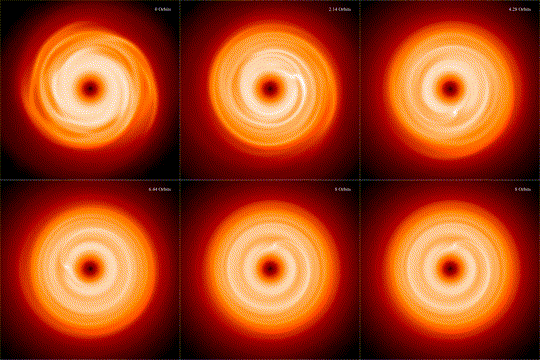
We carry out three-dimensional smoothed particle hydrodynamics simulations to show that a migrating giant planet strongly suppresses the spiral structure in self-gravitating disks. We present mock Atacama Large Millimeter/submillimeter Array (ALMA) continuum observations that show that in the absence of a planet, spiral arms due to gravitational instability are easily observed. Whereas in the presence of a giant planet, the spiral structures are suppressed by the migrating planet resulting in a largely axisymmetric disk with a ring and gap structure. Our modeling of the gas kinematics shows that the planet's presence could be inferred, for example, using optically thin 13C16O. Our results show that it is not necessary to limit the gas mass of disks by assuming high dust-to-gas mass ratios in order to explain a lack of spiral features that would otherwise be expected in high-mass disks.
Exoplanet Demographics
Christopher Manser -- Doppler Imaging of a Second Planetary Debris Disc Around a White Dwarf
Talk begins at 4:16:02.
Dimitri Veras -- Full-lifetime Simulations of Planetary Systems
Talk begins at 2:00:00.
Catriona McDonald -- Triaxial Asteroids as Reservoirs for Planetary Debris around White Dwarfs
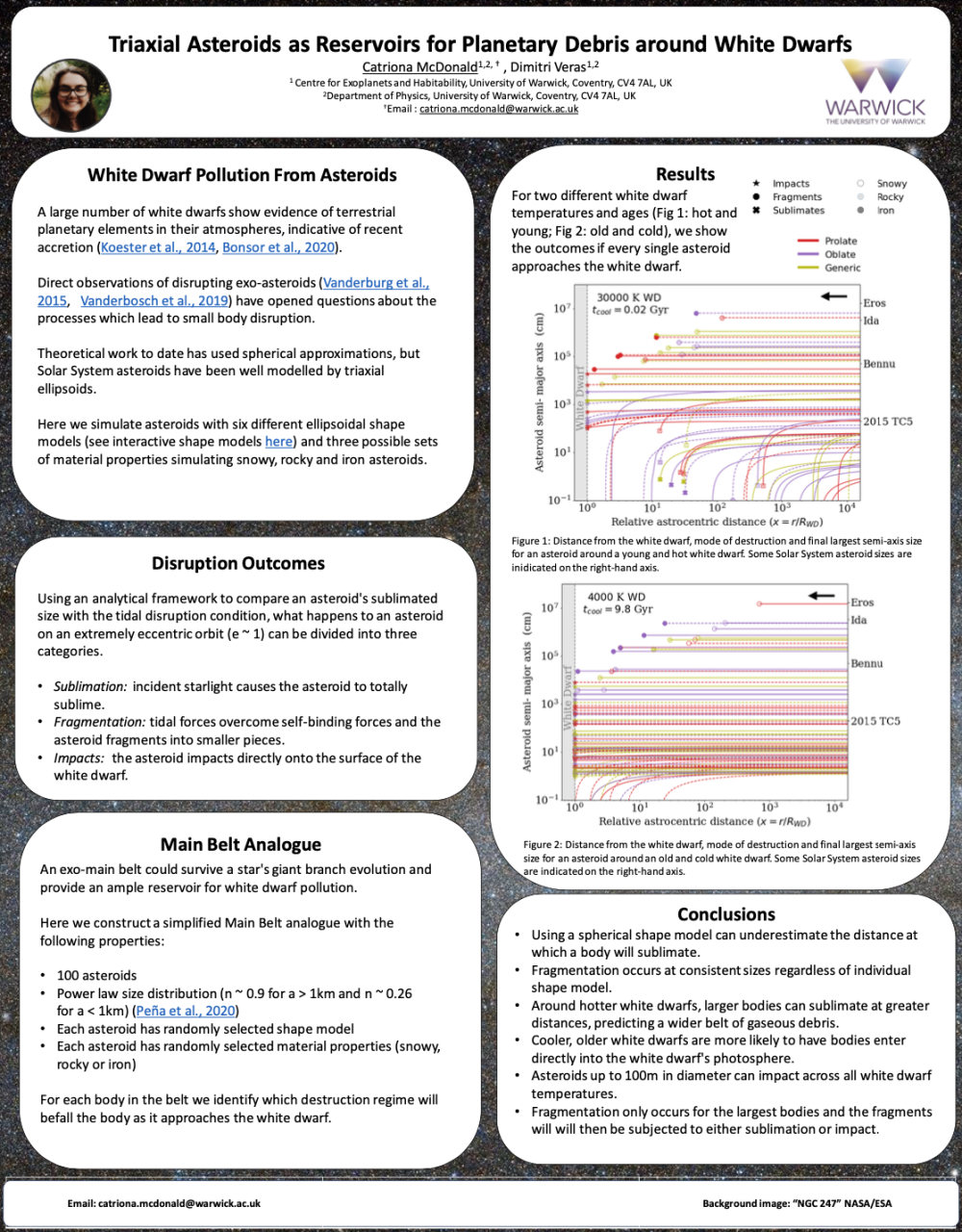
Here, we present an analytical framework incorporating tidal, self-gravitational and internal strength forces to triaxial ellipsoids approaching a white dwarf on extremely eccentric (e ~ 1) orbits. Such extreme orbits could be produced by dynamic interactions with planets in the white dwarf system. The subsequent disruption of the asteroids is split into three distinct regimes: tidal fragmentation, sublimation, and direct impact. This framework is extended to cover a simplified Main Belt analogue of 100 planetesimals with an observational size distribution and randomly chosen shape model and material, for a range of white dwarf temperatures. We find that using a spherical shape model consistently underestimates where sublimation occurs and overestimates fragmentation distance. The small spatial scales of white dwarf planetary systems can cause these discrepancies to have a large effect on predicted debris distributions. Our results allow us to place constraints on the expected planetary debris from asteroids at different white dwarf cooling ages and motivates future studies to include more accurate shape models
Spirals, shadows and precession in HD 100453 - II. The hidden companion
Rebecca Nealon, Nicolás Cuello, Jean-François Gonzalez, Gerrit van der Plas, Christophe Pinte, Richard Alexander, François Ménard, Daniel Price
 The protoplanetary disc HD 100453 exhibits a curious combination of spirals, shadows, and a relative misalignment between the observed outer disc and inferred inner disc. This disc is accompanied by a secondary star on a bound orbit exterior to the disc. In our companion paper, the orbit of the secondary was shown to be misaligned by 61° to the plane of the outer disc. Here, we investigate the properties of the inner companion and the origin of the misalignment between the inner and outer discs. In our proposed model, the misalignment observed between the outer and inner disc arises naturally as a result of the misaligned outer companion driving the outer disc to precess more rapidly than the inner disc.
Exoplanets III
Sahl Rowther -- Hiding Signatures of Gravitational Instability in Protoplanetary Discs
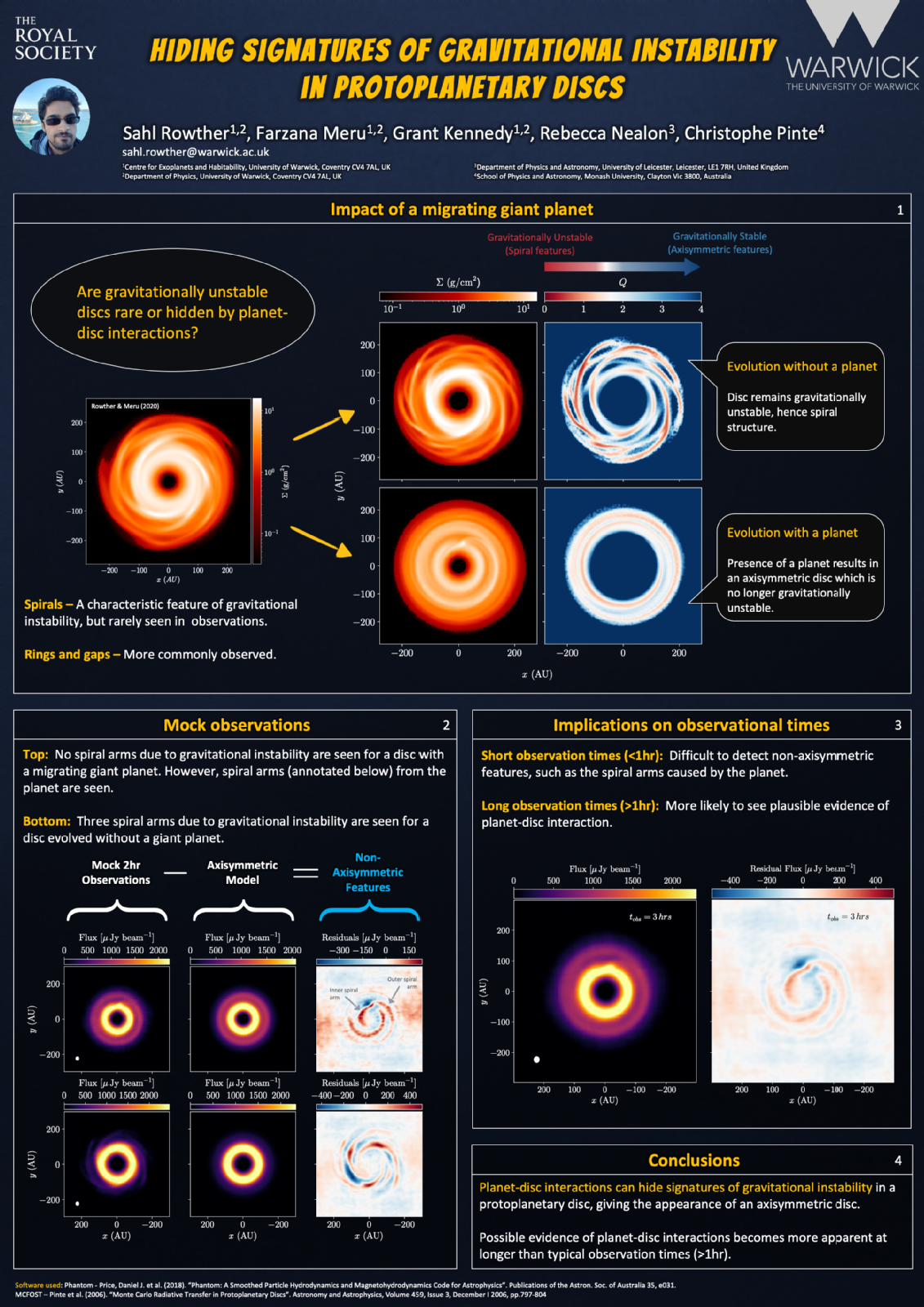
We carry out three-dimensional smoothed particle hydrodynamics simulations to show that a migrating giant planet strongly suppresses the spiral structure in self-gravitating disks. We present mock Atacama Large Millimeter/submillimeter Array (ALMA) continuum observations that show that in the absence of a planet, spiral arms due to gravitational instability are easily observed. Whereas in the presence of a giant planet, the spiral structures are suppressed by the migrating planet resulting in a largely axisymmetric disk with a ring and gap structure. Our modeling of the gas kinematics shows that the planet's presence could be inferred, for example, using optically thin 13C16O. Our results show that it is not necessary to limit the gas mass of disks by assuming high dust-to-gas mass ratios in order to explain a lack of spiral features that would otherwise be expected in high-mass disks.
Planet Migration in Self-Gravitating Discs: Survival of Planets
Sahl Rowther, Farzana Meru
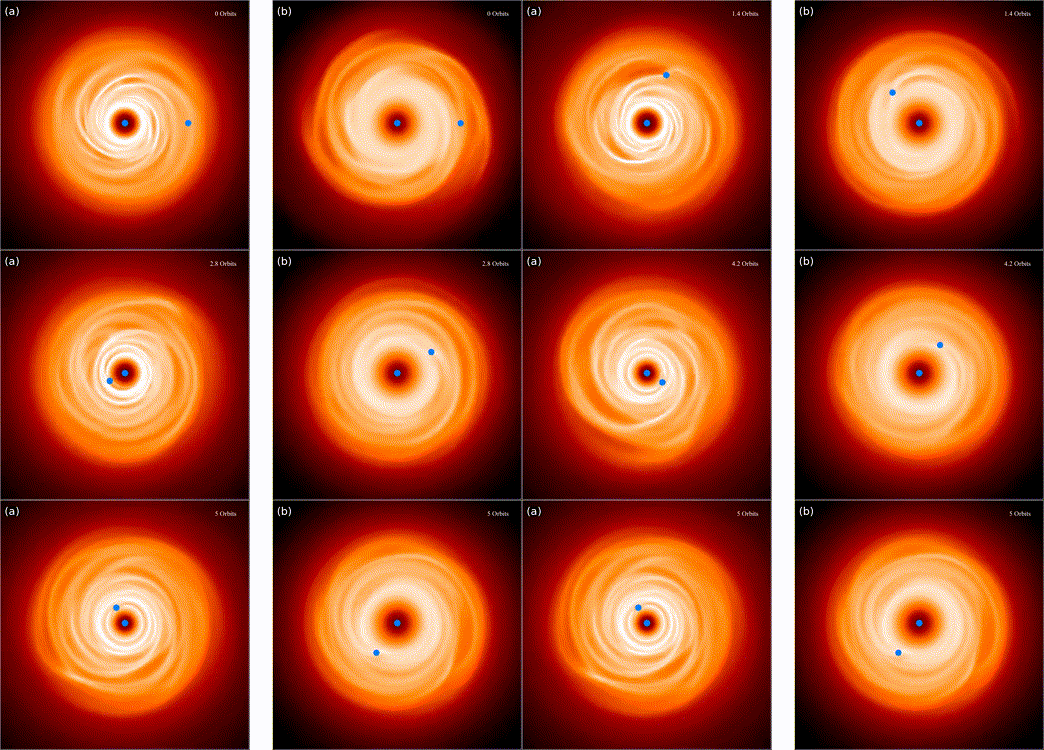
We carry out three-dimensional SPH simulations to study whether planets can survive in self-gravitating protoplanetary discs. The discs modelled here use a cooling prescription that mimics a real disc which is only gravitationally unstable in the outer regions. We do this by modelling the cooling using a simplified method such that the cooling time in the outer parts of the disc is shorter than in the inner regions, as expected in real discs. We find that both giant (> M_Sat) and low mass (< M_Nep) planets initially migrate inwards very rapidly, but are able to slow down in the inner gravitationally stable regions of the disc without needing to open up a gap. This is in contrast to previous studies where the cooling was modelled in a more simplified manner where regardless of mass, the planets were unable to slow down their inward migration. This shows the important effect the thermodynamics has on planet migration. In a broader context, these results show that planets that form in the early stages of the discs' evolution, when they are still quite massive and self-gravitating, can survive.
The liftetimes of planetary debris discs around white dwarfs
Dimitri Veras and Kevin Heng
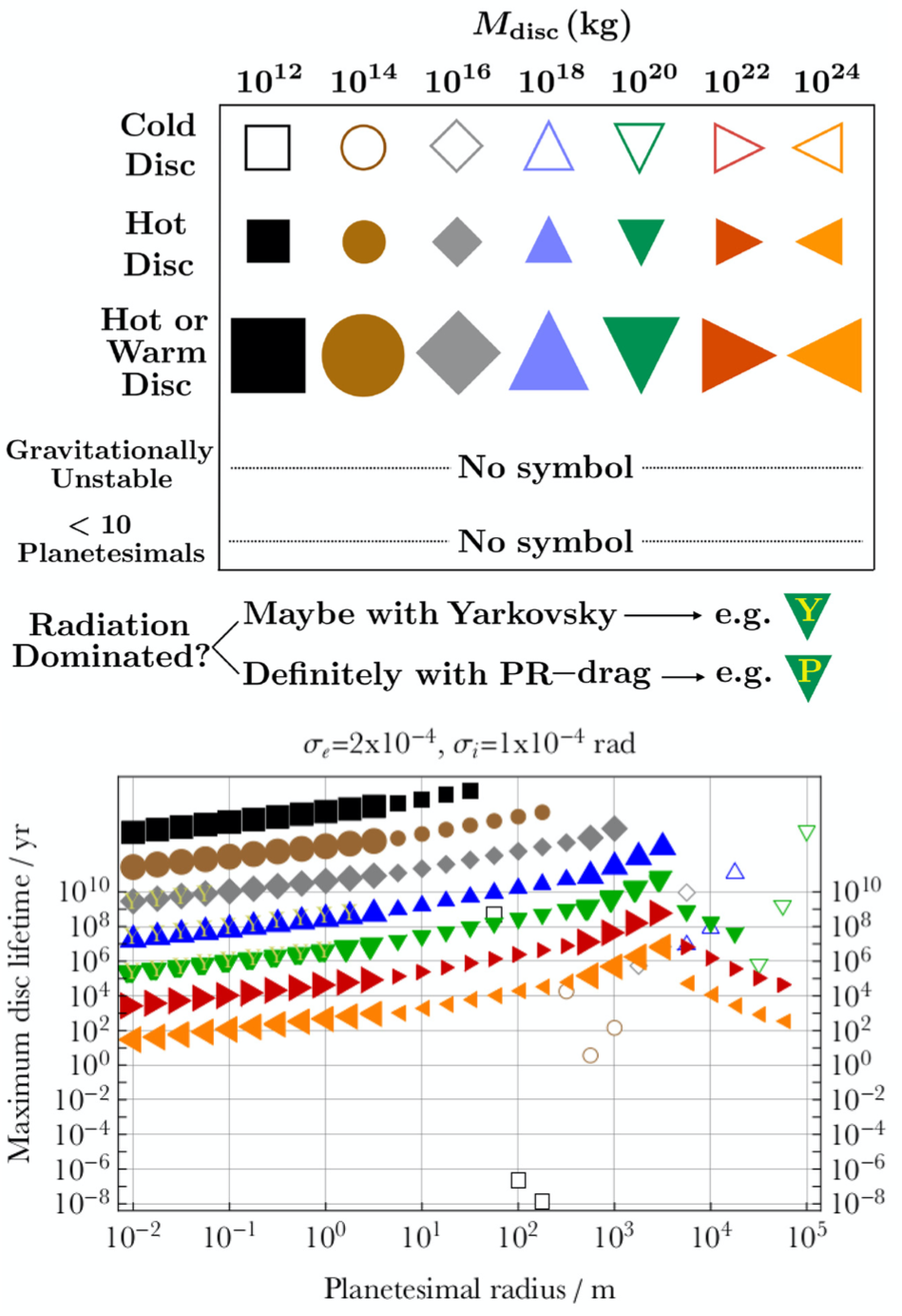
The lifetime of a planetary disc that orbits a white dwarf represents a crucial input parameter into evolutionary models of that system. Here we apply a purely analytical formalism to estimate lifetimes of the debris phase of these discs, before they are ground down into dust or are subject to sublimation from the white dwarf. We compute maximum lifetimes for three different types of white dwarf discs, formed from (I) radiative YORP break-up of exo-asteroids along the giant branch phases at 2-100 au, (II) radiation-less spin-up disruption of these minor planets at R⊙, and (III) tidal disruption of minor or major planets within about R⊙. We display these maximum lifetimes as a function of disc mass and extent, constituent planetesimal properties, and representative orbital excitations of eccentricity and inclination. We find that YORP discs with masses of up to 1024 kg live long enough to provide a reservoir of surviving cm-sized pebbles and m- to km-sized boulders that can be perturbed intact to white dwarfs with cooling ages of up to 10 Gyr. Debris discs formed from the spin or tidal disruption of these minor planets or major planets can survive in a steady state for up to, respectively, 1 or 0.01 Myr, although most tidal discs would leave a steady state within about 1 yr. Our results illustrate that dust-less planetesimal transit detections are plausible, and would provide particularly robust evolutionary constraints. Our formalism can easily be adapted to individual systems and future discoveries.