
Dept News
T-ray camera speed boosted a hundred times over
Scientists are a step closer to developing a fast and cost effective camera that utilises terahertz radiation, potentially opening the opportunity for them to be used in non-invasive security and medical screening.
A research team led by Professor Emma MacPherson and involving scientists from the Chinese University of Hong Kong has reached a crucial milestone towards developing single-pixel terahertz imaging technology for use in biomedical and industrial applications.
Revealing the Magnetic Nature of Tornadoes in the Sun’s atmosphere
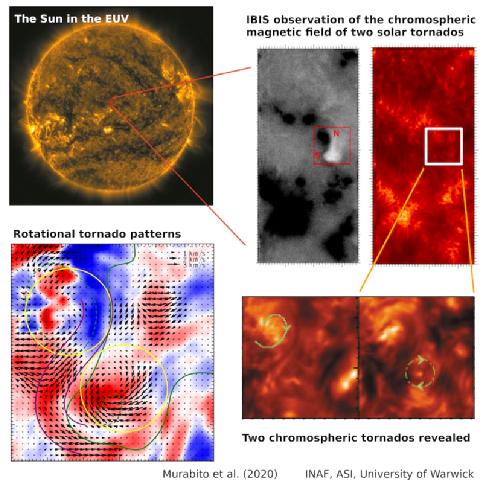
In a study to be published in the Astronomy & Astrophysics journal, a collaboration between the Italian National Institute for Astrophysics (INAF), the University of Warwick and the Italian Space Agency (ASI) has achieved the first three-dimensional tomography of the magnetic fields in a solar tornado and have measured their faint polarimetric signals.
The constant motions of the Sun’s surface creates giant tornados in the chromosphere a few thousand kilometers in diameter. Like their name sakes on Earth they carry mass and energy high up into the atmosphere and are therefore keenly studied as energy channels to explain the extraordinary heating of the solar corona. The main building block of solar tornados are tangled magnetic fields. This work presents the first direct observation of the chromosphere magnetic field to reveal the magnetic nature of solar tornados. Read more
New diagnostic tool for rapid detection of Coronavirus being developed by University of Warwick and Partners
Coronavirus diagnostics currently require centralised facilities and collection/distribution of swabs and results are ‘next day’. A new diagnostic tool being developed by the University of Warwick and its partner Iceni Diagnostics may allow on-the-spot detection of Coronavirus infection, without facilities using a simple disposal device.
Searching for heavy higgs bosons with tau pairs.
A Higgs boson matching that predicted in the Standard Model was found in 2012. However, many theories such as string theory, which attempts to unite quantum mechanics and gravity, tells us there should be at least four more. ATLAS has just published a search for a second Higgs boson, with a mass between 2 and 20 times that of the first, decaying to pairs of tau leptons. In many models this search is the most sensitive yet - but still no evidence for another Higgs boson is found.
