
The Impact of the Reformation on the Parish Network in Poland in the Second Half of the Sixteenth Century
Arkadiusz Borek, Tadeusz Manteuffel Institute of History, Polish Academy of Sciences
It took some time before the Reformation fully spread its wings in the Kingdom of Poland. Sigismund Augustus had to take the throne after his orthodoxy-adhering father (1548) and the first generation of nobility, which had already matured under its influence, had to come to political voice. Until then, it was rather an intellectual current, an object of discussion and controversy, a novelty, an additional argument that could be juggled in political games, although also a ground for the revolts of the commoners in the cities of Royal Prussia. Only in the middle of the 16th century did the attitude towards the new denominations and the Catholic Church become one of the central issues, and socio-religious changes became a fact. Disputes between the nobility and the Church were present in the Middle Ages too, but the Reformation gave them a completely new dynamic. Which is hardly surprising, since at that time even bishops remained under the influence of such concepts, considering the establishment of a national Church (Fig. 1)[1].
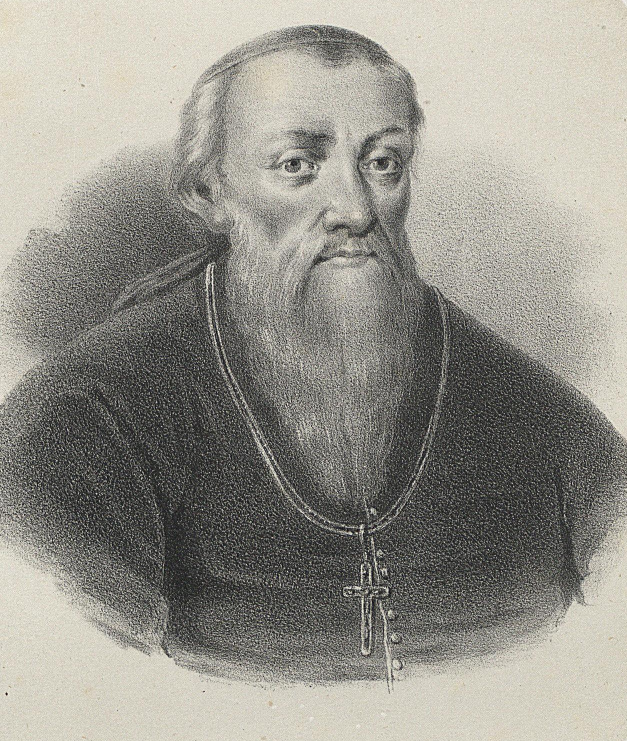
Fig. 1: Primate Jakub Uchański. For a long time, one of the supporters of creating a Polish national church in the episcopate. Reproduction of an older portrait in J. Bartoszewicz, Arcybiskupi gnieźnieńscy, prymasi Rzeczypospolitej i warszawscy, prymasi Królestwa Polskiego: wizerunki z Galeryi Łowickiej, Warszawa 1864. Public domain (https://polona.pl/preview/113d566d-8565-474f-a458-cbbb2ef5129d, accessed 09.07.2026).
Leaving this broad political and social background aside, however, in my short text I would like to focus on showing the impact of the Reformation on the parish network, what the response of the Catholic hierarchy was, and what effects it brought. I would like to illustrate this with examples from the areas of Greater Poland (the Old Polish Poznań and Kalisz voivodeships) and Cuyavia (Brześć Kujawski and Inowrocław voivodeships). In these regions, places of Protestant worship began to appear in the last years of the first half of the 16th century, and this process accelerated in the 1550s and 1560s[2].
When Protestant patrons first started to steer parish churches towards the new religion, the Catholic Church did not have defined procedures to respond – the doubtful orthodoxy of some bishops did not help either. It is not known whether it was for these reasons, bureaucratic inertia, or other motives that such churches were not suppressed; the advice was simply that the faithful should attend neighboring Catholic places of worship. This practice was framed as an official recommendation, first at some diocesan synods but in 1607 at the level of the entire Gniezno province[3].
… Censuit Synodus, ut de restituendis atque reformandis eisdem [ecclesiis occupatis], Reverendissimi Domini Ordinarii Locorum, sedulo elaborent. … Providendum est denique ne aliarum Ecclesiarum aedificatione, Parochiales Ecclesiae detrimentum patiantur, et ad desolationem veniant. Quod si in aliquo loco nullo modo Ecclesia prophanata recuperari possit, populus eius una cum iuribus et fructibus, viciniori Parochiae adiungatur, quoad Ecclesia illius propria, pristino statui restituta non fuerit[4]. [The Synod decided that the Most Reverend Ordinaries of the places should diligently work on restoring and reforming the occupied churches. Ultimately, care must be taken that the building of other churches does not harm or lead to the ruin of parish churches. If in no way a desecrated church can be recovered in a certain location, its people, along with their rights and benefits, should be joined to the nearest parish until their own church is restored to its former state.]
The effect of this approach can be seen in the first preserved visitations of Polish dioceses (from the turn of the 16th and 17th centuries) – they include all the churches of the diocese, including those occupied by Protestants. Sometimes this was limited only to noting this fact, but sometimes more information was provided. The case of the visitation in the parish of Kościelec in the Włocławek diocese in 1584 is rather striking. The Catholic visitator was received with full hospitality by a Protestant minister, who explained by whom he had been ordained and what had happened to the items associated with Catholic worship[5]. The aforementioned policy of the church authorities is one thing, but the patronage of a given church remained another matter. Even if a patron had turned Protestant, due to his hereditary rights he could still influence the legal status of his church and the associated Catholic parish. The Church was forced to accept that a “parish” is not only an object in canon law (whose status in Poland was probably the biggest victim of the Reformation), but also in Polish law – disputes with patrons over churches could be fought before secular land courts and the Crown Tribunal. Nevertheless, one should agree with the thesis that the Polish Catholic Church considered the takeover of churches by Protestants an illegal and temporary phenomenon[6], which cannot be legitimized by organizational changes.
Consequently, acknowledging the existence of a parish de iure when it was not functioning de facto had an impact on conserving the parish network existing in the first half of the 16th century. This pattern is well illustrated by the example of the church in Chorzewo, which at the end of the second decade of the 16th century was formally united with the neighboring church in Brzezie, due to poor endowment (see Fig. 2). Normally, Chorzewo would probably have been successively integrated into Brzezie parish. However, when a visitator appeared in Chorzewo at the beginning of the 17th century, he still recorded it as a parish center, although the village had become depopulated and only remnants of the church remained. Since the temple in Brzezie was in the hands of Protestants, it could not fully incorporate the weaker Chorzewo parish and the relationship between both seats remained as it had been in the first half of the 16th century[7]. Similarly, the ruin of the church in the depopulated village of Ostrówka, where the patrons were also Protestants, was presented as the seat of the parish at the beginning of the 17th century[8]. The parish in Brójce was affiliated to the neighboring one only after being recovered by Catholics[9]. On the other hand, there were occasions when the Reformation influenced changes in the parish network, which caused tensions and necessitated further reorganization when the churches returned to Catholic hands. In the southern part of the Kalisz voivodeship, in Żerniki, a new parish was established in 1569. The then owner of this locality, when founding the church, took advantage of the fact that two neighboring parishes were then in the hands of Protestants and fragments of these old parishes were separated for the newly created unit. When both churches were taken over again by Catholic rectors, they started legal efforts to restore the old borders of their parishes[10]. In 1579, the parish in Lisewo in Cuyavia, occupied by Calvinists, was in fact abolished, and in its place a territorially identical parish with a center in Pęchowo was created. Already in 1611, however, this new unit got divided to re-establish the parish in Lisewo, in which the church was again taken over by Catholics[11].
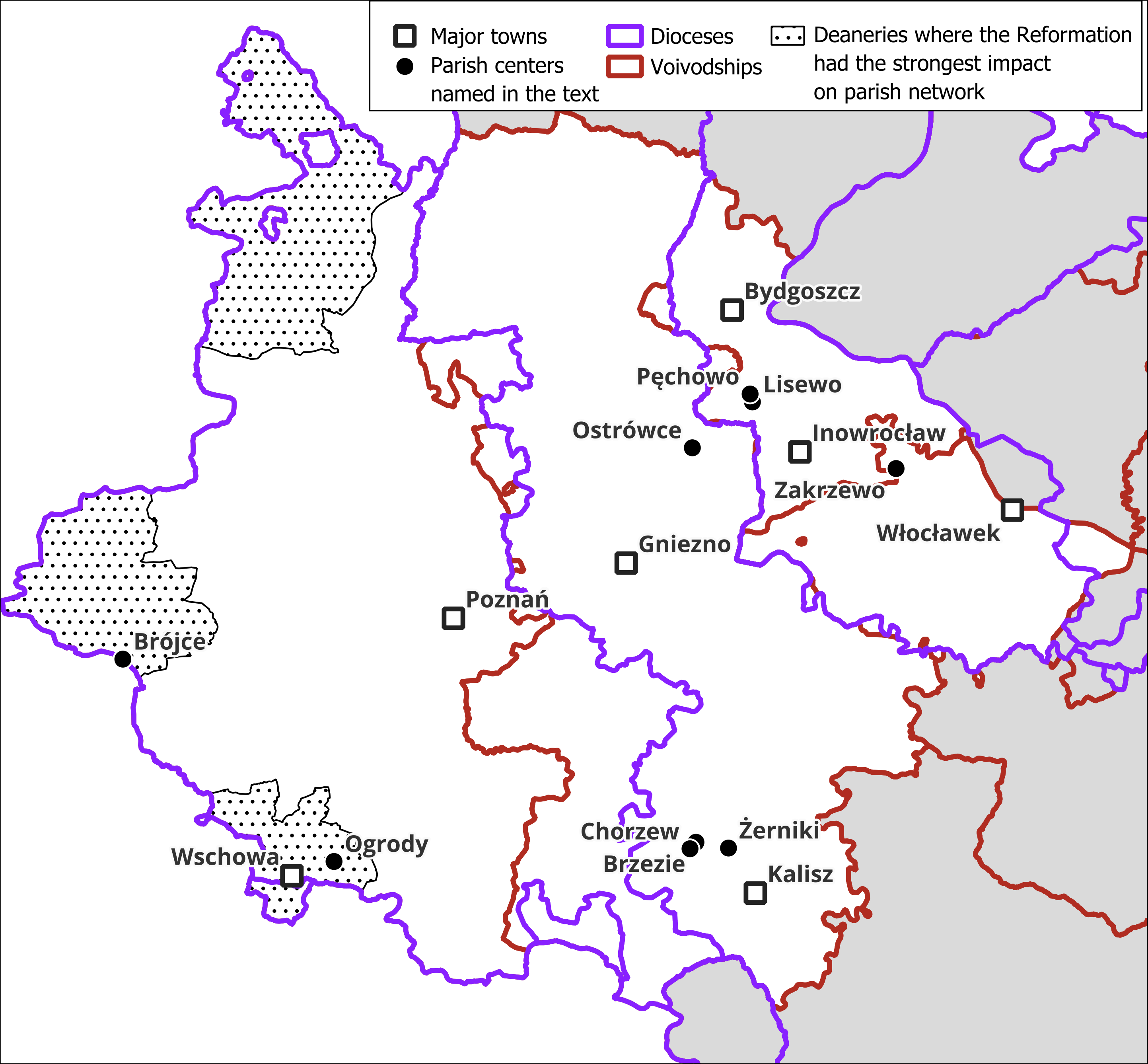
Fig. 2: Map of the basic territorial units of the state and the Catholic Church in Greater Poland and Cuyavia in the second half of the 16th century. Own elaboration based on The map of Polish lands of the Crown in the 16th century – a spatial database (accessed 02.07.2026).
Of course, the outlined situations were not the only possible scenarios. In other cases the existence of certain temples could not be maintained. Often the impact of the Reformation is difficult to determine due to the lack of sources, as in the case of the Ogrody parish, which was abolished somewhere between 1510 and 1639[12]. The picture is rarely unequivocal. The Catholic parish in Zakrzewo began to function again only in the 20th century. At the end of the 16th century, church authorities probably considered it as not having the potential to be recovered, striving for concessions regarding other churches that were located in the estates of the same patron[13]. The situation was most difficult in areas where the influence of the Reformation was particularly strong and where it took root by bringing in new Protestant settlers. However, even here Catholics managed to recover old parish churches with a well-documented history[14].
This post has focused on a few slightly unusual examples. Elswehere, the story could be fairly simple. When the Reformation in Poland weakened, often already at the turn of the 16th and 17th centuries, churches returned to Catholic administration along with their patrons who converted back to the old faith. Parishes operated again within the same borders as before the Reformation. The Catholic Church effectively sat out the biggest wave of the Reformation, emphasizing the illegality of the occupation of churches, not accepting faits accomplis and ‘freezing’ the parish network in certain places. Finally, it also awaited a more favourable political climate. After kings who maneuvered in religious matters, the throne was taken by Sigismund III Vasa (1587), who unambiguously supported Catholicism and the Counter-Reformation, which was visible even in his policy of appointments to offices[i].
Translated with the help of the LLM model Gemini 3.1 Pro (High) and Beat Kümin.
Biographical note
Arkadiusz Borek is a researcher in the Department of Historical Atlas at the Institute of History of the Polish Academy of Sciences in Warsaw. His research interests include the institutional history of the Church in Poland during the medieval and early modern periods, historical geography, and the application of digital tools in the humanities. His PhD dissertation examined the functioning of the Kalisz consistory in the first half of the 16th century. My research on parishes covers the reconstruction of the parish network in eastern Greater Poland and Kuyavia in the second half of the 16th century, as well as studies of the parish structure in the Kingdom of Poland after the First Partition. He was a speaker at the 24th Parish Symposium on ‘Parish Data’ in May 2026.
Endnotes
[1] E. Bałakier, Sprawa kościoła narodowego w Polsce XVI wieku, Warszawa 1962; Ł. Godlewski, Spór o powołanie Kościoła narodowego w Koronie w okresie soboru trydenckiego (1545-1563), “Studia Historyczne” 62, no. 1, 2019, p. 17-18. https://doi.org/10.12797/SH.62.2019.01.01.
[2] J. Dworzaczkowa, Reformacja i kontrreformacja w Wielkopolsce, Poznań 1995, p. 7-34.
[3] B. Kumor, Dzieje ustroju kościelnego w Polsce, in: Historia Kościoła w Polsce, vol. 1: Do roku 1764, cz. 2: Od roku 1506, ed. B. Kumor, Z. Obertyński, Poznań–Warszawa 1974, p. 106.
[4I. Subera, Synody prowincjonalne arcybiskupów gnieźnieńskich, Warszawa 1981, p. 256-257. I have made minor transliteration corrections in the excerpt.
[5] Monumenta historica dioeceseos Wladislaviensis, vol. 22, ed. S. Chodyński, Wladislaviae 1903, p. 59-60.
[6] B. Szady, Dioeceses of Poznań and Wrocław, in: Historical Atlas of Poland. Polish Lands of the Crown in the second half of the sixteenth century, ed. H. Rutkowski, M. Słoń, Warsaw 2021, p. 426 (https://rcin.org.pl/Content/233782/WA303_269261_e-book-p2_Crown-com.pdf, accessed 02.07.2026).
[7] A. Borek, Dioeceses of Gniezno and Włocławek, in: Historical Atlas of Poland, p. 394.
[8] Jana Łaskiego Liber beneficiorum archidiecezji gnieźnieńskiej, vol. 1, ed. J. Łukowski, Gniezno 1880, p. 180.
[9] B. Szady, Dioeceses of Poznań and Wrocław, in: Historical Atlas of Poland, p. 439.
[10] A.Borek, Dioeceses of Gniezno and Włocławek, p. 394.
[11] A. Borek, Cuyavia and Dobrzyń Land, in Historical Atlas of Poland, p. 512.
[12] B. Szady, Dioeceses of Poznań and Wrocław, p. 422–423.
[13] A. Borek, Cuyavia and Dobrzyń Land, p. 512–513.
[14] B. Szady, Dioeceses of Poznań and Wrocław, p. 419–422.
[15] T. Kempa, Conversions to Catholicism in the Polish-Lithuanian Commonwealth in the 16th and 17th Centuries in the Context of the Development of the Counter-Reformation: a Summary, “Lietuvos istorijos metraštis”, 2025, p. 73-79 (https://doi.org/10.33918/25386549-202501002, accessed 02.07.2026).