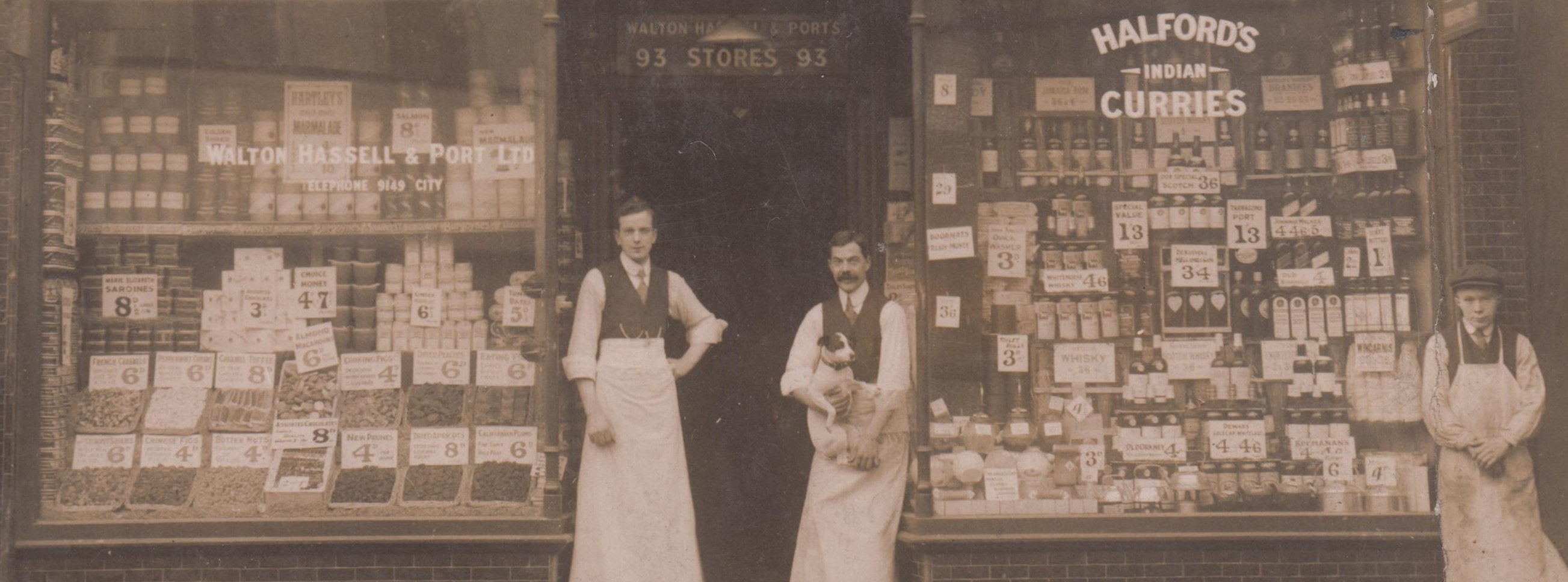
Knowing how much someone was paid only gives us part of the picture. To know whether or not it was a 'sweated' wage, a living wage or a high wage, we need to know how much a worker could buy with their earnings - the contemporary cost of living. This guide provides some general information about how far the Trade Board minimum wage might stretch in the 1910s and 1920s.
Pounds, shillings and pence
Before 1971, money in the United Kingdom was usually calculated in pounds, shillings and pence. There were:
4 farthings in a penny
2 halfpennies / ha'pennies in a penny
12 pence in a shilling
20 shillings (or 240 pence) in a pound
21 shillings in a guinea
Pounds, shillings and pence were abbreviated to '£sd' or 'Lsd', short for the Latin 'librae' (pounds), 'solidi' (shillings), and 'denarii' (pence); so one pound, 10 shillings and six pence, for example, would be shortened to £1 10s 6d. A sum of shillings and pence could also be shown using punctuation, for example, 10 shillings and six pence could be written as 10/6, 10 shillings (and no pence) could be represented as 10/- .
Regular expenses
The archives of the Modern Records Centre include some real life examples of working class budgets and expenditure during the early 20th century. These can give us an idea of how much basic expenses like food, fuel and rent cost and what proportion of a worker's income they consumed.
Extract from 'The Labourer', February 1915, journal of the National Agricultural Labourers' and Rural Workers' Union. It includes a 1914 letter sent by a Shropshire farm labourer's wife, in which she outlines the family's weekly expenditure on two adults and six children. The author of an article about the letter compares the low wages of farm workers to the seven shillings a week "to keep our paupers inside our workhouses" and the nine pence a day given to Belgian refugees "for food alone... no rent, rates, coal, gas, or household necessaries required".
Extract from 'The Railway Clerk', 15 January 1918, journal of the Railway Clerks' Association. The unnamed author, a London railway clerk, provides information about the comparative costs of his household expenses before the First World War and at the end of 1917 ("both sets of figures are comprised of prices actually paid, and are not simply estimates").
Outline of the weekly budget for F. Hodson of Warrington, his wife and seven children. It compares wages and weekly expenditure in 1914 and 1919 (before and shortly after the First World War). The cost of living had risen considerably higher than the family's income over that period.
This item is one of a series of documents on the contemporary cost of living collected by the Dock, Wharf, Riverside and General Workers' Union of Great Britain and Ireland as part of their evidence for the 1920 Court of Inquiry into Wages, Rates and Conditions of Men Engaged in Dock and Waterside Labour (also known as the Shaw Inquiry).
Outline of the weekly budget for the family of L. Brammall of Birkenhead, dock labourer. It compares prices in 1914 and 1920 (before and shortly after the First World War).
This item is one of a series of documents on the contemporary cost of living collected by the Dock, Wharf, Riverside and General Workers' Union of Great Britain and Ireland as part of their evidence for the 1920 Court of Inquiry into Wages, Rates and Conditions of Men Engaged in Dock and Waterside Labour (also known as the Shaw Inquiry).
Outline of the yearly budget for clothes, crockery, bedding and other household items for the family of L. Brammall of Birkenhead, dock labourer. It compares prices in 1914 and 1920 (before and shortly after the First World War) and includes comments on recent price rises on other commodities.
This item is one of a series of documents on the contemporary cost of living collected by the Dock, Wharf, Riverside and General Workers' Union of Great Britain and Ireland as part of their evidence for the 1920 Court of Inquiry into Wages, Rates and Conditions of Men Engaged in Dock and Waterside Labour (also known as the Shaw Inquiry).
Weekly budget for a theoretical working class family of five (2 adults and three children) proposed by the Employers' Council to the Dockers' Inquiry, and described by trade union representatives as "Capitalists budgets for workmen". The budget includes comparative costs for 1914 and 1920, and the calorific value of the food purchased.
This item is one of a series of documents on the contemporary cost of living collected by the Dock, Wharf, Riverside and General Workers' Union of Great Britain and Ireland as part of their evidence for the 1920 Court of Inquiry into Wages, Rates and Conditions of Men Engaged in Dock and Waterside Labour (also known as the Shaw Inquiry).
Outline of the weekly budget for a family of five on the wages of a shop assistant. The information was extracted from the 'Daily Herald' (a newspaper owned by the Trades Union Congress), 23 January 1920.
This item is one of a series of documents on the contemporary cost of living collected by the Dock, Wharf, Riverside and General Workers' Union of Great Britain and Ireland as part of their evidence for the 1920 Court of Inquiry into Wages, Rates and Conditions of Men Engaged in Dock and Waterside Labour (also known as the Shaw Inquiry).
Summary of the weekly budget of a Pearl Assurance agent and his family (wife and one child?). The information was extracted from the 'Evening News', 13 January 1920. Insurance agents often went door to door in working class communities, collecting monthly subscriptions and selling new policies.
This item is one of a series of documents on the contemporary cost of living collected by the Dock, Wharf, Riverside and General Workers' Union of Great Britain and Ireland as part of their evidence for the 1920 Court of Inquiry into Wages, Rates and Conditions of Men Engaged in Dock and Waterside Labour (also known as the Shaw Inquiry).
Extract from a letter from Ralph James Ward of 7 Dora Street, Limehouse, London, sent as an objection to the proposed reduction of the minimum wages by the Rope, Net and Twine Trade Board in 1921. Ward has included a day to day outline of his family's weekly expenditure to support his argument against a wage cut, as well as some background information about their shopping habits.
Extract from a letter from Frederick Thompson of 11 Macquarie Way, Millwall, London, sent as an objection to the proposed reduction of the minimum wages by the Rope, Net and Twine Trade Board in 1921. Thompson has included an outline of his family's weekly expenditure to support his argument against a wage cut, as well as some background information about his family.
Extract from a letter from Henry William Martin of 17 Gawthorne Street, Bow, London, sent as an objection to the proposed reduction of the minimum wages by the Rope, Net and Twine Trade Board in 1921. Martin has included an outline of his family's weekly expenditure to support his argument against a wage cut.
Resolution passed by members of the National Union of General Workers, Women Workers Section, employed at Lucas Ltd., Birmingham. The resolution protests against the proposed reduction in wages and includes information about the comparative weekly budget of a member in 1914 and 1921. The budget was given by a woman who lived in lodgings (i.e. rented a room or rooms in a house) and paid for board (meals) to be supplied by the landlady. The worker's other expenses included travel, insurance and clothing.
Extract from 'The Land Worker', May 1922, journal of the National Union of Agricultural Workers. The letter was written by Mrs F. Lodge, the wife of a farm worker in Barking, Essex, and counters claims that country women "waste money" earned by their husbands. She includes an outline of the weekly budget for her family of two adults and four children, and argues that "the lower classes, so-called, as well as the upper classes, require nourishing food, as we have to work hard, and must have good food if we wish to see our little family grow up around us".
Information about the cost of winter and summer clothes for a woman clerical worker "to provide appearance and health expected by City Employers", May 1922. The clothing budget was included in 'The cost of living for women clerical workers: Some facts and figures, 1922' produced by the Association of Women Clerks and Secretaries. The pamphlet also includes information about cost of rent, fares and recreation, and can be read in full through our online catalogue.
Form submitted by a Leicester postman as part of the Union of Post Office Workers' standard of living enquiry in 1926. The survey of members was intended to provide evidence that the union could use in negotiations for pay increases. The postal worker includes details of his average weekly income, notes on general circumstances affecting his family's standard of life, and a list of household expenditure over two weeks in February and March 1926.
Form submitted by a London postal sorter, employed at the Foreign Section, as part of the Union of Post Office Workers' standard of living enquiry in 1926. The survey of members was intended to provide evidence that the union could use in negotiations for pay increases. The postal worker includes details of his average weekly income, notes on general circumstances affecting his family's standard of life, and a list of household expenditure over two weeks in March 1926.
Consumer goods
Trade union journals can include advertisements for clothing, foodstuffs, furniture and other consumer goods. Find out more about the cost of products targeted at working class audiences through these sample adverts:
The cost of living increased substantially during the First World War and continued to fluctuate during the 1920s. These sources provide information about the changing cost of household expenditure during the 1910s and early 1920s.
Table comparing the prices of food and fuel in 1905, 1912 and 1920, based on government sources (the Board of Trade Gazette in 1905 and 1912 and the Ministry of Food in 1920).
This item is one of a series of documents on the contemporary cost of living collected by the Dock, Wharf, Riverside and General Workers' Union of Great Britain and Ireland as part of their evidence for the 1920 Court of Inquiry into Wages, Rates and Conditions of Men Engaged in Dock and Waterside Labour (also known as the Shaw Inquiry).
Memorandum issued by the War Emergency Workers' National Committee as a leaflet in 1917. The first page provides information about the Board of Trade 'standard working class budget', this was set in 1904 and acted as the base rate for the government's cost of living index. The second page contains monthly statistics which show the 109% increase in the cost of food between July 1914, when the First World War started, and July 1917.
This item is one of a series of documents on food included in the Research Department papers of the Transport and General Workers' Union.
Information about the comparative cost of commonly purchased items of clothing in 1914 and 1918, divided into categories for men, women, boys and girls.
This information was published in the report of the Working Classes Cost of Living Committee (also known as as the Sumner Committee). The committee was appointed by the Chancellor of the Exchequer to "enquire into and report upon (i) the actual increase since June, 1914, in the cost of living to the working classes and (ii) any counterbalancing factors (apart from increases of wages) which may have arisen under war conditions". The Trade Boards were represented on the committee in the form of workers' representative J.J. Mallon, in his capacity as Secretary of the Anti-Sweating League.
The Sumner report included a range of data on average working class expenditure and can be read in full through our online catalogue.
Information about the comparative cost of an average grocery shop at the Bolsover Co-operative Society Ltd. in April 1914, April 1916, April 1918 and April and October 1920, based on information supplied by the store manager.
The data was included in the final report of the Labour Party and Trades Union Congress Joint Committee on the Cost of Living, published in 1921. This edition of the report is included in the archives of the Transport and General Workers Union.
Information about the cost of standard household items in Birkenhead in 1914 (before the First World War) and in 1920. The list includes prices for items of food, clothing, laundry and crockery, together with the percentage by which prices had increased over six years.
This item is one of a series of documents on the contemporary cost of living collected by the Dock, Wharf, Riverside and General Workers' Union of Great Britain and Ireland as part of their evidence for the 1920 Court of Inquiry into Wages, Rates and Conditions of Men Engaged in Dock and Waterside Labour (also known as the Shaw Inquiry).
Information about the cost of standard household items in Liverpool in 1914 (before the First World War) and in 1920. The list includes prices for items of food, clothing, laundry and crockery, together with the percentage by which prices had increased over six years.
This item is one of a series of documents on the contemporary cost of living collected by the Dock, Wharf, Riverside and General Workers' Union of Great Britain and Ireland as part of their evidence for the 1920 Court of Inquiry into Wages, Rates and Conditions of Men Engaged in Dock and Waterside Labour (also known as the Shaw Inquiry).
The minimum wage
Summarised information about Trade Board minimum rates of pay is available for these trades: