Liberal Arts and Sciences at Warwick is a way of approaching what matters most to you through a rigorous and flexible degree. As part of a close-knit community, you will draw on knowledge from a range of disciplines bridging the arts, sciences and social sciences to address complex problems in hands-on teaching and learning. You will design your own degree by choosing a science stream and optional modules integrated within our Liberal Arts and Sciences curriculum supported by our expert tutors. This unique course balances both breadth and depth. It gives you the critical tools to think across disciplines, flexibility with your module choices, and specific expertise in your area of interest.
On this interdisciplinary degree we will encourage you to think independently as you work closely with experts from the Liberal Arts department and from across the University. In small groups you will explore challenging problems from different times and places, using a toolkit of emergent skills to create your own responses. This course is ideal for passionate students who want to combine a greater focus on the sciences and social science while still learning across disciplines to build their degree around their own interests and unique ambitions.
Dedicated expert tutors with a passion for liberal education lead the Liberal Arts and Sciences modules. These modules focus on investigating key issues from multiple disciplinary perspectives and developing your critical thinking skills. You will learn how to analyse cutting-edge problems and to think outside the box as you evaluate evidence and interpretations. These modules will also help you to build your primary and secondary research skills. We will ensure that you have the intellectual tools needed to undertake advanced interdisciplinary undergraduate research and engage in different disciplines as you develop your own interests and expertise.
Within the first year, you will choose a science or social science stream with one of our partner departments, bringing together modules most suited to your interests and strengths. You will spend at least one third of your degree studying modules relating to your chosen stream. These modules will give you the knowledge, skills, and expertise to become a leader in an area you are passionate about. Our tutors will guide your decision about which stream to choose and will provide support to you throughout the degree selecting modules and developing your studies. We currently have streams with the School of Life Sciences and Warwick Business School. Students who complete the requirements of their studies will graduate with a “BASc. (Hons.) Liberal Arts and Sciences" with their stream title highlighted on their Higher Education Achievement Report (HEAR).
BASc in Liberal Arts and Sciences aims to develop innovative critical thinkers who will be able to analyse the global challenges of the past, present, and future. To further enable this, we also offer the opportunity of extending your degree by a year either to study abroad or to complete a work placement. To give you the time to consider whether these opportunities are right for you, we automatically enrol all our new students on the three-year course. Once you join us, you will have the option to change to a four-year course with an intercalated year of study abroad or a work placement in the third year. The year spent studying abroad or on a work placement is subject to departmental academic requirements.
The skills you develop during your degree are as important as the course content. You will also have the opportunity to complete co-curricular certificates and short work placements. These will help you develop your professional skills, giving you the edge when it comes to your employability. You will have the support of our dedicated Employability and Placement Manager who provides one-to-one careers guidance.
What is Liberal Arts and Sciences?
A Liberal Arts education puts critical thinking and innovative problem solving at the heart of learning. It is based on a rich, two-thousand-year-old tradition of thinking across different disciplines to solve the most pressing challenges of the day and of the human experience. It aims to form critical global citizens who will be future leaders and independent thinkers in their own chosen field. Our Liberal Arts and Sciences degree, emphasises the important role of the sciences within a Liberal Arts framework. By teaching you how to learn rather than what to learn, a Liberal Arts and Sciences education will expose you to a broad range of knowledge and disciplines, allowing you to specialise in the issue or problem that matters most to you.
Entry requirements
A level typical offer
AAB.
You will also need grade C/4 in English and Mathematics at GCSE.
We welcome students with STEM backgrounds, as well as those with Humanities backgrounds, Creative Arts backgrounds, and Social Science backgrounds, along with those who have studied a range of A levels (or equivalent).
A level contextual offer
We welcome applications from candidates who meet the contextual eligibility criteria and whose predicted grades are close to, or slightly below, the contextual offer level. The typical contextual offer is BBB. See if you're eligible.
We advise that you also check the English Language requirements for your course which may specify a higher GCSE English requirement. Please find the information about this below.
International Baccalaureate (IB) typical offer
34
International Baccalaureate (IB) contextual offer
We welcome applications from candidates who meet the contextual eligibility criteria and whose predicted grades are close to, or slightly below, the contextual offer level. The typical contextual offer is 30 and above. See if you're eligible.
We advise that you also check the English Language requirements for your course which may specify a higher GCSE English requirement. Please find the information about this below.
BTEC
We welcome applications from students taking BTECs and/or CTECs alongside on or two A levels.
You will also need grade C/4 in English and Mathematics at GCSE.
Scotland Advanced Highers
AA in 2 Advanced Highers with ABB or BBB in Highers in 3 further subjects or AB in two Advanced Highers with AAB in Highers in 3 further subjects.
Welsh Baccalaureate
ABB in three subjects at A level plus grade C in the Advanced Skills Baccalaureate Wales.
Access to Higher Education Diplomas
We will consider applicants returning to study who are presenting a QAA-recognised Access to Higher Education Diploma on a case-by-case basis.
Typically, we require 45 Credits at Level 3, including Distinction in 33 Level 3 credits and Merit in 12 Level 3 Credits. We may also require subject specific credits or an A level to be studied alongside the Access to Higher Education Diploma to fulfil essential subject requirements.
We advise that you also check the English Language requirements for your course which may specify a higher GCSE English requirement. Please find the information about this below.
Warwick may make differential offers to students in certain circumstances, such as those who have participated in a Widening Participation programme or who meet the University’s contextual data criteria. These offers are usually one or two grades below Warwick’s standard offer.
Do you offer foundation programmes?
All students who successfully complete the Warwick International Foundation Programme (IFP) and apply to Warwick through UCAS will receive a guaranteed conditional offer for a related undergraduate programme, for selected courses only. Further details are available in the standard offer and conditions for the IFP.
Can I take a gap year before starting my course?
Yes, Warwick welcomes applications for deferred (gap year) entry.
Will I need to interview for this course?
Warwick does not typically interview applicants. Offers are made based on the UCAS application, including predicted and achieved grades, the personal statement, and the school reference.
Note that information found by following the links to the module catalogue is subject to change for future years of study, as we evolve our courses in response to the latest developments in academia and industry.
Year 1
You will choose one of the following modules:
You will choose one of the following Critical Issues modules:
You will choose one of the following research training modules:
The other half of your first year will consist of at least 30 CATs of modules from your stream and any optional modules from across the University. This is your time to start exploring your interests and finding out where your passions lie.
At the end of your first year, you will confirm the stream you wish to follow for the rest of your degree. On your stream you will take a further 90 CATs across your second and final year (to total 120 including 30 in your first year.)
Year 2
You will study two core modules:
The remaining modules in the second year will be from your chosen stream with opportunities for additional options. Depending on your stream, you may need to study certain modules to fulfil the pathway requirements while others require you choose from a selection of modules. All Liberal Arts and Sciences students are expected to take two of our optional modules (below) in their second and final year.
Year 3
In your second year and in your final year, you are required to take two interdisciplinary Liberal Arts optional modules from our optional core offering. These modules include the two modules taught in Venice. You may choose how many to take in each year.
The remaining modules in your final year will be from your chosen stream plus any additional options.
Optional Modules
All students in Liberal Arts and Sciences are required to take two optional core modules offered by the Liberal Arts Department in their second and final year (though you can take more if you like!). The optional modules offered can vary from year to year, and new optional modules may be added to this list over time.
Liberal Arts modules taught onsite at Warwick Venice Centre:
As part of your degree, you will be required to take 120 CATs of modules from your selected partner department to form your stream in the Sciences or Social Sciences.
Fees and funding
Tuition fee
£10,050
For the 2027-28 academic year, the UK government announced in March 2026 that the tuition fee cap for UK undergraduate students for the 2027-28 academic year would be £10,050.
If you are joining Warwick for the 2026-27 academic year, the University of Warwick’s Executive Board has confirmed a change in fees to £9,790 (from the 2025-26 rate of £9,535), following the UK government announcement in November 2025 to increase in the tuition fee cap for Home students for the 2026-27 academic year.
Students who qualify for government-regulated fees are classed as ‘Home’ students for fees purposes. In future years, fees for continuing students may be subject to an increase in fees in line with any inflationary uplift as determined by the UK Government (if permitted by law or government policy).
We carry out an initial fee status assessment based on the information you provide in your application. Students will be classified as Home or Overseas fee status. Your fee status determines tuition fees, and what financial support and scholarships may be available. If you receive an offer, your fee status will be clearly stated alongside the tuition fee information.
If you believe that your fee status has been classified incorrectly, you can complete a fee status assessment questionnaire. Please follow the instructions in your offer information and provide the documents needed to reassess your status.
You will repay your loan or loans gradually once you are working and earning above a certain amount. For students starting their course after 1 August 2023 (on Student Finance England’s Plan 5), you will repay when your income is over £25,000 a year.
Repayments will be taken directly from your salary if you are an employee. If your income falls below the earnings threshold or you stop working, your repayments will stop until your income goes back up above this figure.
Access thousands of part-time opportunities through our agency UnitempsLink opens in a new window (such as office work, retail jobs or helping at events)
Choose to apply for a job as one of our Student Ambassadors to share your own experience at events like Open Days
There are many different funding routes available, including a number of bursaries and scholarships for full-time undergraduates. If you struggle to meet your essential living costs, our Student Funding team will be on hand to offer advice and support.
Provides additional financial support for qualifying Home students from lower income families of up to £2,500 for eligible students
This bursary is paid directly into your bank account in three equal termly instalments to help with the costs of studying
There is no application for this bursary as your details will be provided directly from the student support awarding bodies (Student Finance England, Student Finance Northern Ireland, and Student Awards Agency Scotland)
A number of scholarship opportunities are open to full-time undergraduate students. These include sporting and musical bursaries, and scholarships offered by commercial organisations.
If you experience financial difficulties during your studies, you may be eligible for Hardship Funding from the University, in the form of an Emergency Loan and/or a non-repayable award
There are no Department scholarships available for our Undergraduate courses, however there are other scholarships which you may be eligible for. Please see our scholarships web pages for more information.
Tuition fee
If you are an overseas student enrolling in 2026-27, your annual tuition fees will be as follows:
Band 1 – £27,870 per year (classroom-based courses, including Humanities and most Social Science courses)
Band 2 – £35,530 per year (laboratory-based courses, plus Mathematics, Statistics, Theatre and Performance Studies, Economics, and courses provided by Warwick Business School, with exceptions)
Overseas Tuition fees for 2027-28 academic year have not been set. In future years, fees for continuing students may be subject to an increase in fees in line with an inflationary uplift. Please check our website for updates about 2027-28 fee rates before you apply.
If you are an EU student and eligible for student finance, you may be able to get a Tuition Fee Loan to cover your fees, please visit our Student Funding webpage for guidance for students ordinarily resident outside of England.
We carry out an initial fee status assessment based on the information you provide in your application. Students will be classified as Home or Overseas fee status. Your fee status determines tuition fees, and what financial support and scholarships may be available. If you receive an offer, your fee status will be clearly stated alongside the tuition fee information.
If you believe that your fee status has been classified incorrectly, you can complete a fee status assessment questionnaire. Please follow the instructions in your offer information and provide the documents needed to reassess your status.
Eligibility for student finance will depend on certain criteria, such as your nationality, residency status, course, and previous level of study. The information below is based on the package of financial support available to students starting their course in 2026.
Eligible European Union (EU) Undergraduates can apply for a loan to help with the cost of Tuition Fees. Eligible EU students who meet additional residency criteria may also be eligible for a loan to assist with living costs.For more information please see Student Finance for Undergraduates - EU StudentsLink opens in a new window.
Access thousands of part-time opportunities through our agency UnitempsLink opens in a new window (such as office work, retail jobs or helping at events)
Choose to apply for a job as one of our Student Ambassadors to share your own experience at events like Open Days
If you are an international student, you may be eligible for financial help from your own government, from the British Council or from other funding agencies. You can usually request information on scholarships from the Ministry of Education in your home country, or from the local British Council office.
A number of scholarship opportunities are open to full-time undergraduate students. These include sporting and musical bursaries, and scholarships offered by commercial organisations.
If you experience financial difficulties during your studies, you may be eligible for Hardship Funding from the University, in the form of an Emergency Loan and/or a non-repayable award.
As well as tuition fees and living expenses, some courses may require you to cover the cost of field trips or costs associated with travel abroad.
Associated costs can be found on the Study tab for each module listed in the Module Catalogue (please note most of the module content applies to 2025/26 year of study). Information about module specific costs should be considered in conjunction with the more general costs below:
Core text books
Printer credits
Dissertation binding
Robe hire for your degree ceremony
Are there any course specific costs?
For departmental specific costs, please see the list of core and optional core modules with hyperlinks to our Module Catalogue, where module-related costs are detailed.
Teaching and learning
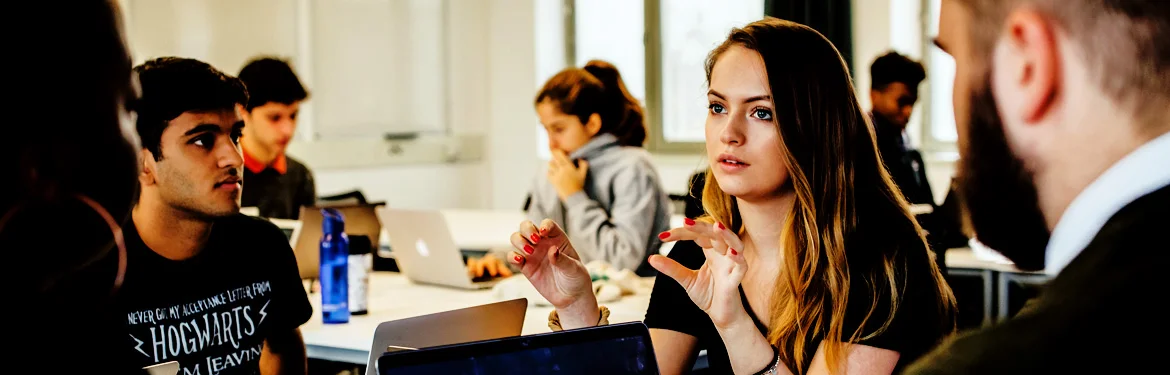
In Liberal Arts and Sciences we use a Problem-Based Learning (PBL) approach. This is where you understand a topic by examining complex problems from a variety of perspectives through hands-on active learning. You will then develop your own distinctive stance on that problem. Our students are co-creators of knowledge in the classroom.
The core modules are mostly delivered using PBL workshops, which are shaped by the independent research conducted by students. Rather than attending formal lectures, you will spend your time in the classroom debating, framing, and presenting research questions/responses. This is an active learning method that relies on your specific interests. Therefore, the content we teach (explored through in-depth case studies) changes from year to year depending on the student cohort and current events.
Your selected stream and optional modules from across the University may involve lectures, seminars, tutorials, and/or laboratory work. You will be taught by tutors from different disciplines. Your tutors in Liberal Arts and Sciences will support you when bringing together these diverse approaches in a way that makes sense to you. They will also offer guidance throughout your degree as you tailor your studies to suit your passions, interests, and career ambitions.
We believe that students learn best when doing hands-on activities in small groups. Modules in the Liberal Arts department typically range from 12 to 25 students per class. Most of the core modules have approximately 15-20 students per class. The size of our classes is designed to create a close and supportive learning community, ideal for Problem-Based Learning.
Your modules in other departments will have more varied class sizes.
Contact hours vary significantly depending on your stream and optional modules. A Liberal Arts and Sciences student can typically expect between 8 and 12 contact hours a week, including stream modules. You may have more than 12 hours, depending on your module choices. Module offerings in other departments may involve different contact hours per week.
Core Liberal Arts and Sciences modules in the first and second year consist of one, two-hour workshop per week. Much of our teaching takes place over two terms. Most year-long modules have around 40 hours of teaching time each. Our teaching curriculum offers regular out-of-classroom activities, including film screenings, skills sessions, discussion groups, reading groups, and field trips. You will also choose two optional core modules from across a wide range of offerings based on the unique research expertise and interdisciplinary interests of staff in Liberal Arts; these are often taught over one term, or in some cases, in an intensive two-week format in Term 3 (such as our Venice modules).
In addition, across the first year you will attend regular one-hour sessions as part of an introductory module (Liberal Arts: Principles and Praxis).
The final-year core Dissertation module involves both lecture/group discussion sessions and one-to-one supervision sessions across three terms.
Assessments in Liberal Arts and Sciences enable you to develop your expertise and advanced skills in addressing different kinds of problems. You will use a wide range of theoretical and practical perspectives, including from the sciences, social sciences, arts, and humanities. You will also learn how to deploy a variety of research methods and will be well-equipped with a strong theoretical foundation that will empower you to approach difficult problems critically, analytically, and creatively. The range of assessments in Liberal Arts and Sciences thus combines the traditional (essays and presentations) with the innovative (creative projects, podcasts, portfolios, video projects, policy proposals, and more).
Our assessments are designed to be authentic learning experiences. Few single assessments are worth more than half of a module’s total mark. Assessment types vary to support the development of academic and professional skills.
Assessment methods will differ according to the optional modules that you choose from across the University. For example, if you choose to take modules in the School of Life Sciences, you may undertake laboratory-based assessments while other departments may use more written exams.
Assessments in each year of the degree contribute to the degree classification. Assessments taken in the study abroad year are pass/fail and do not contribute to the degree classification.
As part of your Liberal Arts and Sciences degree, you will have the unique opportunity to study abroad for one year at one of our Liberal Arts partners. We have exclusive partnerships with specialist Liberal Arts programmes in both Europe and Canada:
Concordia University (Montréal, Canada)
University College Leiden (The Hague, Netherlands)
Charles University (Prague)
Leuphana University, (Lüneburg, Germany)
University College Freiburg (Freiburg, Germany)
University College Utrecht (Utrecht, Netherlands)
Rikkyo University (Tokyo, Japan)
By studying at one of our partners, you will gain a unique understanding of the global context of your degree and how Liberal education is approached in different educational cultures. The year spent studying abroad will not contribute towards the overall grade of your degree, however, it will be recorded on your Higher Education Achievement Report (HEAR).
During your study abroad experience, you will also benefit from the knowledge and understanding gained from experiencing of a different culture. Although the teaching is in English at our partner institutions, we strongly encourage students to acquire competency in another language while studying abroad.
Alternatively, you may also have the opportunity to study abroad at one of the University of Warwick's partner institutions. Please note that the availability of these partners varies each year, and we are unable to guarantee their availability for all students.
Additionally, we also offer short-term study abroad experiences through our School for Cross-faculty Studies (SCFS) Venice programme, which includes two SCFS Venice modules:
As a Liberal Arts and Sciences student, you will have priority on these two-week intensive modules and they will count towards your optional core requirements on your degree course. You can study both if you would like to stay in Venice for a month! Venice is a fascinating case study for problem-based learning; from sustainability challenges to exploring traditions of resistance from the Renaissance to the present day. These modules can be taken after your second year (or your third year if you take a study abroad/work placement year). The work you do on these modules will count towards your final year of study. There is no additional tuition fee for these modules, though students are responsible for the costs of travel, accommodation, and subsistence while in Venice.
For more information about studying abroad please see our Study Abroad pages.
Careers
Graduates from Liberal Arts (BA) have pursued a wide range of careers and further study. As a Liberal Arts student, you will equally have a range of career opportunities available to you. The variety of opportunities will depend on your chosen pathway.
Liberal Arts graduates tend to gravitate towards research-intensive and/or leadership roles, where they can use their critical thinking and problem-solving skills. Our Liberal Arts (BA) graduates have worked in a diverse range of fields and sectors, with recent graduates in the public, private, and third sectors.
We have a dedicated Employability and Placement Manager in our department who provides careers guidance. They work with employers to source work placement opportunities for our students and offer guidance to students before and during placements.
The University's Student Opportunity team also supports students to develop employability skills and guidance on careers options.
We offer a range of unique certificates outside of the curriculum to further enrich your professional development. In the first year, you can complete certificates in Carbon Literacy, Data Literacy and Professional Communication.
Our Student Opportunity (Careers) department offer a wide range of workshops, from developing confidence and interview techniques to learning how to articulate what you have to offer in order to impress potential employers. Online resources are also available, including training in drafting CVs and covering letters, practice aptitude and psychometric tests, practice online interviews, and other resources to help you research job opportunities. The myAdvantage databaseLink opens in a new window also advertises job, placement and internship vacancies that are from employers who are targeting Warwick students for their recruitment.
As part of your Liberal Arts degree, you will also have the opportunity to undertake a work placement. This will enable you to develop your skills in a professional environment whilst improving your employability prospects. Work placements allow you to apply theory to practice and learn from industry professionals. The two work placement options are:
1. Year-long work placement
You will complete a four-year degree and your work placement will take place in your third year. The work placement can take place in or outside of the UK and will be formally recognised on your Higher Education Achievement Report.
2. Short work placement
We also support students to undertake shorter work placements throughout the year.
Our students have been successful in securing work placements with employers from the private, public, and third sectors. These employers include research institutions, governmental bodies, Non-Governmental Organisations (NGOs), media organisations, fashion companies, environmental consultancies, financial consultancies, and many others. They have undertaken diverse roles such as Marketing Assistant, Researcher, Project Officer, and Editor.
Life at Warwick
This is where your journey begins. Our campus is the heart of it all. It’s more than just a campus - it's the places you visit, the people you meet, the fun that you have; the experiences you have here will be transformative.
Within a close-knit community of staff and students from all over the world, discover a campus alive with possibilities.
Our campus is where all the elements of your student experience come together in one place. You won't be short of ways to spend your time on campus - whether it's visiting Warwick Arts Centre, using our incredible sports facilities, socialising in our bars, nightclub and cafés, or enjoying an open-air event. Or if you need some peace and quiet, you can explore lakes, woodland and green spaces just a few minutes’ walk from central campus
Follow our students around campus on our social channels to see their experiences first-hand.
Teaching facilities
Our campus is designed to cater for all of your learning needs. You will benefit from a variety of flexible, well-equipped study spaces and teaching facilities across the University.
Oculus, our outstanding learning hub, houses state-of-the-art lecture theatres and innovative social learning and network areas
Different study spaces offering you flexible individual and group study spaces, computers, printing and scanning facilities, multimedia resources and more
Supporting you
Our continuous support network is here to help you adjust to student life and to ensure you can easily access advice on many different issues. These may include managing your finances and workload, and settling into shared accommodation. We also have specialist disability and mental health support teams.
Whether you live in a campus residence or in partnership accommodation off campus, you’ll be part of a community to get the most from your experience at Warwick.
Societies and sports play a huge part in community life at Warwick. With over 300 to choose from, getting involved is one of the easiest ways to make friends and share in experiences. Whether you’re into films, martial arts, astronomy, gaming or musical theatre, you can instantly connect with people with similar interests.
Your university experience is defined by far more than your course or the career path you follow. At Warwick, it’s where you discover who you could become.
68th
Warwick is ranked 68th in the world and top 10 in all major UK league tables
Our alumni community still call Warwick home. From a few hundred in 1965 to more than 310,000 alumni, and it's ever-growing.
As Warwick graduates, our students have access to employability support for two years after graduation, including access to careers appointments, job vacancies and professional networks.
A liberal education is based on the idea of acquiring knowledge and understanding worthy of a free, active and engaged global citizen. You will ask insightful, investigative questions, and you will not be limited to a single academic discipline.
Your degree in Liberal Arts or Liberal Arts and Sciences will demonstrate the ability to inspire others, provide creative leadership, and to untangle the trickiest and most complex problems. These are highly regarded skills that you can apply to any position in industry, creative endeavours, or future study.
This information is applicable for 2027 entry. Given the interval between the publication of courses and enrolment, some of the information may change. It is important to check our website before you apply. Please read our web page 'Important information to consider before making an application' in advance of applying to Warwick.
Next steps
Experience campus at an Open Day. Can't visit? Receive regular email updates or ask current students and staff questions about life at Warwick.