
Computer Science News
Latest two academic promotions
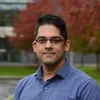
 In further good news, Dr Tanaya Guha and Dr Ramanujan Sridharan have been promoted to Associate Professor, effective from 1 July 2021 and 2 October 2021 (respectively). Many congratulations to them, whose recommendations in particular state:
[Dr Guha has] grown her research group to five PhD students currently, and attracted a portfolio of research grants in her career, including recently a substantial award from Ford. ... In engagement, Dr Guha has been raising the visibility of Warwick in her national and international research communities through her invited talks, leadership in the Association for the Advancement of Affective Computing, programme committee memberships, and conference organisation activities. She has also contributed substantially to the Sutton Trust summer school, a key outreach programme.
and
Dr Sridharan’s high standing in the research community is confirmed by his invited talks at international meetings and leading universities, memberships of the programme committees of prestigious conferences, and his organisation of international research events. ... In teaching, Dr Sridharan has successfully led (jointly and individually) two undergraduate modules. The feedback from students has been generally positive, with many appreciative of Dr Sridharan’s innovative and energetic delivery.
New Professor in the Department
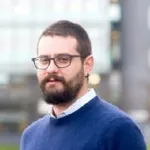 We are happy to announce that Dr Theo Damoulas has been promoted to Professor, effective from 1 August 2021. Quoting from Theo's recommendation,
Since his appointment to Warwick in 2015, Dr Damoulas has steadily and speedily risen to one of the most successful researchers in his two departments of Computer Science and Statistics. ... An impressive characteristic of Dr Damoulas’s expertise is his bridging of fundamentals and applications in these fields, and his ability to collaborate intensively over a wide area spanning several Warwick departments, several groups at the Turing, government bodies and industrial partners. ... Dr Damoulas has been one of the most energetic and most appreciated teachers in the department. ... The teaching achievements of Dr Damoulas extend also beyond Warwick, including his work with NYPD, his mentorships within the Turing PhD enrichment scheme, and his PhD external examining work.
it remains to say many congratulations!
Dr Josiah Lutton and Dr Pavel Veselý Named Joint Winners of a SEM Faculty Post Doctoral Prize
We are delighted to report that Dr Josiah Lutton and Dr Pavel Veselý, Research Fellows from the Department of Computer Science, have been named joint winners of a SEM Faculty Post Doctoral Prize.
Each year, the University of Warwick's Faculty of Science, Engineering and Medicine (SEM) funds a prize for the best Warwick-affiliated research output from an Early Career Researcher. Each department nominates a winner, or joint winners, out of the applications received after a judging process as determined by the Faculty.
Professor Yulan He, who led the Department's selection, commented:
Pavel's paper on quantile summary, co-authored with Professor Graham Cormode, was published in a top-tier conference on theoretical databases, Symposium on Principles of Database Systems (PODS) co-located with SIGMOD. The tight lower bound for quantile summaries proposed in this work is a deep theoretical exploration central to data management. The work led to a collaboration with Splunk, a US-based company that focuses on processing machine-generated big data. The follow-up paper has been accepted to the 2021 edition of the PODS conference. The result has a great potential for a broader impact. Josiah's work is on medical imaging. Together with Dr Sharon Collier and Professor Till Bretschneider, they proposed an enhanced 3D segmentation method (with a curvature-based enhancement term), which outperforms the best-of-breed random walker method in Dictyostelium image volumes. The work was published in a top journal, IEEE Transactions on Medical Imaging, with an impact factor of 6.68. Josiah presented his method at the Actin 2020 meeting and was awarded a prize for best imaging in a talk by the Royal Microscopical Society and has been featured in an article in their inFocus magazine.
Congratulations to Our New Graduates!
Congratulations to our new graduates, who will be receiving their results today!
Below is a video from our Head of Department, Professor Ranko Lazić, celebrating the occasion.
Well done, we wish you all the best for your careers, and we hope you stay in touch!
FoCS Theory Workshop (June 28, 2021)
The FoCS group Theory Workshop 2021 will take place online on June 28 (Monday).
The workshop will consists of some short talks by our PhD students and postdocs, highlighting their recent research.
For more information about the event please see
https://warwick.ac.uk/fac/sci/dcs/research/focs/activities/theory-workshop-june-2021/
WATE Win for Dr Matthew Leeke
We are pleased to report that Dr Matthew Leeke, Reader at the Department of Computer Science, has been recognised as part of the Warwick Awards for Teaching Excellence (WATE) 2020-21. WATE seeks to recognise outstanding teaching and support of learning across the University. This year the awards celebrated stories of everyday excellence in challenging times, and worked to plant the seeds for future approaches to teaching and learning.
Dr Matthew Leeke said regarding his award:
I'm hugely grateful to our students for the nomination. I feel fortunate to be recognised but even more fortunate to work with such talented and thoughtful people. I'd also like to thank my colleagues for their support. So much of what we do in academia goes unseen, making it important to remember that any success is always a team effort. The module tutors I worked with this year are a great example. Archie, Kabir and Vasan went well above-and-beyond in exceptionally difficult circumstances. It's the work of postgraduate students like them and our support teams that make any kind of recognition possible.
Ninad Rajgopal joins the department as a Research Fellow
We're happy to announce that Ninad Rajgopal has joined the department as a Research Fellow. Ninad is currently funded by Tom Gur's UKRI project "Foundations of classical and quantum verifiable computing".
Ninad completed his PhD at the University of Oxford under the supervision of Rahul Santhanam. He is broadly interested in theoretical computer science, complexity theory, pseudo-randomness, and learning algorithms.