
IER News & blogs
Congratulations to Dr Lorraine Johnson and Dr Jeisson Cárdenas-Rubio
 We would like to congratulate two of our former students who have been awarded their doctorates today, Dr Lorraine Johnson and Dr Jeisson Cárdenas-Rubio.
Dr Johnson interviewed women about their transition from public sector work during a period of austerity focusing on the intermediary systems they used. Lorraine’s research evidenced the range of support systems used to aid transitions and provided a number of recommendations for careers practice. Lorraine is currently undertaking an early career fellowship at the Institute for Advanced Studies at the University of Warwick.
Dr Cardenas-Rubio investigated to what extent a web-based model of skill mismatches could be developed for countries where the information on the labour market is relatively scarce. Jeisson’s research drew upon innovative methods in web scraping, big data analytics and machine learning to produce labour market information for Columbia that was analysed to provide a picture of the Columbian labour market. We are pleased that Jeisson joined the IER team earlier this year.
Listen to Clare Lyonette talking about her new project assessing the Covid-19 related burden on working-class women
 Professor Clare Lyonette was interviewed on BBC Radio Nottingham on Thursday July 16th about her new UKRI-funded project 'Carrying the work burden of the Covid-19 pandemic: working class women in the UK'. Listen to the interview here, starting at around 11.20 am.
The project, led by Professor Tracey Warren from the University of Nottingham, in collaboration with Professor Clare Lyonette and the Women's Budget Group is being funded under the Covid-19 programme. Using new Covid-related questions from the UK Household Longitudinal Study, the research will assess how working-class women, who already juggle paid employment with the bulk of housework and childcare responsibilities, have been affected by the additional pressures of increased demands, both at home and at work. Read more in the University of Warwick press release here.
Keep up the good work – planning a way out of the Covid-driven jobs crisis - Blog by Chris Warhurst
 Not even out of the health crisis, the UK is entering a jobs crisis. New data from the Office for National Statistics (ONS) shows a mixed picture of employment but with strong indications that employment is set to fall. The UK Government has done well to maintain employment levels to date but needs to be equally brave going forward and stick to its plan to create more good jobs in the UK.
Industrie 4.0 Policy brief published
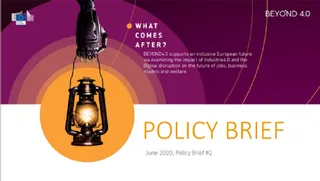 Beyond 4.0 is a Horizon 2020 project examining the future of work and welfare in Europe.
Chris Warhurst of IER and Steve Dhondt of the Dutch innovation organisation TNO have just published a Policy brief outlining the opportunities and challenges with Industrie 4.0 as part of the project.
Skills and transformation of the EU Automotive sector
 Terence Hogarth (as part of the FGB/EY team investigating skill needs in the automotive sector for the European Commission) moderated the 'Skills and Transformation of the EU Automotive Sector' webinar held on 27th May 2020.
The webinar was convened on behalf of the European Commission to report on its sector blueprint studies looking at the automotive sector’s skill needs and how they might be met. The webinar will be followed by a high level conference, planned for 23 September 2020, to explore the sector’s skill needs in greater depth.