
News
Dr Martine Barons from the Department of Statistics contributes to article examining narratives of foodbank use in online local press as part of a collection of articles created by BUP on the COVID-19 Economy
A collection of articles under the title 'Living in a COVID-19 Economy' and which examine economic crises and their effects on politics, poverty and social justice has been created by Bristol University Press and free to read until 31 October.
Dr Martine Barons from the Department of Statistics and Director of the Applied Statistics & Risk Unit at the University, along with Catherine Price, a Warwick alumnus contribute with others in an article entitled ‘The do-gooders and scroungers': examining narratives of foodbank use in online local press coverage in the West Midlands, UK.
Developing an IPM strategy for managing aphids on brassica crops - Andy Gladman's PhD project at the Crop Centre
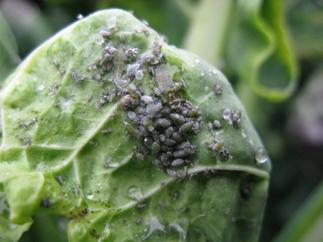 Aphids are economically important pests of a wide range of crops and control relies mainly on applications of synthetic chemical pesticides. However, pressures on growers to reduce the use of pesticides, together with increasing failures of aphid control due to the evolution of pesticide resistance, have raised serious questions about the long-term viability of this approach. Alternative methods of managing aphids are needed urgently.
Andy Gladman, a PhD student at at the Crop Centre, is investigating the development of a novel management strategy for pest aphids of Brassica crops (left picture: cabbage aphid) which aims to combine partial host plant resistance with biological control. More information
All Crop Centre articles as part of International Year of Plant Health 2020
Professor Rebecca Earle, a food historian from the History department comments in the Observer article: 'Let us eat cake: Britain turns to baking to banish the blues'
'If the spring was marked by a national obsession with baking sourdough or banana bread, it seems that autumn is set to inspire a craze for cake-making' writes the Observer in its article entitled ' Let us eat cake: Britain turns to baking to banish the blues'.
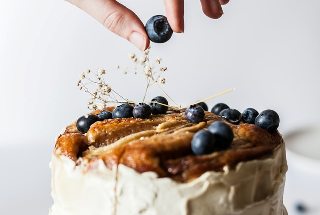 Professor Rebecca Earle, Head of the Department of History and a food historian at the University of Warwick contributes in a belief that [as nights draw in and months of uncertainty loom] “Baking a family recipe makes us feel closer to our absent grandmothers, mothers, aunts. Preparing their recipes is a form of conjuring, of summoning them up, of remembering them. [It is] an active process of remembrance that takes place not only in our heads but also in the sweet batter in a mixing bowl.
“Classicists employ the term ‘ekphrasis’ to describe creative practices that bring to life the nature or essence of a work of art from a different genre, such as a poem describing a painting, or a piece of music inspired by a novel. I think that preparing family recipes is an ekphrastic act. Cooking, perhaps humanity’s oldest form of art, momentarily connects us to our families.”
Natural way to boost crop yield to be explored by Warwick Scientists
An innovative way to increase plant yield naturally, reducing the need for expensive fertilisers is being explored by Dr Miriam Gifford, Dr Isabelle Carré and colleagues, thanks to a £492,343 grant from the BBSRC.