
IER News & blogs
Adult education

Blog from Dr Deirdre Hughes OBE, Research Programme Director & Associate Fellow at IER.
The numbers of adults participating in formal education is in serious decline in local communities. Adult education maximises engagement, retention and progression for those who might otherwise become lost in the less tailored support offered in Further Education provision. Four key themes need to be urgently addressed by Secretaries of State, Ministers, policy-makers and providers:
- Greater alignment of strategic priorities and funding streams - Adult education should feature in national and local strategic priorities.
• There is a need to promote adult education’s role in healthcare prevention strategies that contribute towards easing demand on acute health services. This needs Ministerial interest and commitment to bring about the necessary policy changes that will put adult education in a sustainable position for the future.
• Greater flexibility and alignment of funding streams can support targeting individuals and groups most in need. Changes to funding since 2010 have squeezed the social infrastructure between adult education, Further Education (FE) and wider community-based organisations. Whilst closer collaborative working is underway to share expertise and services, this remains piecemeal.
-
Capturing the evidence - There is much evidence of the positive impact and efficacy of adult education on individuals, communities and other public services; however, it is often neglected by policy-makers.
• Secretaries of State, Ministers, and those responsible for NHS ‘Sustainability and Transformation Partnerships’ (STPs), NHS Improvement, Health and Well-Being Boards, Clinical Commissioning Group (CCGs), Local/Combined Authorities and Local Enterprise Partnerships (LEPs) need to have greater access to the evidence of successful policies and practices through adult education. There is a critical need to build upon existing health and well-being surveys to identify any gaps in research, including those that examine whether short, part-time community learning courses help people develop strategies to manage their everyday lives more effectively.
• There are significant benefits to be gained in capturing contextualised adult education, health and wellbeing e.g. the Good Things Foundation and its work with NHS shows health inequalities account for well in excess of £5.5 billion in healthcare costs to the NHS annually. Based on a cost to the NHS of £45 per GP visit, ensuring everyone had the Basic Digital Skills to access health information online would provide savings of £121 million a year by 2025. Other research in the report points to cost benefits and savings. There is significant scope to produce more podcasts/videos of adult education in care homes, healthcare centres, schools, community centres, libraries and workplace settings, to inspire individuals and family learning.
-
Getting the message across - There are missed opportunities for collaborative and co-productive work between sectors and professionals. As a result of fragmented national policies, people often fall between the gaps in health and education practice.
• National and local policies must focus on ratcheting up the demand for adult education provision, particularly from healthcare sectors (and in healthcare contexts).
• Social prescriptions that include ‘prescribing for learning’ should help partnerships to engage with the process of creating a healthy society and focusing on the health and well-being of individuals.
- All policy interventions should consider how inequality can best be addressed
The Social Mobility Commission indicates new divides have opened up in Britain, across geographies, income groups and generations.
Adult education: important for health and well-being
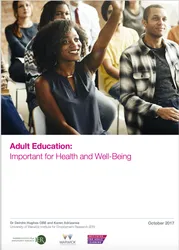
This latest research, commissioned by the Institutes for Adult Learning, aims to increase awareness of the benefits that adult education can bring to the nation's health and well-being. It also aims to stimulate dialogue on how central and devolved government policies and practices can ensure that adult education remains a strategic priority.
So much evidence points to the fact that adult education makes a significant contribution to the health and well-being of individuals and communities. It can be relied upon to assist in addressing national policy challenges such as encouraging and enabling individuals and families to take a more active role in their own health and well-being. However, this added-value contribution is at serious risk of being lost in a policy landscape pre-occupied with apprenticeships, skills and qualification reforms. Devolution presents some real opportunities in local economies to address the skills shortages expected to follow Brexit.
Our evidence points to three key messages:
- Adult education does help keep individuals well and supports longer and productive lives.
- Adult education does help meet major challenges such as: ageing, loneliness, long-term conditions, mental health and well-being and community cohesion.
- Adult education does help save money in the National Health Service (NHS) and the social care system.
Six recommendations are outlined in the report. These are aimed at local, regional and national policymakers, educationalists, NHS 'Sustainability and Transformation Partnerships' (STPs), Health and Well-Being Boards, Clinical Commissioning Group (CCGs), Local/Combined Authorities and Local Enterprise partnerships (LEPs) and others working in the Health and Social Care Sector. This report builds upon earlier research 'Adult Education: Too Important To Be Left To Chance' (2016).
Developing a post-Taylor Report measure of job quality for the UK
 Last year’s Taylor Review of Modern Working Practices recommended that the UK Government establish a measure of job quality. IER Director Chris Warhurst has been invited to sit on a working group in support of that recommendation organised by the Carnegie Trust UK and co-chaired by Matthew Taylor. It is due to report in early summer 2018.
Working Futures review
 Alex Hall, Director and Chief Economist in the Department of Labor and Employment for the state of Colorado, will visit IER in February. Alex is an expert advisor to the Federal Bureau of Labor Statistics in the US and will work with Professor Rob Wilson to review Working Futures, IER’s flagship programme modelling the UK labour market and funded by the UK Government.
New report on sexism in schools launched
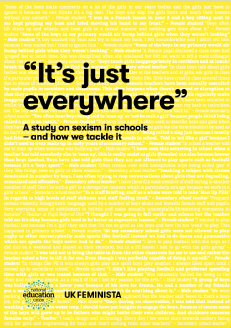 IER’s Gaby Atfield, Erika Kispeter and Clare Lyonette have been commissioned by the National Education Union (NEU) and UK Feminista to conduct research on sexism in UK schools.
The report summarising the findings will be launched today (12 December 2017) at the Houses of Parliament.
Key findings from the research include:
- Over a third (37%) of girls at mixed-sex schools have been sexually harassed while at school.
- Over a third (34%) of primary school teachers say they witness gender stereotyping in their schools on at least a weekly basis.
- 64% of teachers in mixed-sex secondary schools hear sexist language in schools on at least a weekly basis.
- Students generally do not report sexism: only 14% of those who experienced sexual harassment told a teacher and 6% who heard the use of sexist language reported it.
UK Feminista and the NEU call on the Government, Ofsted and schools to take urgent action to challenge sexism and sexual harassment in schools. The report is based on a survey of 1508 secondary school students and 1634 teachers at secondary and primary schools in England and Wales. Discussion groups were also conducted with secondary school students.