
IER News & blogs
IER to host an event discussing job quality and working life in the UK
 In mid-January IER will host a meeting of the Working Life Engagement and Improvement Group. The group was established in 2018 by social scientists committed to using insights from social science to advance the quality of jobs and working life in the UK.
For further details contact: c.warhurst@warwick.ac.uk.
Talent Match youth employment programme keynote
 Gaby Atfield was invited to give a keynote speech at Talent Match Staffordshire's conference and awards ceremony in Lichfield on 22nd November 2018. Talent Match is a five-year, £108m Big Lottery-funded programme supporting young people who are furthest from the labour market, including hidden NEETs who are completely outside the benefits, work and training system, gain the skills they need to get into employment.
IER, in partnership with CRESR at Sheffield Hallam University, City-REDI at Birmingham University and Cambridge Economic Associates, have been evaluating the programme across the 21 youth unemployment hotspots in England since 2014.
The presentation on findings from the national evaluation can be found here.
Keynote at the ATHE conference
 Dr Heike Behle delivered a keynote on ‘Employability as an outcome of tourism education beyond TEF: Theoretical conceptualisation and measurement’ at the Association For Tourism in Higher Education (ATHE) conference on 'Creativity & Transformation in Tourism Education' on 6th December 20018 at Leeds Beckett University.
Measuring Good Work report launched
 Following the 2017 Taylor Review of Modern Working Practices’ recommendation that the UK Government should develop new measures of job quality for the UK, a Working Group was established by the RSA and Carnegie UK Trust, and included IER Director Chris Warhurst. The Group has now reported, launching its Measuring Good Work report. The report recommends that seven dimensions of job quality should be monitored annually by the government. These dimensions include pay and benefits, voice and representation, work-life balance and job security. A formal response form the UK Government is expected later this autumn.
New research highlights challenges veterans face in becoming self-employed
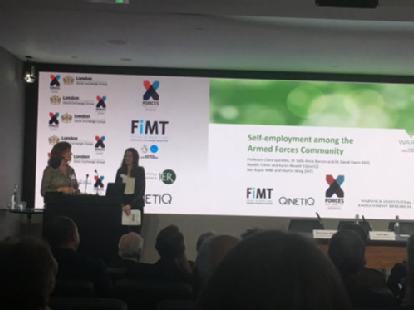 A new report, ‘Self-employment and the Armed Forces Community’, has revealed the barriers ex-Service personnel face in becoming self-employed after leaving the Armed Forces and calls for broader support from the MOD to help Service personnel transitioning out of the Forces and into self-employment. Research conducted by the IER, supported by defence technology company QinetiQ and X-Forces Enterprise (XFE) and funded by Forces in Mind Trust, was carried out to understand what more could be done to support ex-Service personnel to successfully move into self-employment. The report was launched on 10th October at the X-Forces Enterprise 5th Anniversary event at the London Stock Exchange.
More info can be found here and a copy of the report, co-authored by IER's Professor Clare Lyonette, Dr Sally-Anne Barnes and Dr David Owen , Natalie Fisher and Karen Newell (both QinetiQ), Ren Kapur MBE and Martin Wing (both X-Forces Enterprise) can be viewed here.