
IER News & blogs
Caste differences in the acquisition of soft skills among disadvantaged young people in India
Blog by Clare Lyonette, Sudipa Sarkar, Gaby Atfield, Beate Baldauf, Bhaskar Chakravorty and Erika Kispeter
‘Soft’ skills are important labour market skills and include social aptitudes, language and communication capability, friendliness and ability to work in a team. Using survey data collected at two time points from a large sample of disadvantaged young people enrolled on a skills training programme in India, we examine whether caste affects initial levels of soft skills, and whether or not these skills can be learned during a relatively short period, providing young people with longer-term opportunities within the labour market.
Call for papers for Beyond 4.0 conference on digitalisation and work
 Beyond 4.0 will hold a scientific conference in Sofia over 30 September-1 October 2021. It focuses on digital transformations on work and employment. It is likely to be a hybrid conference. The deadline for submitting proposals is 15 March 2021. Proposals should be no more than 450 words and sent to: sofia2021@beyond4-0.eu. Read more here.
Peter Dickinson appointed as advisor to two organisations
 Peter Dickinson, Senior Research Fellow at IER, has been appointed to the What Works Growth’s Evaluation Panel. The panel provides advice and support to central and local government on the design and implementation of evaluations of local economic policies. It helps ensure evaluations are high quality and supports policymakers in developing their evaluation skills, knowledge and capacity. Over the longer term, it will also expand the evidence have about ‘what works’.
Peter has also been appointed to the International Labour Organisation's (ILO) roster of consultants providing advice, expertise and support on skills policy and practice.
A web-based approach to measuring skills mismatches and profiles in a developing country
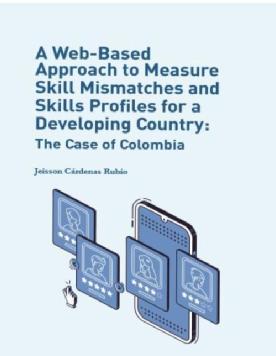 Despite information failures in the labour market and their consequences on unemployment and informality rates, countries like Colombia lack a proper labour market information system to identify skill mismatches and employer skill requirements.
The use of online job portals as a potential source of labour market information has recently gained researchers’ and policymakers' attention. However, debates continue about the efficacy and robustness of job portals for labour market analysis.
This new book by Jeisson Arley Cardenas Rubio contributes to our current understanding of the topic by developing a conceptual and methodological approach to identify skills, occupations, and skill mismatches using online job advertisements, which would otherwise be too complex to analyse.
Climate emergency and sustainable working practices
 Chris Warhurst has been invited to address Scotland's Climate Assembly, giving evidence on sustainable working practices.
His evidence, presented on 24 January, focuses on three issues: the greening of the labour market, the quality of green jobs and ensuring access to these jobs by marginalised workers. Watch a short video here.
The Assembly will develop recommendations for the Scottish Government.