
IER News & blogs
Job quality network meeting at IER
 On 19th December 2019 IER hosts the latest meeting of the Working Life Engagement and Improvement Group' (WLEIG). The Group is a network of researchers and practitioners interested in job quality. Its aim is to improve the quality of working life in relation both to policy and practice within organizations.
The meeting is from 11.00am to 1.30pm and newcomers are welcome to participate. For details, please contact Amanda Kerry: a.kerry@warwick.ac.uk
Peter Elias elected to the Council of the Royal Statistical Society
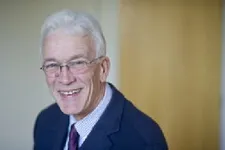 Professor Peter Elias, CBE, was elected to the Council of the Royal Statistical Society in November, serving as a member for a four year period.
Earlier this year he has been conferred as Fellow of the Academy of Social Sciences.
LMI for All team meets Studiekeuze123
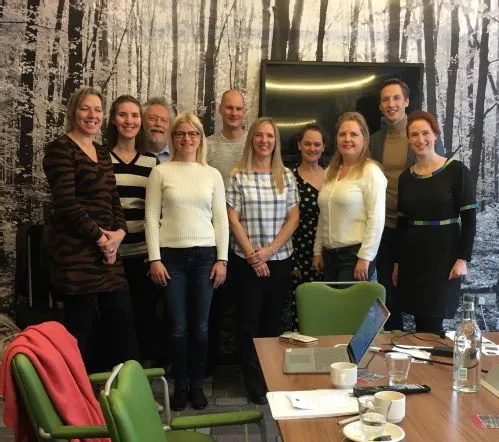
As part of a knowledge exchange and sharing good practice, Sally-Anne Barnes, as part of the LMI for All team, met with the Stichting Studiekeuze123 team from the Netherlands.
Studiekeuze123 had just won three #LovieAwards for their website Studiekeuze123.nl, which is the official Dutch platform to support students in their study orientation and choices.
Sally-Anne and the Studiekeuze123 team had a great morning talking about careers LMI, course and occupational mappings and widgets! The LMI for All team look forward to future opportunities to work together.
Jordan British Council and AQACHEI visit IER
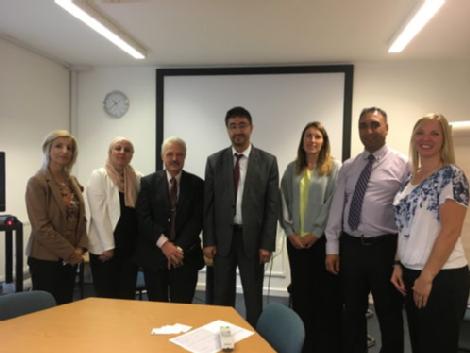 IER welcomed members of the Jordan British Council, the Accreditation and Quality Assurance Commission for Higher Education Institutes and the higher education sector (AQACHEI) in October 2019. The delegation was comprised of key members responsible for the implementation of the Jordan National Qualification Framework.
They came to find out more about LMI for All and how it is supporting careers education and guidance within the education sector.
The event was organised by Lisa Collett from Cotswold Research who has been managing the Action Learning Forum project in Jordan.
Professor Peter Elias, CBE, Fellow of the Academy of Social Sciences
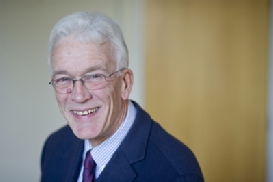 Professor Peter Elias, CBE, of IER has been conferred as a Fellow of the Academy of Social Sciences. This Fellowship is a huge accolade. Fellows are drawn from academics, practitioners and policymakers, marking the impact of their work through the use of social science for public benefit.
Professor Chris Warhurst, Director of IER said:
‘It is another indication of the very high esteem with which Peter is held for his work on, amongst other things over the past thirty years, occupational classification schemes in the UK and internationally and, more recently, developing protocols for the use of Big data for the OECD countries.’