
IER News & blogs
New Futuretrack Reports: Ten Years On - and the impact of the pandemic on graduate careers
 The publication of the Futuretrack Stage 5 study conducted in 2019, led by Professors Peter Elias and Kate Purcell and funded by the Nuffield Foundation, showed ‘how the majority of graduates had by then achieved reasonable job security, with many balancing work and parenting or other caring roles when the pandemic hit’ (see press release). In 2020, the research team went back to respondents to investigate how they had been affected by the Covid restrictions and economic impact and conducted Futuretrack Stage 6.
For full details of the research see:
- the report on the Covid-19 impact: Covid 19 and graduate careers
- a slightly revised version of the report published in March 2021: Ten Years On – the Futuretrack Graduates
- a short report that summarises and draws the implications of both the above What a difference a year makes: the impact of Covid 19 on graduate careers
Carrying the work burden of the Covid-19 pandemic: working class women in the UK – final report out now
 Clare Lyonette from IER has been collaborating with Professor Tracey Warren from Nottingham University Business School on a 12-month ESRC-funded project on the impact of Covid on working class women. The final report was published to coincide with a webinar on June 18th.
The authors are also presenting their main findings to the Women and Equalities Committee on June 30th, as part of an ESRC Impact Acceleration Account grant, which focuses on disseminating current Covid-related employment research undertaken by IER to relevant UK parliamentarians, with the hope that it will then feed into their deliberations about economic recovery post-Covid.
More information can be found:
- in the final report
- in an article in The Conversation
- on the Nottingham University Business schools' COVID-19 Working women page
- in the webinar recording.
Dr Sally Wright attended workshop on algorithmic management of work
 Dr Sally Wright was invited to participate in a technical workshop on ‘Practices towards algorithmic management and their impact on workers’. The technical workshop, held 15 & 16 June, was jointed hosted by the European Commission’s Joint Research Centre of the European Commission (JRC) and the International Labour Organisation (ILO), and organised as part of the EU-funded project on the Future of Work.
The workshop was aimed at developing new evidence around several specific but understudied themes. The workshop considered how algorithmic management and other practices that are often associated with platform work are being increasingly used beyond digital labour platforms, by traditional companies, thus leading to ‘platformisation’ of work.
The experts considered the extent and how the introduction of a new digital outsourcing model, new tools and modalities for work planning, monitoring and surveillance are likely to impact on business models, work organisation, working conditions, employment and industrial relations.
Second Beyond 4.0 Summer School
 IER staff and PhD students participated virtually in Beyond 4.0’s second summer school, held again in San Sebastian in Spain. Beyond 4.0 is a Horizon 2020 funded project that examines the future of work and welfare in the digital age.
The summer school offered a mixture of themes: careers guidance for PhD students, plus research on the digital transformation of workplaces; regional responses to digitalisation; historical analysis of industrial transformations; and social policy contexts.
Among the 22 speakers, Professor Chris Warhurst and Dr Sally-Anne Barnes presented sessions during the Summer School. Two of IER’s PhD students Wafaa Elmezraoui and Gianni Anelli Lopez were among the 21 PhD students who participated in the event. Congratulations to Wafaa. Having ‘pitched’ her PhD topic in a poster session during the event she was awarded first prize.
Watch a short explanation of the summer school in this video.
Journal Special Issue on Decent Work, Inclusion and Sustainability
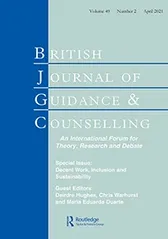 Along with IER Associate Fellow Dr Deidre Hughes OBE and Professor Maria Eduarda Duarte of the University of Lisbon, IER’s Chris Warhurst has guest edited a special issue of the British Journal of Guidance and Counselling (Vol. 49) on Decent Work, Inclusion and Sustainability. Just published, the special issue examines the implications for career guidance and working life transitions in the context of rising inequalities and inclusion deficits in labour markets internationally.
Together with Deirdre Hughes, Emma Benger and Mandy Ifans, Chris Warhurst also co-authored an article in this special issue on Building better futures: decent work, inclusion and careers support services in the UK.