
IER News & blogs
IER welcomes two visiting International Fellows from Italy
 Dr Giulio Pedrini and Dr Luca Cattani from the University of Bologna will visit the IER for a month, working with Dr Daria Luchinskaya (IER) and Dr Charoula Tzanakou (PAIS) to develop a collaborative programme of research on graduate employment between the University of Warwick and the University of Bologna.
As part of their Institute for Advanced Study funded visit, they will present a workshop titled:
Graduate labour market transitions in the UK and Italy: initial patterns and institutional similarities
and difference on 17 July, 2018 at 12.30 hours in B0.41, ground floor, Social Sciences Building.
If you wish to attend please email L.Marston@warwick.ac.uk to book a place.
For more information about other events on graduate transitions in the UK and Italy during July read here.
Military spouses/partners: identifying the barriers to employment and future support needed
 The IER and QinetiQ, were commissioned by Army Families Federation to analyse the factors shaping the employment of military spouses/partners and to formulate recommendations for effective support services.
The report, launched by AFF at the Royal Horseguards Hotel in London on Tuesday 19th June, with speakers including the Right Honourable Esther McVey, contains a series of key recommendations for supporting military spouses/partners into employment.
The research involved five separate phases of data collection, undertaken between October 2017 and April 2018. Data was collected from an online survey with almost 1500 spouses/partners from all three Services, 32 telephone interviews, an online survey with 38 employers and 14 stakeholder interviews.
Lyonette, C., Barnes, S-A, Kispeter, E., Fisher, N. and Newell, K. (2018) 'Military spousal/partner employment: Identifying the barriers and support required' - report to Army Families Federation.
IER award to help create measures of job quality for the post-Taylor Review
 Sally Wright and Professor Chris Warhurst have a new ESRC-funded Impact Accelerator Award to support their work for the working group tasked with responding to the job quality recommendations made in the UK Governments’ Taylor Review of Modern Working Practices. The working group is co-chaired by Martyn Evans, Chief Executive of the Carnegie UK Trust, and Matthew Taylor, Chief Executive of the Royal Society for Arts.
Exploring collaborative research on graduates’ transitions into the labour market
 In July 2018, Dr Giulio Pedrini and Dr Luca Cattani from the University of Bologna will visit the IER for a month, working with Dr Daria Luchinskaya (IER) and Dr Charoula Tzanakou (PAIS) to develop a collaborative programme of research on graduate employment between the University of Warwick and the University of Bologna.
IER delegation visits the VUB in Brussels
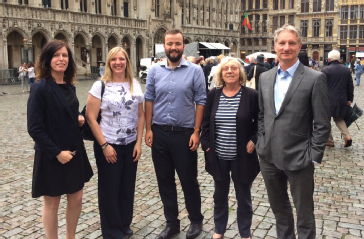
In May, a delegation of senior staff from IER visited the Interface Demography and Tempus Omnia Revelat (TOR) research groups at the Vrije Universiteit Brussel (VUB) in Brussels. This visit was part of Warwick’s new strategic collaboration with the VUB. A Memorandum of Agreement has been signed by the two universities on 6 June.
IER will be developing joint research and PhD studentships with the two groups, both of which have research specialisms in job quality, labour market transitions and careers guidance.
Following the success of the visit, Catherine Vassallo, IER’s departmental administrator said:
‘IER and its counterparts at VUB (Interface Demography and TOR) were able to identify clear areas of shared interest, which have real potential to achieve innovative outcomes and build on our shared commitment to Europe-wide research.'