
IER News & blogs
A delicate balance? Health & Social Care spending in Wales - new report

Dr Daria Luchinskaya led on a report, A delicate balance?, with Wales Public Services 2025 colleagues Joe Ogle and Michael Trickey, analysing health and social care spending patterns in Wales over 2009-10 to 2015-16, and the issues that this raises for the future of public services financing and sustainability . This work builds on Daria's earlier contribution to the Institute of Fiscal Studies Green Budget (February, 2017), and provides the basis for further analysis of public services provision in Wales.
The main findings were that spending on NHS Wales has been growing as a proportion of all spending allocated to the Welsh government for day-to-day running of public services, which raises questions about the extent to which non-NHS public services, such as social care, can be financed. While day-to-day spending on local authority-organised adult social services has remained broadly flat in real terms in Wales, the increasing over-65 population in Wales means that spending per older person has fallen by over 12% in real terms over 2009-10 to 2015-16. Wales would need to be spending at least an additional £129 million by 2020-21 (at 2016-17 prices) to bring the per capita spend on local authority social services for over-65s back to 2009-10 levels. In the current austerity context, this raises questions about budgetary trade-offs and decisions about spending priorities. The authors will be exploring these issues in their next report.
Investing in adult education: health and well-being benefits

The APPG for Adult Education commissioned the Warwick Institute for Employment Research in 2016 to conduct research into the needs of adult learners. This work was supported by the Institutes for Adult Learning (IALs). The nine Specialist Designated Institutions (SDIs), including City Lit, Morley College, Hillcroft College, Northern College, Ruskin College, Working Men’s College, Mary Ward Centre, Fircroft College and the Workers’ Educational Association (WEA),– each has its own identity, mission and distinctive approach, which adds to the rich diversity of adult education.
Our primary focus was on adult education, and on adults returning to learn. Learning can occur in education or training institutions (offline or online), the workplace (on or off the job), the family, or cultural and especially, community settings. Findings from this in-depth study highlighted local and newly Combined Authorities will be accountable for the allocation of funds with Local Enterprise Partnerships (LEPs) in setting the agenda and identifying priorities within local communities. It is, therefore, critical that the contribution of adult education, including its contribution to improving health and well-being (which are pre-requisites for progression into and within employment), must not be lost or forgotten within current and any new devolution arrangements.
It is clear that most providers of adult education have invested in reaching out to people who are disadvantaged one way or the other. Many of whom would not otherwise know about adult education and what it could do for people in their circumstances. Adult education providers have developed the expertise, teaching skills and resources to deliver non-qualification provision and/or bite-sized units that successfully engage these adults in learning again, offering a stepping stone to success. Therefore, any policy or practical interventions need to reflect this and provide flexibility. Post-devolution, local Skills Commissioners will be required to make investment decisions - which is why their role is so central to the sustainability of adult education now and in the future.
IER'’s formal ‘Call for Evidence’ in 2017 has a distinctive focus on adult education, health and well-being. The main purpose is to gather the views of key stakeholders, partners and providers on the contribution of adult education to health and wellbeing outcomes. We have deliberately not attempted to define the parameters of the Call For Evidence too tightly as we want respondents to explore many different aspects of health and wellbeing. We hope to hear from those interested in any aspect of physical or mental health, including health and wellbeing in the context of age, disability, ethnicity, gender and location. For further information contact: Dr Deirdre Hughes OBE, deirdre dot hughes at warwick dot ac dot uk.
LMI for All – webinar on accessing labour market information
 Accurate, reliable and up-to-date labour market information (LMI) is acknowledged to be essential for successful individual career transitions for individuals making their way into, and through, the labour market. The LMI for All service has been under development at IER since 2012. Its usage across various established websites is testimony to its efficacy and usefulness. Interest in the portal is significant and growing.
The LMI for All database provides a reliable and up-to-date source of national data and careers labour market information. By using the LMI for All API (application programming interface), there is the potential to provide access to data relevant to all individuals at various stages of their learning and career journey for making career decisions. Find out more about the LMI for All service, who is using it and how to access at the next free webinar on 3 May. To register go to the project website.
Online map of innovation, job quality and employment outcomes in the UK and the rest of Europe
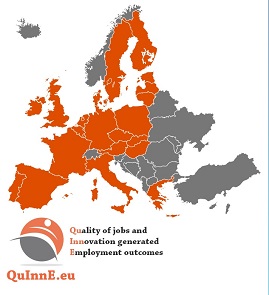 Based on new statistical analysis from its Horizon 2020 project ‘QuInnE’, the team have just published an online map that calculates and compares innovation, job quality and employment outcomes for the EU and its Members states. It shows that the UK is 'medium-high' on job quality, with high wages but also high part-time and short part-time working. The UK is 'medium-high' on innovation: output indicators at the firm level are high but levels of innovation enablers at the national and employee levels are lower. The UK is 'high-high' on employment performance, with a high level of employment for the prime-age population (25 to 54 years) and relatively high levels of employment for vulnerable groups. Further details of QuInnE, please contact ier at warwick dot ac dot uk.
Harnessing growth sectors for poverty reduction

Two further reports have been published by Professor Anne Green, Paul Sissons (Coventry University) and Neil Lee (LSE) from an ESRC-funded project on Harnessing Growth Sectors for Poverty Reduction.
The first report on employment entry finds that there is potential for using a well-targeted, sector-focused approach to increase employment entry and help reduce poverty. Social care and the hospitality industry offer opportunities for sector-specific training programmes for people who find it difficult to access employment. But because these sectors are characterised by low pay policies need to promote career progression as well as job entry. The construction sector is also well placed to provide employment and training opportunities for local residents, and the government could encourage this through procurement and planning policies. There is also growing interest in the potential role of social enterprises in providing local jobs – especially with regard to repairs and maintenance of social housing. Sector-focused work experience is an important way of getting young people and unemployed adults skilled up for work.
The second report examines aspects of job quality. It finds that while job quality should be a critical issue for policymakers there is a lack of empirical evidence from approaches seeking to enhance job quality. Pay and job security are important elements of job quality, as are flexible employment practices that enable people to balance work and caring responsibilities. Trade unions can play an important role in improving job quality outcomes. Where there is evidence from sector-focused approaches to job quality these have sought to link changes in employment conditions with service improvements for employers; utilised procurement as an opportunity to shape job quality; or sought to encourage changes in business models as a precursor to improving job quality. There is a need to pilot and trial different approaches to improving job quality in different sectors and for different types of employment.