
International Student Support

Information Hub for international students
You'll be joining one of the most international campuses in the UK - students here come from over 140 countries - and this guide has been written with your specific journey in mind. Here, you will find comprehensive pre-arrival guidance, top tips on settling in and getting support when you are here, a wide range of opportunities to help you thrive, and meeting people from around the world (for example, through our weekly Global Lounge).Jump to content
Key priorities for
Step-by-step support
Before you arrive

Meeting offer conditions
If you have received an offer, Congratulations! Check how to meet your offer conditions for:
- Undergraduate courses;
- Postgraduate courses (including WMG Master's degrees);
- International Foundation Programme;
- Incoming Exchange Programmes.

Visa Support
Our Student Visa Advice Service offers visa support throughout your journey at Warwick, from pre-arrival to six months after graduation.
This includes advice on how to obtain a visa and register for your eVisa before travelling, attend your 'Right to Study' check, resolve any visa issues during studies, and advice on post-study work visa options.

International Student Success
Studying in a new country can be both exciting and stressful. To prepare, we recommend that you complete this online course, as this will help you prepare for cultural adaptation, understand academic norms and build your confidence.
We recommend that you spend 2-4 hours to complete the 4 modules in July or August, or 2-3 weeks before arriving in the UK.

International Arrivals
Hit the button below to find out more about how to travel to campus, with top tips provided by the UK government on entering the UK.
When you're on campus

Your First Week
Explore where you need to be and what you need to do when you arrive on campus, including: how to collect your accommodation keys; where to eat on campus; campus maps; how to arrange library induction; and how to explore campus and surrounding areas such as Coventry, Kenilworth and Leamington Spa.

Tailored Career Support
If you are here on a 1-year Master's degree, we know career development is one of your top priorities.
We offer tailored career support for international students before you get here, during your course, and up to two years after you graduate, for both jobs in the UK and jobs overseas.

Need Help?
Get in touch with us through events, live chats, emails or online forms, or by visiting us in person.
Once you arrive, there will be lots of friendly student helpers to help you find your way around.
Top Tips from Current StudentsLink opens in a new window
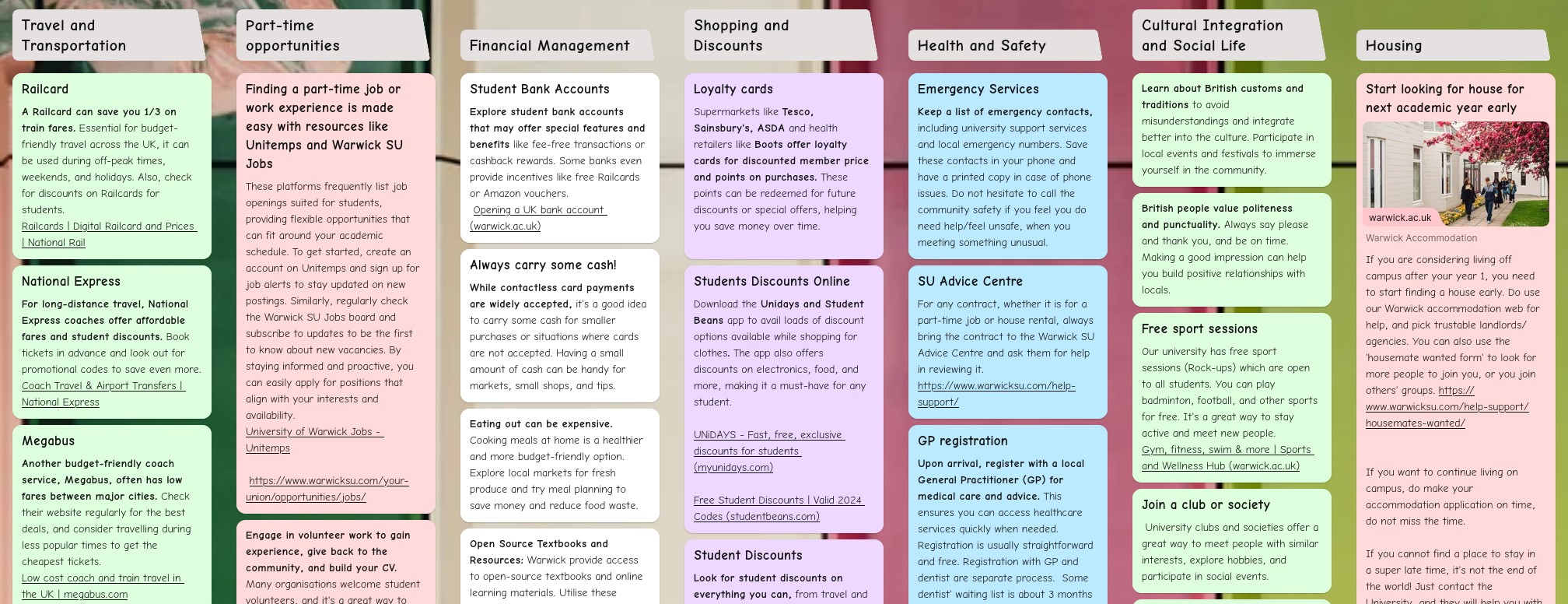
To help you settle in smoothly, we've curated a Padlet filled with top tips and advice from current students and alumni. From housing, navigating campus, managing your finances, and making the most of your social life, you’ll find plenty of helpful insights.
Step-by-step support of your student journey
Use the search bar if you are looking for specific information.
On the below FAQs you can select the '>>' widget next to the section title to unhide the text so it becomes visible to the screen reader.
- Check 'Entry Stamp' on arrivalLink opens in a new window: when you are at the Border Control, check your passport has been stamped. If you are using the 'e-Gate', make sure you keep your boarding pass - you will need this to complete enrolment.
- Visit Senate House: to collect your Student I.D. card if you’re living off campus. Also, if you need the University to sign a sponsor form, have any issues with campus accommodation, or need an ink stamp for your 'student status letter', our Student Information Centre is there to help you.
- Note: incoming exchange students should check the guidance from the Student Mobility team.
- Get a UK phone number: most airports and supermarkets offer pre-paid SIM cards, including the Tesco in Cannon Park Centre Superstore near campus. We also hand out free SIM cards during Welcome Week on a first-come, first-served basis.
- Attend your Right to Study check appointment: this is mandatory for all non-UK and non-Irish students with a time-limited visa, before you can start your course.
- Enrolment Dashboard tasksLink opens in a new window: follow the instructions to register with the Health Centre, pay fees, and complete the Student Conduct online course.
- Student Admin: find out how to register for your modules, pay your fees, keep your student records up to date, and timetabling. Check your Course Handbook for information related to your academic department and studies.
- Download a Certificate of Status letter: First, check and update your Student Records OnlineLink opens in a new window with your UK address and UK phone number. You can then download this letter. This is proof of your student status and you may need it to open a UK bank account, apply for Council Tax exemption (if you live in house-share).
- Together at Warwick: is a portal for all student events on campus - check out the event calendar of exciting cultural celebrations such as the Day of the Dead, Christmas, Lunar New Year and Holi. We also offer weekly events where you can take a break, connect, and discover (for example, board games, crafts, participate in projects and culture exchange).
- Global Lounge: A relaxed weekly drop-in space where you can meet new people, enjoy snacks and conversation, and connect across cultures.
- Student Union events: with over 250 societies, our Student Union is for all students at all study levels. Most events and opportunities, including society-led events, are open to both members and non-members. For example,
- Language Cafes (every Thursday at 7pm - always check for the exact meeting time) - these are the informal get-togethers of Language Society where you'll have the opportunity to practice the language of your choice while meeting people from all over the world.
- Postgraduate student? - if you want to try pub quiz, informal meet-ups and outings with other Home and international postgraduate students, why not join the Warwick Postgraduate Society?
- Love birds, bats or bugs? check out the sustainability events calendar and explore the nature.
- EsportsLink opens in a new windowLink opens in a new window - with lots of games for fun or go for the win!
- Keep Active: Our very own Sports and Wellness Hub offers amazing facilities for you to keep active.
- Student membershipLink opens in a new windowLink opens in a new window: there are a few options and you can choose a membership package that works for you, including Sport Club Pass.
- 'Rock up and PlayLink opens in a new windowLink opens in a new window': you can play lots of different sports (football, other ball games, racquets and bat such as badminton, and swim) for free.
- Explore opportunities: at Warwick, you’ll find yourself learning skills - and enjoying experiences - that will open your eyes to new opportunities, enabling you to develop a global perspective and build upon your employability:
- Global Opportunities - study abroad, short term mobility (to Europe or beyond), intercultural training, global volunteering and more
- Interdisciplinary - explore interdisciplinary modules or courses, learn a new language
- Student Research - URSS, IATL projects, faculty initiatives
- Your academic department: many academic departments highlight events and opportunities in the departmental newsletter or social media account, so be sure to keep an eye for the next event and get involved!
The University prioritises safety and security for all students.
- Avoid ScamsLink opens in a new window: be aware of online scams targeting international students and know what steps to take if you fall victim to a scam. Remember:
-
- Government authorities do not use phone calls to ask for payment. They usually send a letter to your home.
- If you receive a phone call asking for money or giving threatening messages, even if they say they are calling from an Embassy and your phone displays a matching phone number, just hang up. It's most likely a scam.
- If you received messages from a delivery company such as Royal Mail asking for payment for re-deliveryLink opens in a new window, it may be a scam.
- If it is visa/Immigration related, hang up and if feel worried, talk to our Visa team, no matter how scared the caller may have made you feel.
- Quite often, scammers may have some of your personal, passport or visa information and say they have some evidence of you being involved in fraudulent activity, and will cancel your visa or biometric residence permit. They may say they will transfer the call to a police station in your home country. Once your call is transferred, they may say you are the suspect of a criminal investigation. During the call, they will ask a lot of personal questions. They may ask you to verify the caller's phone number as displayed on your screen against the official website. They may ask you not to contact anyone and not to hang up. This is a scam - just hang up.
- Read the UKCISA guidance on frauds and scamsLink opens in a new window on how to stay safe against common fraud, tricks and scams.
- NHS treatment is free of charge if you hold a Student Visa, including a medical note or fit noteLink opens in a new window if you are ill for more than 7 days (some doctors would charge a small admin fee if you are unwell for shorter periods, for example, £30).
- You can also download our Scam leaflet in ChineseLink opens in a new window.
- Policing in the UKLink opens in a new window; Contact the police if you encounter any suspicious activity and ensure prompt reporting of any crimes.
- Community Safety TeamLink opens in a new window: is committed to safeguarding, offering round-the-clock on-campus support and assistance.
- Report and SupportLink opens in a new window: is here if you ever feel unsafe, due to experiencing or witnessing harassment or other socially unacceptable behaviour.
Do it first:
- New student IT guide: from setting up your IT account to connect to campus wifi and prepare your laptop for studying.
- Download the MyWarwick app: If you haven't managed to download it before travelling, once you have completed course registration, you will be able to download and log in to the app. It provides quick access to many useful features such as your Welcome Week Timetable (if your course starts in autumn term), other events on campus, bus timetables, your study timetable, library spaces etc.
Once you've settled:
- Other apps to download: these are commonly used by our current students and should make your life easier!
- Open a UK Bank Account: hopefully you have researched your options before you travelled, and you should have a pretty good idea on what to do! The bank card/ travel card you brought to campus should remain useful for the first few weeks.
- A digital banking card is increasingly popular, and many students have both a traditional bank account and a digital bank account.
- You can even open a UK bank account before you travel, and use it straight away by adding it to your e-Wallet (e.g., Apple Pay or Google Pay).
- Make sure to read the blogs from our current students sharing their experience.
Want to find out more about settling in and what services are like in the UK?
Here are some tips that can help you adapt to the new culture and assist you in settling in.
- Homesickness: learn a few tips to manage homesickness when you feel it.
- Cultural transitionLink opens in a new window: hopefully the International Student Success course you completed before leaving home has prepared you, but it may still take time to adapt:
- Weather can be unpredictable. It gets dark at 4pm and can feel cold and damp in the winter (although this also means you may see snow!).
- Shop opening hours - On Sundays and Bank (public) holidays, shops generally open for shorter periods (usually 10am - 4pm).
- Cash is less common - a lot of shops on campus do not accept cash, but cash in still king if you go to a local market.
- Contactless bank card is very common - people use it to pay for buses, shopping, and even the tube in London!
- It's completely normal to feel lonely or to find the first term harder than you expected - many students do, even ones who look settled. Building a routine, joining one society, and reaching out early (to your personal tutor, join the Global Lounge, or Wellbeing Support) makes a real difference. You don't have to wait until things feel serious to ask for help - we have dedicated teams to help!
- Welcome Week - helps you settle in, meet fellow students, get your academic bearings and discover support and opportunities available.
- Your Course Handbook: this contains a lot of important information such as who to contact in your department (both academic and support services), who does what in your department, must-knows in the first a few weeks, attendance requirements, course information, exam and assessment and academic procedures etc..
- Obtaining a CASLink opens in a new window- you can request a Confirmation of Acceptance for Studies (CAS) once you accept an unconditional offer, usually 3-4 months before your course start date. You need this for your Student visa application.
- Apply for a Student VisaLink opens in a new window - including timing, costs (visa and Immigration Health Surcharge), requirements (Tuberculosis test, financial evidence etc.) and how to fill out the application form.
- Physical visa stickers are not longer issued, so make sure you register for an eVisa before you travel.
- Top FAQ and contact the Visa Advice team - covers top asked questions and obtain help if you can't find what you need.
Good to know:
- Careers - what you can do up to 3 months before your arrival - If you are on a 1-year Master's degree, your time at Warwick will be fast paced. Read our tailored advice about UK job market and what you can do up to 3 months before you arrive.
- Why not attend our 'Pre-arrival Careers Webinar'? Look out for an email invitation in your inbox over the summer. Don't worry if you missed the email or cannot attend, as these workshops will be repeated during the Welcome Week.
- Graduate route visaLink opens in a new window - the post study work visa that enables you to work in the UK without a sponsor, once you complete your course with a valid Student Visa.
Health services available from the NHS (National Health Service):
- Accessing Healthcare (UKCISA guidance)Link opens in a new window: this explains different services available in the UK and how to access.
- University Health CentreLink opens in a new window: register with the Health Centre if you live on campus, or a nearby GPLink opens in a new window (General Practitioner).
-
- Remember, NHS treatment is free if you hold a Student Visa, and you should never be charged for a medical note or fit noteLink opens in a new window if you are ill for more than 7 days (some GP would charge a small admin fee if you are unwell for shorter periods, for example, £30).
If you are seeking help with health and wellbeing, here are some useful links:
- Warwick Wellbeing Support Services: counselling, disability support, emotional support, classes, drop in, appointments, self-help resources
- Talk to Warwick Disability Services: if you have a pre-existing medical condition or a disability so that they can offer you personalised advice.
- Counselling service: counselling can help navigate personal challenges that may arise as you make cultural adjustments to living and studying here.
- Warwick Student’s Union Advice Service: personal issues, dispute with landlords, council tax issues, course related problems etc.
- Falling ill or need more time to submit work? There are two main routes - short self-certification for minor, short-term issues, and mitigating circumstances for more serious situations. Your personal tutor can explain which applies and how to request, and our Student Union Advice Centre offers academic support and representation if you struggle.
- NightlineLink opens in a new window: a student-run, confidential, and non-judgmental peer-to-peer support listening service
- Mental health support in the UKLink opens in a new window
Learn about the public services available to you in case of emergency
If you need space to reflect in the midst of a busy academic life, you can find it at the ChaplaincyLink opens in a new window.
It's a place of safety, care and encounter. The Chaplaincy is available for absolutely anyone who would appreciate peaceful spaces and the support of the Chaplains: whether you belong to a particular religion, faith or belief, none at all or if you’re asking questions. You are all welcome. Prayer and reflection spaces are also available at the Chaplaincy.
- If you have a particular religion, faith, or belief, the Chaplaincy team are able to help you meet with others who share your tradition and who can offer you support and companionship on campus. They can also help you connect to groups in the wider community.
- Looking for halal or kosher food? Several campus outlets offer halal options, and Coventry has a number of halal supermarkets and restaurants.
- University of Warwick Academic Essentials guidance: contains essential information and practical advice from current students to help you navigate your academic experience with clarity and confidence.
- Understand what is plagiarism and how to avoid itLink opens in a new window: your course handbook will give more information about your department's policy.
- Warwick LibraryLink opens in a new window: is open to all
- Take a visual self-guided tour of the Library
- Contact your Academic Support LibrarianLink opens in a new window if you need subject specific support
- Talk to your Personal TutorLink opens in a new window: they can offer guidance on your academic experience and development, and signpost you to any departmental skills sessions.
- Be Well, Learn WellLink opens in a new window: Use this resource bank to develop your own strategy to manage your time and study, and stay motivated.
If you are a postgraduate student:
- Be part of the Postgraduate CommunityLink opens in a new window: there are dedicated support and study space for our postgraduate taught and research students.
The University is always there to help you out. If you have any concerns about your study, contact your academic department without any hesitation!
- In-sessional English support: the University offers free English language classes during studies, available to all international students who want to sharpen their academic English.
- Join the Language SocietyLink opens in a new window: enrich your University experience and expand your language skills while making friends and enjoying a variety of engaging activities. This includes free language classes.
- Attend the 'Global Lounge' events: practise everyday English in a relaxed weekly drop-in space where you can meet new people around the world, enjoy snacks and conversation, and connect across cultures.
Key message: unlike some other universities, Coventry and surrounding areas is lucky to have many rooms available for students. Whilst it's always a good idea to plan early, even if you are late, there is no need to panic and especially don't rush when making a decision.
Your options:
- On-campus accommodationLink opens in a new window - the vast majority of first year Undergraduate students live on campus, and we usually have a few hundred rooms reserved for postgraduate students each year. If you start your course in the autumn, we also recommend postgraduates keep checking the booking portal for live availability if no rooms are showing, as rooms may be released back to the booking system if they become available.
- Planning to live off-campus? Check out our Living Off Campus Guide.
A few more words about off-campus accommodation...
There are mainly two types of off-campus accommodation:
- Off-campus Purpose-build Student Accommodation (PBSAs) -
- There are many private providers for this option in Coventry and so you have many choices. We cannot recommend any provider, so set your budget and do your research carefully.
- Check out the top tips from Ruixin Link opens in a new windowor Nia's experience if you are on a budget.
- House shareLink opens in a new window - this is when you rent a house or a flat from a private landlord and share with 3-4 friends.
- Don't know where to start? Check out the top tips from our current student, Shuangting.
- Paying deposits and payment termsLink opens in a new window: if you rent from a landlord, you are usually asked to pay a deposit before arriving in the UK. You will then need to pay the first year accommodation fees upfront in full within an agreed timeframe after arrival (e.g., one month), or, provide a UK Guarantor (if paying rent monthly) - you can use private companies such as Housing Hand to act as your guarantor (for a fee).
- Signing a contractLink opens in a new window: most student contracts are for a fixed term without a break clause - this means that once you have signed it, you will have to pay the whole rent for the fixed term even if you change your mind.
- Council taxLink opens in a new window: if you hold a student visa, you are likely to be exempt from paying council tax during your registration period, however, you may need to apply for exemption. If you will arrive before your 'course start date', remember to complete course registration before your accommodation contract start date.
- Right to rentLink opens in a new window - your landlord will ask for proof of your immigration permission so that they can verify your right to rent directly with the UKVI.
- Can't decide? See what our current student Diya saysLink opens in a new window and ask any questions!
Good to know:
- If you are going to study a Foundation or Undergraduate course, you can apply for on-campus accommodation once you receive an offer (conditional or unconditional)
- If you are going to study a Postgraduate course, you can apply for on-campus accommodation once you accept an unconditional offer.
- If you wish to use the University's search portal for private housing (Warwick StudentpadLink opens in a new window) you can request access once you accept an unconditional offer.
- Read our 'stay safe - accommodation tips' Link opens in a new windowto avoid scammers.
- Reading list - if there is any course specific reading list, your academic department will inform you in their pre-arrival communication.
- International Student SuccessLink opens in a new window - is an online course helping international students adapt to living and studying in the UK, understand UK culture, succeed in British academic culture and develop wellness strategies. We highly recommend that you complete the course before leaving home (4 modules, 2-4 hours).
- Understanding British academic terms - staff at universities sometimes take it granted that you automatically know all the terminologies we use, for example, seminar, learning outcomes, modules and assessment. As you prepare to start your journey, take an afternoon to read this handy guide about what particular term means, the roles of different university staff, and information on teaching, learning and assessment practice in the UK.
- Pre-sessional English courseLink opens in a new window - is offered in the summer and can clear your offer condition and boost your academic English and study skills.
Learn about arranging finances and insurance before you leave home.
- Knowing the cost - check the course fees and living costs in the UK. Student visa application cost and Immigration Health Surcharge also need to be paid upfront when you apply for your visa.
- Paying course fees - you have the option to pay in full or in 3 instalments (50% due on course start date). If you choose to pay by instalment, you will need to enter your payment details before each payment due date.
- Use 'Flywire Open Portal' if you wish to pay all or part of your tuition fees deposit, tuition fees, or campus accommodation fees before completing course registration.
- Bring a bank card or travel card to the UK - most retail outlets on campus are cashless, so remember to bring a bank card (or a travel card) to the UK (we recommend a 'contactless' card), or arrange to open a UK bank account before traveling. Research your options as early as possible.
- Travel Insurance - this is not mandatory but you may wish to get this for your travel and/or for your possessions once in the UK.
-
Health Insurance - this is not mandatory however, it is recommended:
- If you hold a Student Visa, you will have paid the Immigration Health Surcharge (IHS) and so will be entitled to free medical treatment (NHS) while studying in the UK (to the same level as a UK citizen). However, health insurance might be helpful to cover other medical related costs, or, gain quicker access to private medical care (there is often a long wait for NHS treatment, sometimes many months).
- If you also have a European Healthcare Insurance Card (EHIC), you might be able to apply for an IHS refund although this may create restrictions on your work right so you should carefully consider all the information on the refundLink opens in a new window and applying for a refundLink opens in a new window pages first.
- If you do not hold a Student Visa, for example, you have a Standard Visitor Visa for a short period of exchange, then you will need to ensure you have health insurance and/or are able to pay for any healthcare or medical treatment that might be needed.
Regardless of nationality or immigration status, all individuals are entitled to free emergency treatment at NHS Accident and Emergency (A&E) departments. This includes immediate care for accidents or sudden illnesses, but does not include subsequent treatment if admitted to hospital. Please visit the How to access NHS services in England if you are visiting from abroad - NHS page for further guidance.
Prepare for a seamless arrival:
- Check the transit visa requirements for any country where you are stopping on your route in order to avoid being denied boarding.
- Essential documents to bring: Passport, copy of the Visa Decision Letter or email, Share Code, printout of eVisa and Boarding Pass. We also recommend that you carry original or certified Degree Certificate, evidence of your finances, evidence of your accommodation, unconditional offer letter and CAS, and English Language certificate (if any).
- Arrange your travel: Learn about transportation options, directions, and tips for reaching our campus hassle-free on our Travelling to campus page
- What to bring - discover the essentials to pack for your new adventure in the UK. Remember if you will live on campus, you'll be provided with a mattress and mattress cover, but you'll need to bring or buy your own pillow, pillowcase, duvet/blanket, duvet cover and bedsheet. Shops close early on Sundays (usually at 4pm) and so if arriving after shop opening hours, bring light bedding for the first night.
- Know how to access internet when on campus - you and your family can have a free wi-fi internet access so check out this step-by step guide.
MyWarwick: is the information hub for current students. Check out resources to enhance your learning experience, explore life at Warwick, discover academic, emergency and wellbeing support, and see how you can provide feedback to help the University do even better!
- Student Admin: find out how to register for your modules, pay your fees, keep your student records up to date, and timetabling.
- Academic Support
- Emergency support
- Wellbeing Support
- Support for Doctoral research students
- Report and SupportLink opens in a new window
- Cost of living support: with practical information on managing a budget and food and drink offers
- Check if you can apply for Hardship, emergency funding or loan (the list below is available to international students):
- Research Student Hardship Support Fund: for research students who experience unforeseen exceptional circumstances.
- International Student Emergency Fund: if you have unexpected short-term emergency, which causes difficulty in meeting essential living costs
- Emergency Loan for up to £250: if you face immediate and short term financial difficulties and unable to meet essential living costs such as food and travel.
- International Student Childcare Fund: if you are experiencing unforeseen financial hardship, have pre-school-age children (<5 year old) and need to use an approved childcare facility to study
- Remember, Student Funding Support team offers in person drop-in (Monday - Friday, 10am - 3 pm) - visit the Wellbeing Support Service reception (Senate House) and ask to speak with a member of the team.
- It's always worth checking with your academic department in case they have any additional hardship support for international students.
As a student, you often need to prove that you are over 18 when buying age-restricted items such as alcohol, cigarette and kitchen knives.
We have collated a list of FAQs about how you can show Proof of Age.
1. What can I use to prove my age?
There are several valid forms of ID you can use as proof of age:
- A valid Passport
- A UK Driving Licence (including a provisional driving licence)
- A PASS (Proof of Age) Card. You can apply for one through providers like Post Office PASS card, or CitizenCard.
- A TOTUM Card: this is a Student Discount card which features the PASS hologram
2. How do I apply for a PASS card?
You can apply for a PASS card online. You will need to provide:
- Proof of your identity (such as a passport or driving licence).
- A passport-style photo.
- A fee (usually £15 for standard service - always check the official website for latest information).
Once approved, your PASS card will be delivered, and you can use it to prove your age at any store or venue that accepts the PASS hologram.
Take a look at a blogLink opens in a new window for a deeper insight into the process.
Feast, sip and celebrate with your new friends!
- Eating on campus & SU Food & Drink; from quick bites to sit-down meals, experience the flavours of Warwick. Find your community paradise in our epic on-campus restaurants, bars and cafes! Hit the link to look for plenty of places on campus.
- Craving a Taste of Home? Explore local eateries offering global flavours: whether you're missing the rich spices of Indian curries, the comforting taste of Chinese dumplings, the vibrant zest of Mexican tacos, or the aromatic goodness of Turkish kebabs, Coventry and Leamington Spa have an array of international restaurants to satisfy your home-food cravings. Just search on google to check out more. Read about our current students' favourite place to eat in Coventry
- The supermarket on campus Co-op stocks halal foods, and hala options are available in various campus outlets.
- Coventry Market (at Coventry city centre) and the Foleshill Road area of Coventry has a wide range of halal butchers, grocers and restaurants. Most major supermarkets also stock halal and kosher ranges.
- Food trucks every Wednesday: with tempting, fresh and delicious street food from around the world. This outdoor food Market in central campus opens every Wednesday during term time, between 10.00am and 4.00pm.
- Warwick Arts Centre; creativity lives here! Dive into a world of art, music, and theatre. Find tickets for various shows, movies and performances at the UK's one of the largest arts centres.
- Explore the local area: such as Coventry, Birmingham, Kenilworth, Leamington Spa and Stratford.
- UK cultural attractions; channel your inner tourist: discover the UK’s glittering cultural crown jewels!
- Travelling outside of the UK: explore the visa requirement for travelling to Europe and our top tips for travelling abroad!
You'll find a diverse range of stores catering to your shopping needs on campus, for example:
- Eat Drink Shop; From groceries to pharmacies, these resources provide comprehensive information on shopping options.
- Post delivery: find out how to get your online shop delivered to our package receiving services.
- Cannon Park Shopping CentreLink opens in a new window; Explore numerous shops located in this nearby shopping centre for your convenience.
- Cost of living in Coventry;Link opens in a new window Get a detailed insight into the cost of living in Coventry (note the figures shown are crowd-sourced estimates).
Money saving tips:
- UNiDAYSLink opens in a new window; Sign up for UNiDAYS to access exclusive student discounts on top brands for clothing, tech, and more.
- Money Matters; develop skills to manage money, save money or make money during studies!
Navigate like a local! Your complete guide to getting around campus and beyond.
- Interactive Campus Map never get lost again! Discover the campus with our interactive map at your fingertips. Need to view accessible routes around campus? Head to the campus map and hit the "directions" arrow, then toggle "Step-Free" and the map will calculate a step-free route to wherever you need to go.
- Travelling to and from campus; TaxisLink opens in a new window; BusesLink opens in a new window; seize your day, seize your ride! From taxis to buses, we’ve mapped out your quickest routes if you are living outside campus in Coventry, Leamington Spa or Birmingham.
- A Student bus pass can save you money. Buy the right bus pass that covers YOUR route:
- Student Bus Pass - National ExpressLink opens in a new window (for regular services to Coventry and less frequent services to Kenilworth and Leamington);
- Student Bus Pass - StagecoachLink opens in a new window (for regular services to Leamington).
- Cycling; Car parks on campus; Local Travel Link opens in a new windowCycle lanes, parking spots, and local jaunts - get to know how to move locally, sustainably!
- Driving in the UK; Link opens in a new windowshift gears like a Pro! All you need to know about driving licenses and driving rules in the UK!
We offer visa support throughout your studies until 6 months after your graduation.
- Changes in your circumstances? We offer comprehensive support for any changes, e.g., course change, resit exam, extension, withdrawal etc., and how these may affect your visa.
- Interested in working in the UK after studies? Find detailed information on Graduate Visa and Skilled Worker Visa, the two most popular visa types for after studies.
- Have more questions? Get advice from the Student Visa Advice service who offer appointments and drop-ins on campus and online for free and confidential advice.
Gain experience and career support:
- Career support for international students: read tailored advice about job application timeline, visa pathways, part time work during studies, and essential information about working in the UK.
- Part time work: discover local vacancies from organisations/ employers such as UnitempsLink opens in a new windowLink opens in a new window or the Student UnionLink opens in a new window
- If you hold a student visa, you can usually work 20 hours per week if you study a degree level course.
- If you are a postgraduate student, you can work 20 hours during term time, and 20 hours during university vacation periods.
- Always check the exact conditions on your visa.
- Know your rights and be aware of UK national minimum wageLink opens in a new window.
- Sign up to MyAdvantage: to search for vacancy, browse job fairs and book appointments for career guidance and help with job application.
- Warwick Volunteers: give back, skill up! Volunteering opportunities to make your CV dazzle.
Visa information:
- Working during studies: provides guidance on what a Student Visa holder needs to know when engaging with work whilst studying
- Understand your post-study work visa options for different career choices: explore the various options in relation to your career plan
Understanding Tax on income:
- UK tax for international studentsLink opens in a new window: gain a basic understanding of how UK tax works for international students. Remember, the standard Personal AllowanceLink opens in a new window is £12,570, which is the amount of income you do not have to pay tax on.
- Working multiple jobsLink opens in a new window? If you have more than one job, it is important to make sure you are paying the right amount of tax. The UK's PAYE (Pay as you earn) system does not easily cater for multiple jobs so do your research early! Please note that you will not be eligible for tax credits or Universal credits if you hold a Student Visa.
Are you approaching the last term of your studies? Then it's time to navigate your next steps: Preparing for Life after Studies (warwick.ac.uk)
If you are a government-sponsored or a research student, you may be able to bring your family to the UK.
- Visa for your family - check if you can bring your family to the UK when you study and how to apply for their visa.
- Detailed guide for dependants - from practical living support, family accommodation and school arrangement, we've got you covered.
- Join the Unibuddy Community - this is an exclusive online space for offer holders to connect before arriving. You can find future classmates, future flatmates, other students from your country, anyone who shares your interests and hobbies, and more!
- Obtain a 'Certificate of good conduct' - so that it will be easier if you decide to volunteer whilst at Warwick, which involves working with children or adults at risk.
- Enrolment - from about 5 weeks before your course start date, you will be invited to complete enrolment. This includes:
- Set up your IT account (super important) - watch this 8-minute video demo..
- Upload your photo - we need it to print the student ID card for you
- Complete course registration online - you can do it as soon as you receive your Student Visa, before you travel to the UK
- Access your Welcome Checklist - and find all the essential and recommended tasks on the Dashboard, including pre-arrival training courses
- Book a Right to Study check appointment - part of your Welcome Timetable, this is mandatory for all non-UK and non-Irish students with a time-limited visa, and you must attend your appointment once you arrive on campus, before you can start your course.
- Get a UK SIM card - you may be able to get a UK SIM card before you travel. Remember, you may need a UK phone number to open a UK bank account.