
IER News & blogs
Your chance to inform UK Government research and innovation policies and funding decisions
 The Department for Business, Energy and Industrial Strategy (BEIS) has launched the first government survey of the UK-wide research and innovation workforce.
We ask anyone in the diverse occupations that are vital to innovation and research in the UK to complete it to offer better data for policy decisions that impact this whole workforce.
Find out more about the short survey and complete it online here.
Commission on Social Security published its Plan
 Since 2018 the Commission on Social Security has been working on a plan for a decent social security system in the UK. The Commission has adopted a consensus building and participatory model and its work was supported by four secretariat members, including IER's Michael Orton.
The Commission has recently published its Plan calling for major changes, for example, replacing Universal Credit with a ‘Guaranteed Decent Income’ for all and the introduction of a new disability benefit. The Plan is available in a written and an audio version and it is accompanied by a Project Report and a Technical Note, that contain further details and the statistical modelling of the impact of the Commission’s proposals.
Event: Graduate careers and Covid-19 - winners and losers

Speakers: Professors Kate Purcell and Peter Elias, CBE, Gaby Atfield and Dr Erika Kispeter
Date and time: 1.00 pm - 3.30 pm, Thursday, 10 March, 2022. Lunch will be provided for those attending in person, with the online event starting at 1.30 pm
Venue: Wolfson Research Exchange, Warwick University Library/Zoom
Please register on Eventbrite: face-to-face event or online event.
Professor Chris Warhurst on BBC Radio 4
 Chris Warhurst talked about the social construction of skilled and unskilled work on BBC Radio 4's Thinking Allowed programme with presenter Laurie Taylor and fellow guest, Natasha Iskander of New York University.
Chris argues that skilled and unskilled work are not objective categories, rather, skill has ‘a complex history’, one which has ‘favoured male workers’. Listen to the programme aired on 2 February 2022 on the BBC website.
Further reading: Warhurst, C., Tilly, C. and Gatta, M. (2017) 'A New Social Construction of Skill' in Buchanan, J., Finegold, D., Mayhew, K. and Warhurst, C. (eds) The Oxford Handbook of Skills and Training. Oxford University Press.
Is AI taking your jobs? Lessons from a survey of UK business leaders
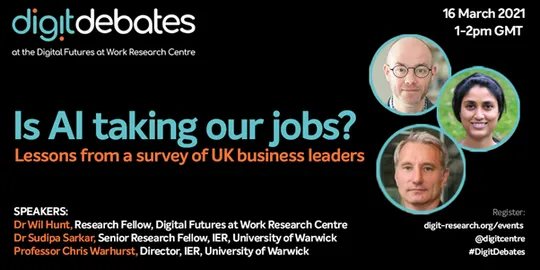 Dr Wil Hunt and IER’s Dr Sudipa Sarkar and Professor Chris Warhurst will be presenting the findings of their most recent study in a webinar on the impact of AI on jobs at the organisational level on 16 March 2022, 1:00pm-2:00pm.
Find out more about this event and register here.